Expansion of Collaboration Among Local Governments, Companies, Universities, and Public Institutions to Foster Regional Innovation Hubs
[Asia Economy Reporter Kangwook Cho] The Ministry of Land, Infrastructure and Transport announced on the 23rd that it plans to focus on activating industry-academia-research clusters, public institution-linked collaborative projects, and improving residential conditions to ensure the sustainable growth and development of innovation cities this year.
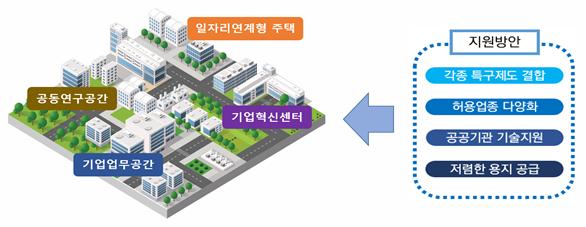
First, in areas where cluster utilization is low, the ministry plans to create an innovation city-type urban high-tech industrial complex called the "Innovation City Biz Park," enabling complex development including corporate spaces, public support facilities, and job-linked housing within the complex scale.
The Innovation City Biz Park is an innovation hub space where various corporate support programs, such as diversification of resident industries, are prioritized. To make the Biz Park an attractive space for companies, benefits (incentives) such as affordable land supply, combination with various special zone systems, and priority application of corporate support programs will be provided.
As part of the regional balanced New Deal project, collaborative projects led by public institutions involving cooperation among companies, universities, research institutes, and local governments will also be actively promoted.
The top 10 collaborative projects by public institutions will receive 48.5 billion KRW in investment this year. Projects such as the Green Energy Campus construction (Daegu-Gas Corporation), Smart Logistics Hub City development (Gyeongbuk-Road Corporation), Industry-Academia-Research Cluster Leading Model (Gyeongnam-LH), and Financial Innovation Big Data Platform (Jeonbuk-National Pension Service) are planned.
Complex innovation centers combining cultural and sports facilities will also begin construction in all innovation cities within this year. Considering the young city characteristic where the population ratio of children under 9 years old is more than twice the national average (Innovation City 16.9%, nationwide 7.6%), child (family)-specialized SOC projects will be promoted in collaboration with the Ministry of the Interior and Safety.
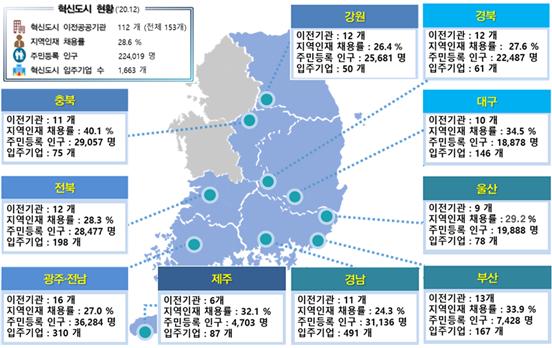 Major Status of Innovation Cities (As of the end of December 2020) / Provided by the Ministry of Land, Infrastructure and Transport.
Previously, the Ministry of Land, Infrastructure and Transport established 10 innovation cities nationwide for balanced national development and relocated a total of 153 public institutions to local areas by the end of 2019. Since 2018, it has been promoting Season 2 to enhance the substance of innovation cities, including improving residential conditions.
According to the ministry, despite difficult conditions such as COVID-19, innovation cities have generally improved in terms of residential conditions and other aspects. The population and number of companies have increased, convenience facilities such as schools and hospitals have been expanded, and local talent has been hired above the target ratio.
Last year, about 8,000 units of multi-family housing (7,893 units) were additionally supplied in innovation cities. The population increased by 19,303 compared to the end of 2019, exceeding 220,000 as of the end of 2020. Additionally, 25 public facilities such as community centers, police stations, and fire stations, 19 educational facilities including 3 schools, 1 kindergarten, and 15 daycare centers, as well as one general hospital in Gwangju-Jeonnam were also newly supplied.
Two hundred thirty-eight companies newly settled in innovation cities, and with 21 additional institutions obligated to hire local talent, a total of 1,517 local talents were newly hired by 130 relocated public institutions. The local talent hiring rate reached 28.6%, exceeding the 2020 target of 24%.
Lee Dong-min, head of the Innovation City Promotion Team at the Ministry of Land, Infrastructure and Transport, said, "This year, we plan to consolidate and support innovation capabilities through collaborative links among innovation stakeholders such as the government, local governments, public institutions, universities, and companies to establish a foundation for the self-sustained development of innovation cities." He added, "Through this, we expect not only innovation cities but also surrounding areas to achieve mutually beneficial development."
© The Asia Business Daily(www.asiae.co.kr). All rights reserved.
![Clutching a Stolen Dior Bag, Saying "I Hate Being Poor but Real"... The Grotesque Con of a "Human Knockoff" [Slate]](https://cwcontent.asiae.co.kr/asiaresize/183/2026021902243444107_1771435474.jpg)

















