[Unicorn Company Analysis 2] Behind the 'Exicon Myth' Are Places That Declined as the Bubble Burst
Unicorns (unlisted ventures with a corporate value exceeding 1 trillion KRW) are the dream of all startups. However, being recognized as a unicorn does not guarantee a smooth growth path without obstacles. The journey to ‘exit’?recovering investment funds?is still challenging. Some succeed in exiting through initial public offerings (IPO) or mergers and acquisitions (M&A), soaring brilliantly as ‘Exicons,’ but some thriving unicorns suddenly experience a sharp drop in value and become ‘Unicorpse’ (dead unicorns). Currently, unicorns are treading on thin ice that separates Exicons from Unicorpse.
According to the Ministry of SMEs and Startups’ statistics, there are 20 companies in the domestic startup and venture ecosystem that have surpassed a corporate value of 1 trillion KRW (as of October 2020). Among them, only eight companies, including Coupang, which recently formalized its listing on the New York Stock Exchange (NYSE), are classified as Exicons. While some of the remaining companies are actively pursuing exits, others have failed to achieve significant results after surpassing the 1 trillion KRW valuation and are moving further away from exit opportunities.
◆ Unicorns with ‘Difficult’ Exits = Yellow Mobile surpassed a corporate value of 1 trillion KRW over six years ago, in June 2015. Aggressively pursuing M&A, its corporate value once soared to 4 trillion KRW. It rapidly increased its value under the concept of a ‘startup alliance.’ However, the problem was that it recklessly expanded its size chasing scale. Due to excessive investments, it became embroiled in dozens of lawsuits and received audit refusal notices from accounting firms starting in 2017. Consequently, the corporate value, once estimated at over 4 trillion KRW, plummeted, distancing the company from exit opportunities. Choi Jung-woo, former CEO of Yellow Travel who worked at Yellow Mobile, pointed out in ‘How Startups Become Unicorns’ that “debt-ridden unicorns were using incoming funds to polish their image rather than creating meaningful business growth,” and “they focused solely on increasing corporate value through additional fundraising rather than achieving substantial business growth.”
LN Cosmetics, which surpassed a corporate value of 1 trillion KRW in 2017, faced difficulties such as operating losses in 2019. This was due to the THAAD (Terminal High Altitude Area Defense) crisis, which directly impacted popular mask pack products in China. Its planned IPO was also postponed. Wemakeprice (WMP) has not been able to hastily consider exit options due to losses. Last year, Wemakeprice recorded an operating loss of 54 billion KRW. Its sales were 386.4 billion KRW, down 17% from the previous year. Although the deficit narrowed, sales declined due to reduced travel and performance activities, and the company did not benefit from the COVID-19 boom because of a low proportion of direct purchase products.
Experts emphasize the need to create an ecosystem for exits. Yoo Hyo-sang, a professor of economics at Soongsil University, said, “Startups are inevitably connected to investment, and this investment is premised on exit. If they fail to pass the exit gateway and remain unicorns forever, they could become zombie companies.”
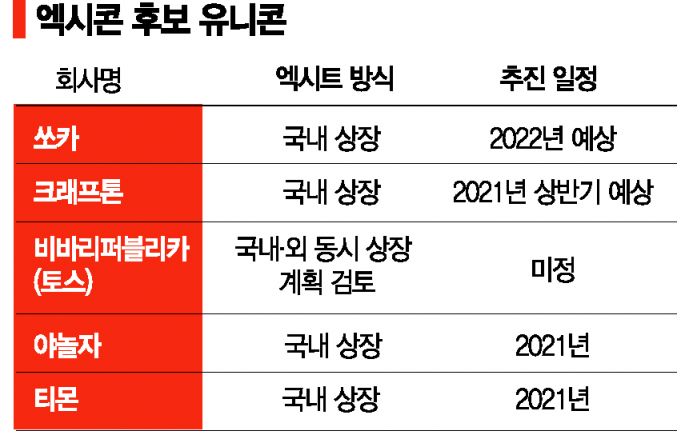
◆ Unicorns Dreaming of Becoming Exicons = Among domestic unicorns, more than five are known to be pursuing IPOs for exit. Representative companies include Socar, Krafton, Viva Republica, Yanolja, and Tmon. Socar joined the unicorn ranks nine years after its founding and has begun full-scale preparations for exit. In December last year, it selected Mirae Asset Daewoo and Samsung Securities as lead underwriters and is preparing for an IPO. The listing is expected next year.
Krafton, which became a global game company thanks to the success of ‘Battlegrounds,’ is expected to enter the stock market in the first half of this year. Krafton selected its lead underwriters last year and started preparing for listing, making it the biggest IPO candidate this year. Some in the securities industry analyze that Krafton’s corporate value could reach around 30 trillion KRW upon listing. Viva Republica, which developed and operates the lifestyle finance platform ‘Toss,’ became the first domestic fintech company to become a unicorn in 2018 and is currently preparing for exit by considering simultaneous domestic and overseas listings.
Yanolja has selected Mirae Asset Daewoo as the lead underwriter aiming for an IPO this year. A Yanolja representative said, “The IPO process is an important step in evolving into the company’s goal of becoming a ‘global hospitality solution and leisure super app,’ and we will prepare steadily.” Tmon is also pushing for a listing within the year. Recently, it completed a paid-in capital increase of 305 billion KRW through pre-IPO equity investments, and preparations are progressing smoothly. Lee Jin-won, CEO of Tmon, said, “We were able to successfully complete fundraising by recognizing Tmon’s competitiveness and future growth potential,” adding, “This will be an opportunity to clear capital deficits and concretize a successful IPO in the second half of the year.”
© The Asia Business Daily(www.asiae.co.kr). All rights reserved.

















