[Asia Economy Reporter Donghyun Choi] COVID-19 is reshaping the domestic travel landscape for Koreans. It has been observed that more people are visiting lesser-known places rather than popular tourist spots crowded with visitors.
On the 23rd, the Korea Tourism Organization analyzed the tourism-specialized big data platform 'Korea Tourism Data Lab' and found that the number of visitors to regions nationwide last year decreased by 18% compared to the previous year. However, despite this overall decline, the number of visitors to hidden tourist spots, non-face-to-face nature tourism sites, campgrounds, and parks in the metropolitan area actually increased.
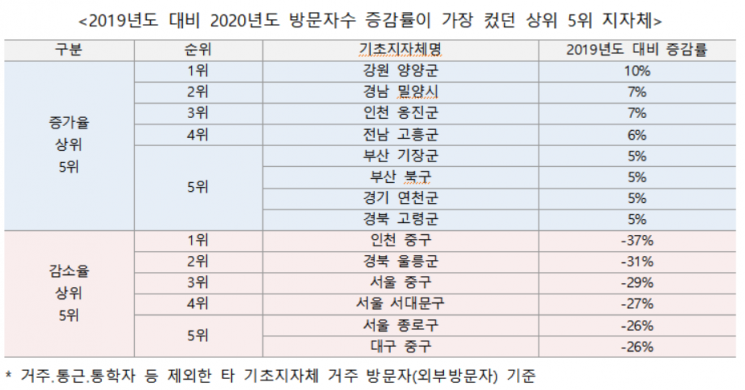
By examining visitor numbers by local governments using mobile big data from KT, it was found that Yangyang-gun in Gangwon Province saw a 10% increase in visitors compared to the previous year. During the same period, Ongjin-gun in Incheon, known for its many islands, also experienced a 7% rise in visitors. Additionally, Miryang-si (7%), Goheung-gun (6%), and Gijang-gun in Busan (5%) saw increases in visitor numbers compared to the previous year. This is analyzed as a result of demand for visits to hidden travel destinations recognized as pristine tourist spots. However, visitors to Jung-gu in Incheon, where Incheon Airport is located (-37%), and Ulleung-gun in Gyeongbuk (-31%) sharply declined. Other areas with significant decreases in visitors included Jung-gu in Seoul (-29%), Seodaemun-gu (-27%), Jongno-gu (-26%), and Jung-gu in Daegu (-26%).
When investigating visitor numbers by metropolitan local governments over time, a noticeable decline in regional visitors was observed during March (-36%), September (-28%), and December (-26%) of last year, periods when social distancing levels were high. The periods and regions with the largest decreases were March in Daegu (-57%) and Gyeongbuk (-44%), April in Jeju (-44%), and August and December in Seoul (-41%).
The period and region with the largest increase in visitors throughout the year was May in Gangwon (10%). During October, when social distancing was at level 1, there was a temporary increase in visitors compared to the previous year in Gangwon (5%), Jeonnam (8%), Jeonbuk (8%), Gyeongnam (8%), and Gyeongbuk (8%). In December, however, visitor numbers decreased by 26% compared to the previous year due to the escalation of distancing levels and the reduction of winter festivals, significantly diminishing the winter travel boom.
According to navigation T-map data on the number of searches by type of tourist attraction, places that saw an increase in searches compared to 2019 included drive-in theaters (144%), campgrounds (54%), fishing spots (42%), beaches (39%), and golf courses (30%). These are representative non-face-to-face travel destinations. In contrast, indoor tourist spots with high population density such as casinos (-62%), amusement facilities (-59%), racetracks (-58%), and science museums (-56%) saw a significant decrease in search numbers.
Regarding specific top searched tourist spots, until 2019, Everland and Lotte World ranked first and second respectively, but last year, natural tourist spots such as Yeouido Hangang Park and Eulwangri Beach took the first and second places. Particularly last year, natural tourist spots like parks and beaches dominated the majority of top search locations.
Spending in the tourism industry significantly decreased compared to 2019. According to last year's BC Card user spending status by tourism sector, expenditures on travel agencies and duty-free shops each plummeted by 90%. Cultural services such as movie theaters and theaters also decreased by 73%. On the other hand, as people avoided public transportation, rental car spending increased by 57% compared to the previous year, and experiential leisure sports consumption decreased by only 6%. Notably, in some local governments such as Chungbuk (19%), Jeju (4%), and Gangwon (3%), leisure sports consumption actually increased, which is analyzed to be largely influenced by increased spending at golf courses.
Meanwhile, the Korea Tourism Organization launched the Korea Tourism Data Lab service on the 17th to promptly analyze and open tourism big data such as mobile communications, credit cards, and navigation data in a timely manner to quickly grasp and respond to rapidly changing travel trends.

© The Asia Business Daily(www.asiae.co.kr). All rights reserved.


















