Ministry of Trade, Industry and Energy Finalizes the '4th Basic Plan for Eco-Friendly Vehicles'
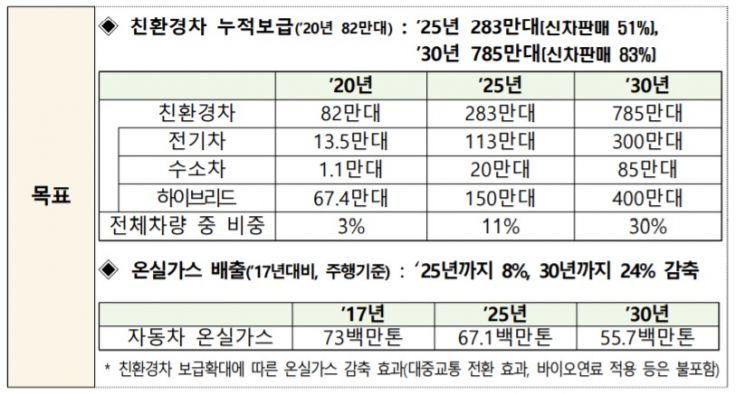
[Sejong=Asia Economy Reporter Kwon Haeyoung] The government plans to distribute 7.85 million eco-friendly vehicles by 2030, raising the share of eco-friendly vehicles to 83% of total new car sales and 30% of all vehicles. It also aims to reduce automobile greenhouse gas emissions by 24% by 2030.
The Ministry of Trade, Industry and Energy announced on the 23rd that it finalized the "4th Basic Plan for Eco-Friendly Vehicles" through a Cabinet meeting chaired by Prime Minister Chung Sye-kyun. The Basic Plan for Eco-Friendly Vehicles is a five-year plan to expand eco-friendly vehicles and enhance the economic power of the automobile industry, which was disclosed at the National Policy Issue Inspection and Coordination Meeting on the 18th.
The government aims to reduce greenhouse gas emissions by 24% by 2030, cumulatively distributing 2.83 million eco-friendly vehicles by 2025 and 7.85 million by 2030. These represent 11% and 30% of all vehicles, respectively. The share of new car sales is planned to increase to 51% and 83%, respectively.
To achieve this, the mandatory purchase ratio of electric and hydrogen vehicles in the public sector, including national and local governments and public institutions, will be raised from 80% this year to 100% in 2023. A purchase target system for eco-friendly vehicles will be introduced for private demand sectors such as rental cars and large corporations, gradually increasing the purchase ratio from 10% this year to 12% in 2022. Subsidies and incentives for commercial vehicles such as taxis, buses, and trucks will also be expanded.
Charging infrastructure for electric and hydrogen vehicles will also be expanded. The number of electric vehicle chargers will be increased to 500,000 units, which is more than 50% of the distributed vehicles by 2025, and ultra-fast chargers capable of 300 km driving with 20 minutes of charging will be expanded to 123 units this year. Hydrogen vehicle chargers will be increased to 450 units by 2025. The mandatory installation rate of chargers in new buildings will also be expanded to 5% in 2022 and 10% in 2025. The obligation to install chargers will be imposed on existing buildings as well, raising the rate to 2% for public buildings in 2022 and 2% for private buildings from 2023 to 2025.
Additionally, the government will support dedicated platforms and localization of parts and materials to reduce the price of eco-friendly vehicles by more than 10 million KRW by 2025. Through a battery lease business, it plans to lower the initial purchase cost by about half.
Furthermore, the government is considering reflecting life-cycle greenhouse gas assessments in automobile greenhouse gas standards.
Through these measures, the government aims to expand eco-friendly vehicle exports from 280,000 units annually in 2020 to 830,000 units in 2025, increasing their share of total exports from the current 14.6% to 34.6%. In addition, it plans to convert 500 parts companies by 2025 and 1,000 by 2030 into future vehicle sectors.
An official from the Ministry of Trade, Industry and Energy said, "Eco-friendly vehicles are an effective means to reduce greenhouse gases and fine dust in the transportation sector and a growth engine responsible for future livelihoods," adding, "We will faithfully implement the 4th Basic Plan for Eco-Friendly Vehicles in cooperation with related ministries and agencies."
© The Asia Business Daily(www.asiae.co.kr). All rights reserved.
![Clutching a Stolen Dior Bag, Saying "I Hate Being Poor but Real"... The Grotesque Con of a "Human Knockoff" [Slate]](https://cwcontent.asiae.co.kr/asiaresize/183/2026021902243444107_1771435474.jpg)
















