Waste Overflowing Due to COVID-19... Stricter 탈Plastic Policies Reimposed
Plastic Container Thickness Limits Starting Next Year... New Deposit System for Disposable Cups Introduced
Accelerating Eco-Friendly Management in Food and Distribution with Biodegradable Packaging Material Transition
[Asia Economy reporters Jo In-kyung and Im Chun-han] As the non-face-to-face (untact) trend continues, where people buy necessary items online and use delivery services instead of dining out, plastic waste is accumulating. One of the causes of the increase in plastic waste is the packaging materials used for courier and delivery services, but the issue has spread to the distribution and food industries, leading to the proposal of an amendment to the Resource Recycling Act that requires pre-inspection and approval of product packaging materials. Whether the bill will pass remains uncertain, but eco-friendly management has become a reality rather than just a slogan for related companies.
Courier Deliveries Up 19.8%, Food Delivery Up 75.1% Since COVID-19
According to the Ministry of Environment on the 23rd, during last year's COVID-19 pandemic, the amount of plastic household waste generated in South Korea increased by 14.6% compared to the previous year, and waste vinyl increased by 11%.
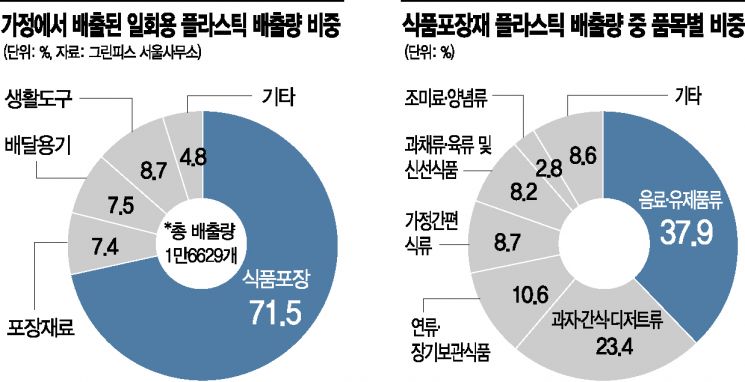
A survey conducted by Greenpeace Seoul Office on 260 households nationwide, measuring plastic waste generated over one week, totaled 16,629 items. This means each household produced about 64 pieces of plastic waste per week. Of these, 71.5% (11,888 items) were food packaging materials, while daily necessities such as cosmetics, cleansing products, and stationery accounted for 8.7%. Food delivery containers made up 7.5%, and packaging materials for courier services accounted for 7.4%.
Last year, courier delivery volume increased by 19.8% compared to the previous year. Food delivery surged by 75.1%. The untact trend caused by COVID-19 has increased the amount of household waste.
COVID-19 has also increased waste generation in dining establishments. In August 2018, the government banned the use of disposable items inside coffee shops in response to the growing consumer trend of using courier and takeout services. It also announced the 'Reducing Disposable Items Together Plan,' aiming to reduce disposable item usage by more than 35% by 2022.
However, as COVID-19 spread, these policies became ineffective. The use of disposable cups inside coffee shops increased, and with strengthened social distancing policies, dining establishments had no choice but to encourage delivery services. This ultimately led to a sharp increase in the use of disposable items.
'De-plasticization' Policy Burden Falls on Producers
Although changes in consumer trends play a large role, the government is steering policies that place the burden on producers. Starting next year, the thickness of plastic containers for food delivery will be limited to a certain level, and a deposit system for disposable cups will be introduced. Repackaging of promotional or giveaway items at large supermarkets or convenience stores has also been banned, and by 2030, the use of disposable plastic bags will be prohibited across all industries.
The 'Pre-inspection of Packaging Materials Act (Resource Recycling Act amendment)' currently being promoted by the National Assembly shares the same intent. It requires manufacturers, importers, and sellers to have their packaging materials and methods inspected by a specialized institution designated by the Ministry of Environment before product launch, and to display the inspection results on the packaging surface. If the bill passes as originally proposed, it will apply to about 100,000 companies.
A food industry official said, "If applied to all products, the food industry, which has many low-cost and numerous products, will incur enormous costs," and added, "If the government and ruling party want to enforce the law, regulations must be established at a reasonable level."
Eco-friendliness Now a Matter of Survival
The distribution sector is moving swiftly to respond to these government regulations. They are determined to do what they can regardless of regulations. Bottled water companies are distributing label-free water bottles and minimizing the thickness of plastic bottles to reduce plastic use. The use of biodegradable plastics for packaging materials is also increasing.
Food companies are developing beverage bottles that can be drunk from without straws and are eliminating plastic straws attached to beverage containers. Refill dispensers for detergents are being installed in large supermarkets. These eco-friendly moves by the distribution industry are having a positive effect on the MZ (Millennial + Z) generation, who are sensitive to social issues and interested in eco-friendly products.
A distribution industry official explained, "As the overall social atmosphere shifts toward valuing eco-friendliness, it has become essential for corporate management as well," adding, "Especially since the MZ generation, which will lead future consumption, is sensitive to social issues and interested in eco-friendly products, companies cannot help but be on alert."
© The Asia Business Daily(www.asiae.co.kr). All rights reserved.

















