Securities Market, KOSPI Index Tops Mid-3100s... Adjustment Inevitable Due to Rising Interest Rates and Inflation
Upward Curve After Box Range Adjustment Completion... Basket Strategy for Cyclical Stocks During Correction
Concerns Over Widening Correction Lead to Advice for Caution Over Bargain Buying... Institutional Selling Pressure
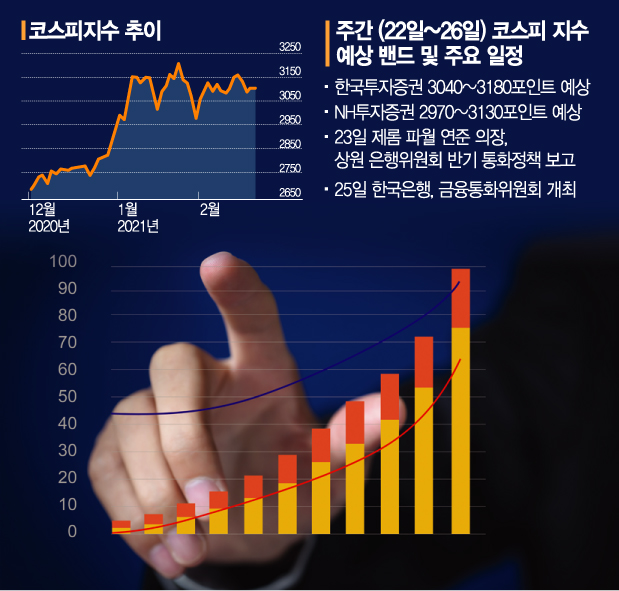
[Asia Economy Reporter Lee Seon-ae] There are rumors of a market correction in March. This is based on the judgment that inflation and interest rates are rising more sharply than expected, which could burden the stock market. While institutional investors continue their selling spree, foreign investors?who hold the key to the market’s direction?have not returned due to concerns over rising interest rates. Only individual investors are defending the index, resulting in a difficult sideways market. There is some confusion, with investment advice ranging from buying on dips during the correction to prioritizing observation due to the expected expansion of the correction range, all based on the belief that the index will complete its sideways adjustment and follow an upward trajectory.
Slowing Pace of Rise and Belief in Upward Trend
On the 22nd, the KOSPI index opened at 3,114.03, up 6.41 points (0.21%) from the previous trading day. Although it started with a slight increase, the securities industry expects the KOSPI upper range this week to be in the mid-3100s. Korea Investment & Securities forecasts the KOSPI band at 3,040?3,180, while NH Investment & Securities projects 2,970?3,130. This is based on the judgment that the market will continue in a sideways range due to the sharp rise in U.S. Treasury yields and inflationary pressures.
Kim Dae-jun, a researcher at Korea Investment & Securities, said, "The Federal Open Market Committee (FOMC) minutes confirmed the asset purchase stance, but there was no mention of tapering timing, so the upward trend in U.S. interest rates is likely to slow. However, due to the remaining expectations for economic stimulus from the Biden administration, the upward trajectory in terms of trend is expected to be maintained." He added, "Since U.S. interest rates also affect domestic rates, we must keep in mind the market weakness caused by a gradual rise in interest rates."
No Dong-gil, a researcher at NH Investment & Securities, also said, "The continued program selling mainly by institutional investors and simultaneous profit-taking by foreigners in both spot and futures markets are factors slowing the pace of the domestic stock market’s rise," adding, "The global stock market shows signs of overheating and may react sensitively to rising interest rates and inflation."
However, there are opinions that market participants’ concerns about inflation are somewhat excessive. An So-eun, a researcher at IBK Investment & Securities, emphasized, "There is no need to fear inflation and monetary tightening behind the economic recovery before we even see the recovery with our own eyes," and added, "Despite inflation concerns, the upward trend in the stock market will not change." This is based on the judgment that in the past, from 1999 to 2000 in the U.S., stock prices continued to rise until inflation accumulated and economic and earnings indicators turned down, and currently, considering additional stimulus measures by major countries and the effects of COVID-19 vaccines, the upward trend in economy and earnings will continue.
No also forecasted, "Considering the Federal Reserve’s accommodative monetary policy direction, improvements in U.S.-centered economic indicators, strong belief in global economic recovery, and corporate earnings growth, the stock market’s upward trend will continue."
Possibility of Expanded Market Correction
On the other hand, there are cautious views. This is based on the judgment that inflation and rising interest rates are not temporary phenomena. According to KB Securities, whenever interest rates rose over the past year, the 20-day moving average gap widened. This suggests that the market has been continuously under the influence of interest rates, so if interest rates rise further at this point, the possibility of an expanded market correction should be considered.
KTB Securities views the rise in interest rates as a significant turning point in the current market trend. The KTB Securities macro team said, "We must keep open the possibility that the U.S. 10-year Treasury yield could rise to 1.5% in the first quarter," adding, "If it reaches this level, it is essential to observe rather than buy on dips." In particular, the macro team noted, "If the U.S. 10-year Treasury yield approaches 2%, it will be a major turning point for the price volatility of growth stocks."
There are also voices emphasizing the need to consider that it will be difficult for institutions to aggressively participate in buying from a supply-demand perspective. Due to the nature of institutions seeking absolute returns, it is unlikely they will actively buy in a stock market with increased valuation burdens.
Betting on Cyclical Stocks
Most experts agree that investing in cyclical stocks is effective. Researcher No advised, "When foreigners switch to net buying, the net buying is expected to focus on the semiconductor sector, so maintaining weight in this area is necessary," and recommended buying on dips in cyclical stocks. Especially from a supply-demand perspective, considering that small and mid-cap KOSPI stocks can escape the influence of program selling linked to index products, he emphasized the need to maintain a favorable view on cyclical stocks while paying attention to small and mid-cap KOSPI stocks.
SK Securities also suggested cyclical stocks. Han Dae-hoon, a researcher at SK Securities, said, "Since the Fed has announced it will continue accommodative monetary policy, the dominant view is that Chairman Jerome Powell will try to soothe the market," adding, "Despite the short-term sharp rise in interest rates and oil prices, individual investors’ net buying continues, and there are no signs yet of liquidity outflows due to rising interest rates, so we expect cyclical stocks to strengthen in the short term due to rising interest rates."
There is also advice that a strategy focusing on sectors and companies that can quickly pass on rising production costs to product prices is effective. According to Hana Financial Investment, in phases where the inflation spread between the U.S. and China rises, sectors with improved price pass-through rates recently (2016?20) compared to the past (2011?15) include display, refining, semiconductors, machinery, retail/distribution, and holding companies. Conversely, sectors with worsened price pass-through rates recently compared to the past include banks, hydrogen consumables, utilities, media, and hotels/leisure. Lee Jae-man, a researcher at Hana Financial Investment, advised, "As U.S. and domestic market interest rates rise rapidly and affect the stock market, one way to prepare for the inflation spread phase between the U.S. and China is to focus on sectors and companies with high price pass-through rates, meaning sales can rise faster than cost of sales."
There is also a view that growth stocks need to be included in portfolios. Heo Jae-hwan, a researcher at Eugene Investment & Securities, said, "In an inflation phase, cyclical stocks tend to perform well, but currently growth stocks are leading in earnings," adding, "It is time to restructure portfolios without bias." Lee Kyung-min, a researcher at Daishin Securities, explained, "While somewhat sluggish trends continue, this is an opportunity to prepare for a resumption of the upward trend in the second quarter," and maintained a top preference for structural growth stocks (internet, secondary batteries, renewable energy) and export stocks (semiconductors, automobiles, transportation)."
© The Asia Business Daily(www.asiae.co.kr). All rights reserved.
![Clutching a Stolen Dior Bag, Saying "I Hate Being Poor but Real"... The Grotesque Con of a "Human Knockoff" [Slate]](https://cwcontent.asiae.co.kr/asiaresize/183/2026021902243444107_1771435474.jpg)
















