Downturn This Year... Interest in Sectors Like Semiconductors and Electric Vehicles Declines
Focus on Rebound After March... Expectations Rise as Clinical Results Are Released at Major Conferences
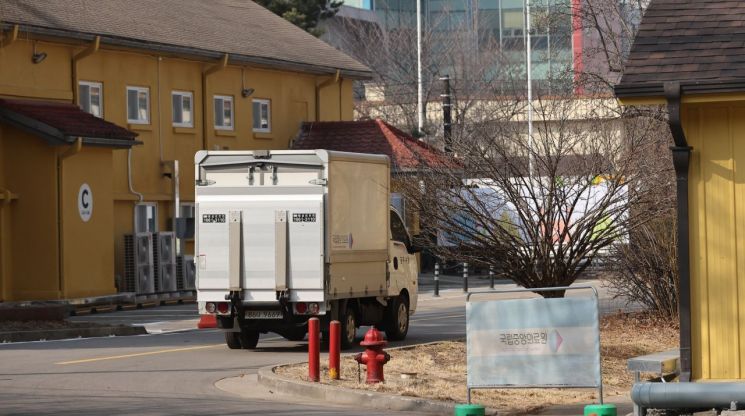 On the morning of the 21st, a medical center vehicle is entering the Central Vaccination Center set up at the National Medical Center in Jung-gu, Seoul.
 [Image source=Yonhap News]
[Asia Economy Reporter Minwoo Lee] The number of listed pharmaceutical and bio companies surpassing 1 trillion KRW in sales exceeded 10 for the first time last year. However, their stock prices have struggled to gain upward momentum and have been declining.
According to the industry on the 22nd, among pharmaceutical and bio companies last year, 11 companies including GC Green Cross, Celltrion, Kolmar Korea, Celltrion Healthcare, Chong Kun Dang, Yuhan Corporation, Kwangdong Pharmaceutical, Hanmi Pharmaceutical, Daewoong Pharmaceutical, Seegene, and Samsung Biologics surpassed annual sales of 1 trillion KRW. With Seegene and Samsung Biologics added to the previous year's 9 companies, it was the first time that more than 10 listed pharmaceutical companies achieved sales of 1 trillion KRW.
The COVID-19 boom was a key factor. Seegene, the leading diagnostic kit company, is a representative example. Last year, it recorded sales of 1.1252 trillion KRW and operating profit of 676.2 billion KRW, surging 822.7% and 2915.6% respectively compared to the previous year. Samsung Biologics, a contract manufacturing organization (CMO) for biopharmaceuticals, also achieved sales of 1.1648 trillion KRW and operating profit of 292.8 billion KRW last year, thanks to contract production of COVID-19 treatments for companies like Eli Lilly. This marked the first time in its 9 years since establishment that it surpassed 1 trillion KRW in sales.
However, stock prices faltered. In Seegene's case, its stock price fell 40.7% from 285,000 KRW on November 5 last year to 169,000 KRW on the 19th. As of the 19th, the KOSPI pharmaceutical index and the KOSDAQ pharmaceutical index dropped 9.81% and 13.1% respectively compared to the beginning of the year. Minjung Sun, a researcher at Hana Financial Investment, explained, "While the KOSPI surged to the 3200 level early this year, pharmaceutical and bio companies were sidelined," adding, "Investor sentiment was focused on the semiconductor and electric vehicle sectors due to expectations of improved earnings and momentum."
Internal limitations also emerged. Samsung Biologics' stock price doubled after securing new CMO contracts worth about 2.7 trillion KRW last year, leaving little room for further growth. Celltrion's growth momentum also diminished as its market share for Truxima in the U.S. stagnated.
Attention is turning to whether the atmosphere will reverse starting next month. Researcher Sun predicted, "Starting with SK Bioscience, which is scheduled to be listed in mid-next month, expectations for vaccine contract manufacturing companies may rise again," and added, "If clinical results are released at major conferences starting in April, companies developing anticancer drugs and new drugs could also gain momentum."
© The Asia Business Daily(www.asiae.co.kr). All rights reserved.












