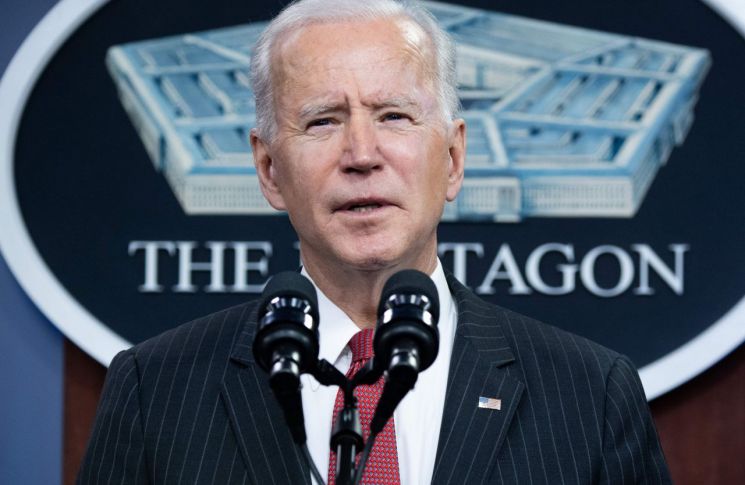
[Asia Economy Reporter Seungjin Lee] U.S. President Joe Biden formally reiterated an apology for the forced internment of Japanese Americans during the Pacific War between the United States and Japan.
According to Japanese media reports including Kyodo News on the 21st, President Biden issued a statement on the 19th (U.S. local time) marking the 79th anniversary of the signing of the presidential order that served as the basis for the forced internment of Japanese residents in the U.S. during the Pacific War.
In the U.S., a commemorative event is held every year on February 19, known as "Day of Remembrance," at the Smithsonian Museum in Washington DC. This year, due to the impact of COVID-19, the event was held online.
In his statement, President Biden said, "During one of the most shameful periods in American history, our ancestors were confined in inhumane camps solely because they were Japanese," adding that this led to deep-rooted racism, xenophobia, and anti-immigrant sentiment.
He also emphasized reaffirming the 1988 U.S. government’s recognition under the Ronald Reagan administration through the Civil Liberties Act (Forced Internment Compensation Act), which acknowledged the wrongful nature of the internment policy and issued an official apology.
The U.S. considered Japanese Americans as "enemy aliens" based on the executive order signed by then-President Franklin Roosevelt on February 19, 1942, following Japan’s surprise attack on Pearl Harbor in Hawaii on December 7, 1941, during the Pacific War, and forcibly interned about 120,000 people for several years without trial or due process.
After the war, a movement led by the victims sought to restore their honor, and in 1988, then-President Reagan acknowledged past wrongs and issued an official apology.
In this statement, President Biden reiterated former President Reagan’s acknowledgment and apology, criticizing the policy of forced internment solely based on being Japanese as "one of the most shameful periods in American history" and describing it as immoral and unconstitutional.
He also mentioned the late Fred Korematsu, who led the movement for redress after being released from the camps, praising "the courage of many Japanese Americans who stood up against this reprehensible policy" and emphasizing the importance of protecting human rights.
Meanwhile, the cabinet of Shinzo Abe, launched in 2012, has maintained the position that the Japanese government has sufficiently apologized regarding the historical issues between Korea and Japan, and the current cabinet under Prime Minister Yoshihide Suga, who succeeded the Abe cabinet in September last year, holds the same stance.
Previously, the Japanese government expressed apologies and remorse over historical issues between Korea and Japan, including acknowledging the Japanese military’s direct and indirect involvement in managing comfort stations and transporting comfort women through a statement by then-Chief Cabinet Secretary Yohei Kono in August 1993.
© The Asia Business Daily(www.asiae.co.kr). All rights reserved.

















