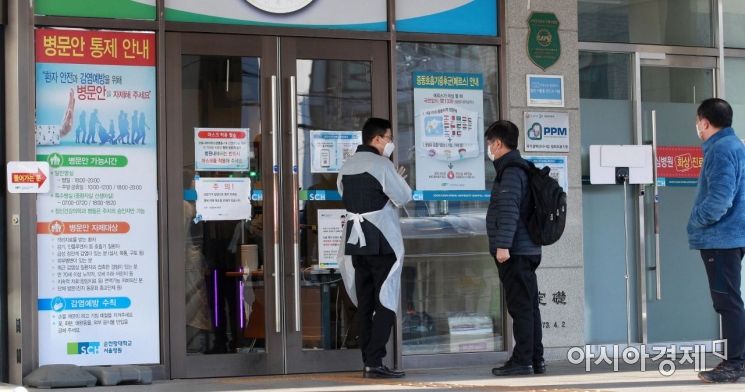
 On the 19th, citizens visiting Soonchunhyang University Seoul Hospital in Yongsan-gu, Seoul, were informed about the suspension of outpatient services. Soonchunhyang University Seoul Hospital will suspend outpatient care and health checkups until the 21st to prevent the spread of COVID-19 and ensure patient safety. According to health authorities, since a confirmed case was reported at this hospital on the 12th, a total of 171 people have tested positive as of the 18th, including 70 patients, 24 staff members, 54 guardians and family members, 15 caregivers, and 8 acquaintances. Photo by Kim Hyun-min kimhyun81@
[Asia Economy Reporter Seungjin Lee] On the 21st, the number of new COVID-19 confirmed cases remained in the low 400s for the second consecutive day. Although it slightly decreased compared to the previous day, the number of tests conducted over the weekend dropped sharply to less than half of the weekday volume, so it is too early to say that the spread has slowed down.
Large-scale cluster infections occurred in large workplaces such as medical institutions and offices, as well as small-scale cluster infections continued nationwide in family and acquaintance gatherings, restaurants, and other places.
The quarantine authorities expect the effects of the Lunar New Year holiday (2.11?14), which involved large population movements, and the easing of social distancing measures to gradually appear. They plan to finalize the social distancing adjustment plan to be applied from next week while monitoring the trend of confirmed cases.
Among 391 locally transmitted cases, 79.5% are in the Seoul Metropolitan Area
The Central Disease Control Headquarters announced that as of midnight, the number of new COVID-19 confirmed cases was 416, down 32 from the previous day (448). The cumulative number of confirmed cases is 86,992.
In the past week (2.15?21), the daily new confirmed cases were 343 → 457 → 621 → 621 → 561 → 448 → 416. During this period, there was one day in the 300s, three days in the 400s, one day in the 500s, and two days in the 600s.
Regarding the infection routes of the new confirmed cases on this day, 391 were locally transmitted and 25 were imported cases. The number of locally transmitted cases decreased from the previous day (416) to the high 300s. It is the first time in six days since the 15th (322 cases) that locally transmitted cases have dropped to the 300s.
By region, the Seoul Metropolitan Area accounted for 311 cases, including 120 in Seoul, 170 in Gyeonggi, and 21 in Incheon, making up 79.5% of all locally transmitted cases.
Non-metropolitan areas reported a total of 80 cases: 11 in Busan, 10 in Chungnam, 8 in Jeonnam, 7 each in Jeonbuk and Gyeongnam, 6 each in Daegu, Gangwon, Chungbuk, and Gyeongbuk, 5 in Gwangju, 4 in Ulsan, 3 in Jeju, and 1 in Sejong. The number of confirmed cases in non-metropolitan areas fell to double digits for the first time in six days since the 15th (68 cases).
Major cluster infection cases include the steadily increasing confirmed cases related to Soonchunhyang University Seoul Hospital in Yongsan-gu, Seoul, which reached a cumulative total of 201 as of the previous day.
Regarding the plastic factory in Jingwan Industrial Complex, Namyangju-si, Gyeonggi, a total of 148 people including workers, family members, and acquaintances were confirmed positive, and at least 165 cases were reported related to the Kiturami Boiler factory in Asan-si, Chungnam.
At a church in Jeongseon-gun, Gangwon, 9 confirmed cases occurred as a cluster, and at a nursing hospital in Bundang-gu, Seongnam-si, 12 additional cases were confirmed, including 9 patients and 3 caregivers, increasing the cumulative total to 49.
In addition, new infections continued in various places such as kindergartens, daycare centers, trading companies, home care facilities, and restaurants.
155 critically ill patients in total... 4 more deaths
The number of imported confirmed cases was 25, down 7 from the previous day (32). Among them, 8 were identified during quarantine inspections at airports or ports. The remaining 17 tested positive while in self-quarantine at their residences or temporary living facilities in Seoul (10), Daegu (2), Gyeonggi, Busan, Gwangju, Jeonbuk, and Gyeongbuk (1 each).
They are estimated to have come from 12 countries, with 14 Koreans and 11 foreigners. By country, there were 4 each from Indonesia and the United Kingdom, 3 each from Russia, Pakistan, and the United States, 2 from Ethiopia, and 1 each from the Philippines, India, Spain, Colombia, Tanzania, and Chad.
Combining local transmission and imported cases (excluding quarantine), the Seoul Metropolitan Area accounted for 322 cases: 130 in Seoul, 171 in Gyeonggi, and 21 in Incheon. Nationwide, new cases were reported in 16 cities and provinces except Daejeon.
Meanwhile, the number of deaths increased by 4 from the previous day, reaching a cumulative total of 1,557. The domestic average fatality rate is 1.79%. The total number of critically ill patients is 155, down 1 from the previous day.
The number of confirmed cases released from isolation increased by 433 to a cumulative total of 77,516, and the number of patients undergoing isolation treatment decreased by 21 to 7,919.
So far, a total of 6,411,340 COVID-19 diagnostic tests have been conducted domestically, of which 6,250,992 tested negative, and 73,356 are awaiting results.
The number of tests conducted through screening clinics on the previous day was 20,709, which is 23,928 fewer than the 44,637 tests conducted the day before.
The positivity rate calculated by comparing the number of confirmed cases to the number of tests conducted the previous day was 2.01% (416 out of 20,709), which is about twice the previous day's 1.00% (446 out of 44,637). It is the first time in about a month since January 25 (2.01%, 437 out of 21,737) that the positivity rate exceeded 2%.
As of midnight on this day, the cumulative domestic positivity rate is 1.36% (86,992 out of 6,411,340).
© The Asia Business Daily(www.asiae.co.kr). All rights reserved.

















