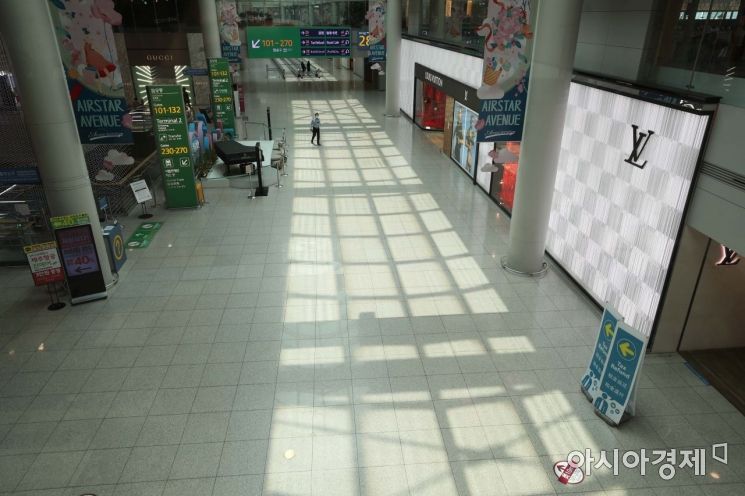
 On the 18th, the duty-free shop at Terminal 1 of Incheon International Airport was quiet due to the impact of the novel coronavirus (COVID-19). Photo by Mun Ho-nam munonam@
[Sejong=Asia Economy Reporter Kim Hyunjung] The duty-free industry, which has been hit hard by a sharp decline in foreign tourists due to the spread of COVID-19, is struggling ahead of the payment of license fees. Although the National Assembly amended the Customs Act to allow for a reduction in license fees if damage is incurred during a disaster situation, the government, which is supposed to implement this, has not yet prepared enforcement regulations, putting the industry in a situation where it must pay around 50 billion won in fees.
According to the National Assembly and the Ministry of Economy and Finance on the 21st, Article 176-2-4 of the Customs Act, amended last December, stipulates that if bonded sales outlets suffer significant damage due to a national disaster, the related license fees can be reduced. This bill was originally proposed to support the duty-free industry struggling due to COVID-19.
However, despite the passage of the law, the amount of license fees to be paid by companies next month has not changed. This is because the Ministry of Economy and Finance has not prepared follow-up measures on how to reduce the license fees. License fees are determined by the Ministry of Economy and Finance in March based on the previous year's sales, ranging from about 0.1% to 0.5% depending on sales. Until 2016, the rate was 0.05% of sales, but it jumped to 0.1% to 1% after the Customs Act enforcement regulations were revised in 2017. When the duty-free industry's sales hit a record high of 24.8586 trillion won in 2019, the top three companies?Lotte, Shilla, and Shinsegae?paid about 73 billion won in license fees.
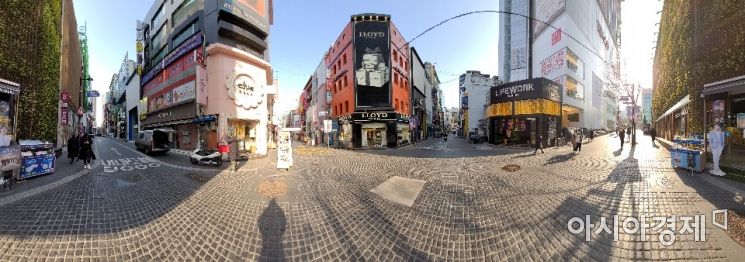 On the 4th, when the measure prohibiting private gatherings of five or more people was expanded nationwide, the streets of Myeongdong, Jung-gu, Seoul, were deserted during lunchtime due to the impact of the novel coronavirus infection (COVID-19). Photo by Moon Honam munonam@
This year, the duty-free industry is practically facing an existential crisis due to COVID-19. Based on the number of arrivals, the number of Chinese tourists in January dropped by 98.5% compared to the same period last year. Although it recovered to about 97% in the third quarter of last year when COVID-19 cases sharply decreased, visits have again sharply declined. However, the Ministry of Economy and Finance appears to have judged that no additional reduction measures are necessary because the license fees naturally decrease in proportion to the decline in sales. On the 16th, in a plenary session of the National Assembly's Finance Committee, Deputy Prime Minister and Minister of Economy and Finance Hong Nam-ki responded to a question from Assemblyman Ko Yong-jin of the Democratic Party, who requested related measures, by saying, "The National Assembly amended the law last time, so the basis was established. Follow-up measures are probably expected, but they are not included this time," and explained, "The law only opened the door to allow for fee reductions, and this time, it was judged that license fees have significantly decreased due to reduced sales."
According to the Korea Duty Free Shop Association, last year's duty-free sales are expected to fall sharply by 37.6% from the previous year (2019) to 15.5052 trillion won. Since the remaining sales were also structured to leave only minimal profits to maintain transactions with each brand, an operating loss of around 500 billion won is expected based on operating profit. The license fees that the duty-free industry must pay are projected to be around 50 billion won.
An industry insider explained, "Last year's operations were at the level of clearing out inventory, not a structure that could generate profits through sales." Another insider expressed concern, saying, "Since license fees have a quasi-tax nature rather than being a simple fee, reductions are essential," and added, "Even large companies are considering scaling down their duty-free businesses, and some companies are delaying store openings to hold on." A Ministry of Economy and Finance official said, "We are currently reviewing the preparation of enforcement regulations, but nothing has been decided." If the Ministry does not prepare separate enforcement regulations, each duty-free shop will have to pay license fees based on the existing rates by the end of next month.
Meanwhile, considering the prolonged damage caused by COVID-19, the government is expected to extend special employment support for specific industries such as aviation and duty-free shops. Last year, the government designated eight industries severely hit by COVID-19?including travel, aviation and tourism transportation, tourism accommodation, performance, aviation ground handling, duty-free shops, airport buses, and exhibition/international conference industries?as special employment support sectors and has been supporting up to 90% of labor costs due to paid leave or suspension under the name of employment retention subsidies. The designation period was extended once last August and is set to expire at the end of next month. The ruling party and government are reportedly leaning toward a second extension.
© The Asia Business Daily(www.asiae.co.kr). All rights reserved.

![Clutching a Stolen Dior Bag, Saying "I Hate Being Poor but Real"... The Grotesque Con of a "Human Knockoff" [Slate]](https://cwcontent.asiae.co.kr/asiaresize/183/2026021902243444107_1771435474.jpg)















