Egg Prices Must Be Controlled... Temporary Reduction of 'Blind Culling' Until the End of This Month
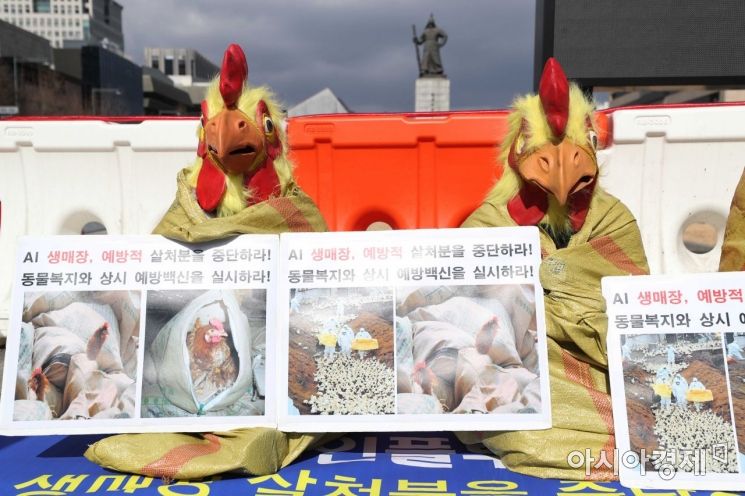 A performance press conference urging the suspension of preventive culling for avian influenza (AI) burial and calling for animal welfare and the implementation of preventive vaccines was held on the 15th at Gwanghwamun Square in Jongno-gu, Seoul. Photo by Moon Ho-nam munonam@
[Sejong=Asia Economy Reporter Moon Chaeseok] With the confirmation of highly pathogenic avian influenza (AI) at a mixed-breeding farm in Tongyeong, Gyeongnam, the number of confirmed domestic cases has surpassed 100.
The Central Avian Influenza Countermeasures Headquarters (CAC) announced yesterday that after analyzing the suspected report from the Tongyeong farm, it was confirmed to be H5N8 type highly pathogenic AI.
The number of highly pathogenic AI cases occurring in domestic poultry farms and experience farms has increased to 100.
The government repeatedly emphasized that before culling, farm owners must thoroughly disinfect and follow basic rules such as changing boots when entering and exiting the livestock barns.
They also urged thorough disinfection of livestock facilities and vehicles daily, including disinfecting related vehicles and drivers.
The problem is that due to the soaring egg prices, it has become difficult to cull many more poultry.
Therefore, since the 15th, the CAC has temporarily reduced the culling radius from 3 km to 1 km around farms for two weeks.
The trace of the quarantine authorities’ concerns can be seen in the temporary implementation of the 1 km radius reduction policy.
Kim Hyun-soo, Minister of Agriculture, Food and Rural Affairs, said at the Agriculture, Food, Rural Affairs, Oceans and Fisheries Committee plenary session held at the National Assembly on the 16th, "We set the culling radius at 3 km, but once transmission occurs, management becomes difficult."
Instead of continuing so-called "indiscriminate culling," the inspection system will be refined more precisely.
They will switch from rapid tests to detailed tests to detect poultry infected with AI at an early stage.
Rapid tests for laying hens, breeding hens, and quail, as well as for broilers and native chickens, will be replaced with detailed tests.
Additional detailed inspections of egg-producing poultry farms will be conducted from the end of this month to early next month.
Furthermore, supply management of laying breeding hens and laying chicks will be implemented, and price adjustments will be made through discount sales at large supermarkets.
Minister Kim also stated, "We will simultaneously implement measures to refine the inspection system more meticulously, such as the 'Disease Management Grading System.'"
Meanwhile, the authorities drew a clear line, stating that the introduction of AI vaccines from outside is not effective.
© The Asia Business Daily(www.asiae.co.kr). All rights reserved.

















