[Asia Economy Reporter Seungjin Lee] At the beginning of the new year, major food companies simultaneously raised product prices, but consumer price inflation is expected to start from now on. As international grain prices such as soybeans, corn, and wheat rise sharply, price increases across the food sector are anticipated.
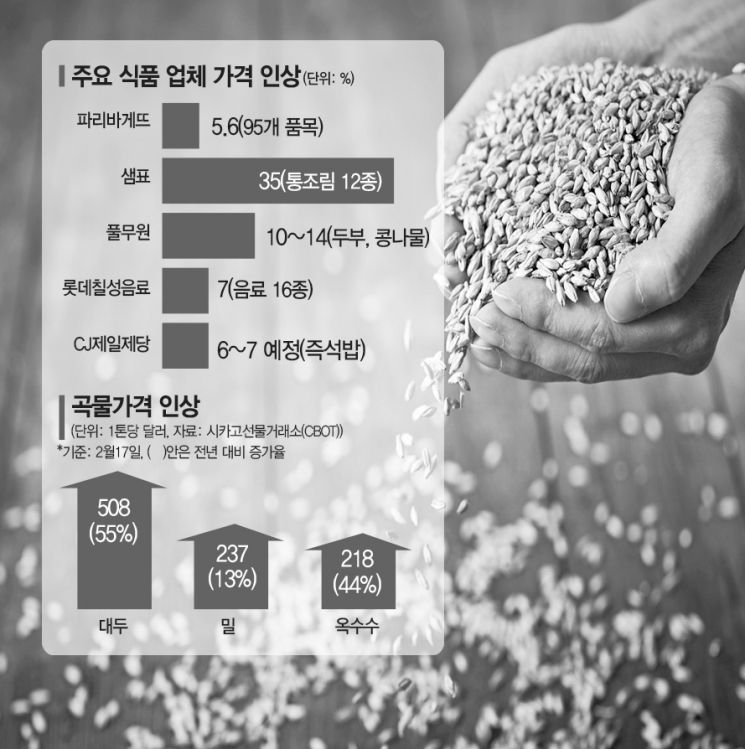
According to overseas grain market information from the Korea Rural Economic Institute on the 20th, the price of soybeans traded on the Chicago Board of Trade (CBOT) on the 17th was $508 per ton (t), up 55% from a year ago. Wheat rose 13% to $237 per ton, and corn increased 44% to $218 per ton.
As raw material prices rose sharply, Paris Baguette raised prices for 95 items, accounting for 14.4% of its 660 products, by an average of 5.6%. Earlier, the second-largest bakery brand, Tous Les Jours, also raised prices for about 90 products by an average of 9%, citing raw material price increases.
The problem is that unprecedented cold waves caused by abnormal weather in parts of Europe and the United States are expected to push grain prices even higher. Generally, it takes about half a year for grain prices to be reflected in consumer prices, so companies that have not yet raised product prices are likely to implement larger price hikes. Products frequently consumed in daily life, such as snacks, ramen, and instant foods, are the main targets.
In particular, the rise in grain prices is also pushing up feed costs, which is expected to affect the prices of imported beef and pork. For example, the price of Korean beef sirloin has surpassed 12,000 won per 100g, reaching an all-time high, and if imported meat prices also rise, the consumer price inflation felt by consumers will be greater. Imported meat is widely used in dining establishments and home meal replacements (HMR), whose demand increased due to COVID-19, making it a direct blow to consumer price inflation.
Additionally, from August this year, the price of raw milk will increase from 1,034 won to 1,055 won per liter, a rise of 21 won (about 2.3%), following demands from the dairy industry. Due to the impact of COVID-19, milk consumption has decreased as school meals and other services were suspended, making price increases inevitable for dairy product manufacturers. A dairy industry official explained, "When raw milk prices rise, prices are usually increased within 1 to 2 months, so price hikes could occur as early as September."
Moreover, avian influenza (AI), which has persisted for four months, is also becoming a trigger for consumer price inflation. Although egg and chicken prices, which had been soaring daily, have temporarily stabilized, the spread of AI continues. The chicken industry is currently experiencing supply disruptions in chicken parts, and if the situation prolongs, they may consider raising chicken prices.
Meanwhile, at the beginning of this year, major food companies raised product prices simultaneously, citing raw material cost increases. Lotte Chilsung Beverage raised beverage prices by an average of 7.0% for the first time in six years, CJ CheilJedang and Ottogi increased instant rice prices by around 7%, and McDonald's Korea will raise prices for 30 items, including 11 types of burgers, by up to 300 won starting on the 25th. Lotteria also raised prices for 25 products, including burgers and desserts, and Sempio increased prices for canned side dishes by an average of 42%.
© The Asia Business Daily(www.asiae.co.kr). All rights reserved.
![User Who Sold Erroneously Deposited Bitcoins to Repay Debt and Fund Entertainment... What Did the Supreme Court Decide in 2021? [Legal Issue Check]](https://cwcontent.asiae.co.kr/asiaresize/183/2026020910431234020_1770601391.png)