Contacting with personal information obtained during work saying 'Let's meet'
Expert: "The contact itself is illegal... It can lead to additional crimes"
 Requests for private meetings using personal information obtained during work are frequent, requiring caution. [Image source=Yonhap News]
[Asia Economy Reporter Han Seung-gon, Intern Reporter Kim So-young] Crimes involving contacting individuals using personal information obtained through work continue unabated. From the victim's perspective, it is difficult to prevent such crimes in advance, and depending on the purpose of the contact, punishment is not always easy, leading to criticism. Experts pointed out that the act of contacting itself is illegal and could lead to serious crimes.
Recently, a woman who called the suicide prevention counseling hotline 1393, operated by the Ministry of Health and Welfare for depression counseling, received a text message from the counselor after the session ended.
According to the text message disclosed through media reports, the counselor said, "Strangely, I never had these feelings before, but they keep lingering in my mind, so I’m texting you," and added, "Normally, counselor phone numbers are not disclosed, but I’m opening it because I want to be a comfortable friend. You can text or call anytime you feel down. Would you like to be comfortable friends?"
When public criticism arose over illegal acts such as contacting using personal information unlawfully, the man explained, "I was worried about the complainant."
The Ministry of Health and Welfare stated, "Since COVID-19, volunteers have been deployed to counseling duties, significantly increasing response rates, and everyone is responsibly engaged in counseling. We regret that such an unfortunate incident occurred," adding, "We are conducting re-education for counselors to prevent similar incidents from happening again."
Earlier, at the end of January, a similar incident occurred at a hospital in Suncheon, Jeollanam-do. A radiologist contacted a woman who had undergone an X-ray at the hospital, saying, "Do you have a boyfriend? I contacted you after seeing the number on the chart. Sorry if I startled you," expressing interest.
The hospital’s attitude also became an issue. The woman reported the incident to the hospital but only received indifferent responses such as "It’s nothing serious. Change your phone number." After public criticism, the hospital responded, "The response was inadequate despite good intentions," and "We have blocked the radiologist’s access to medical records and will take personnel action once the investigation is complete."
It does not end there. In August last year, a doctor at a university hospital in Daejeon was fired after making private contact with a patient who came for a health checkup, expressing personal interest.
Accessing patient personal information to make private contact is a violation of the law. Using personal information for purposes other than patient consent is punishable. According to the Personal Information Protection Act, violations of medical law can result in imprisonment of up to five years or a fine of up to 50 million won.
Meanwhile, in September last year, a male police officer made inappropriate contact eight times over a month to a female complainant. The officer admitted his mistake, saying, "I was immature and foolish to call from my personal number," but explained, "My sincere efforts to support the complainant in difficulty were partly misunderstood."
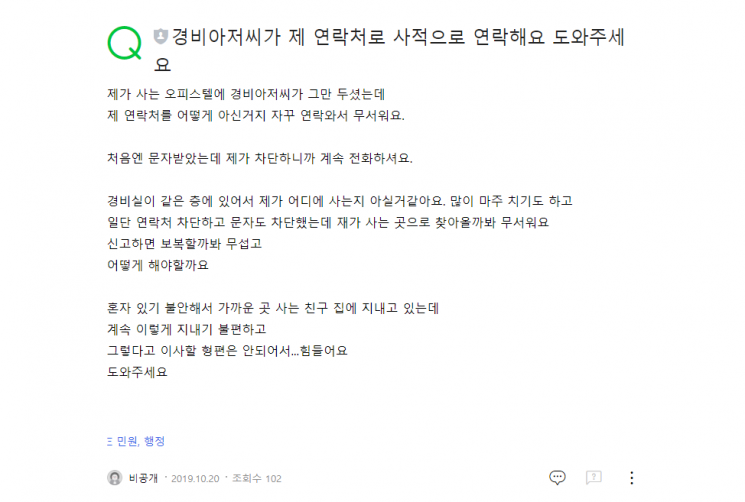
Many people also share similar experiences online. The problem is that legal action is not easy. Under the Personal Information Protection Act, only those classified as 'personal information handlers' can be punished for 'acquiring personal information by improper means or leaking/damaging it.'
There have been cases where punishment was avoided for this reason. On November 15, 2018, at a university scholastic ability test (Suneung) site in Gangdong-gu, Seoul, a test supervisor identified a test taker’s contact information by comparing the application form and admission ticket and made private contact, saying he liked her.
The first trial court acquitted him, stating that under current law, 'personal information handlers' can only be punished for acquiring personal information by improper means or leaking/damaging it, and there is no punishment provision for merely 'using' personal information as in this case. However, the appellate court convicted him, saying, "This undermines the legislative purpose of the Personal Information Protection Act."
There are also concerns that such approaches could lead to actual crimes. This refers to cases where contact is persistently continued even after refusal.
Professor Lee Soo-jung of Kyonggi University, specializing in criminal psychology, said, "The act of contacting itself can be considered illegal," and warned, "Additional crimes to achieve the intended purpose may occur, making it a very dangerous situation."
She added, "However, if the person contacting insists repeatedly that their intentions were good, it is difficult to assume malicious intent and impose severe punishment."
© The Asia Business Daily(www.asiae.co.kr). All rights reserved.


















