KOSPI Shows Correction, Falls to 3000s Due to Rising US Treasury Yields
Individual Investors Shift to Large-Cap Stocks After Lunar New Year Holiday
"Temporary Volatility from Interest Rate Decline... Opportunity to Increase Growth Stock Holdings"
[Asia Economy Reporter Minwoo Lee] Since the Lunar New Year holiday, the KOSPI has been moving sideways without a clear rebound. As analyses suggest that the liquidity-driven market phase is passing, individual investors appear to be focusing on safely purchasing large-cap stocks at the top of the market capitalization rankings.
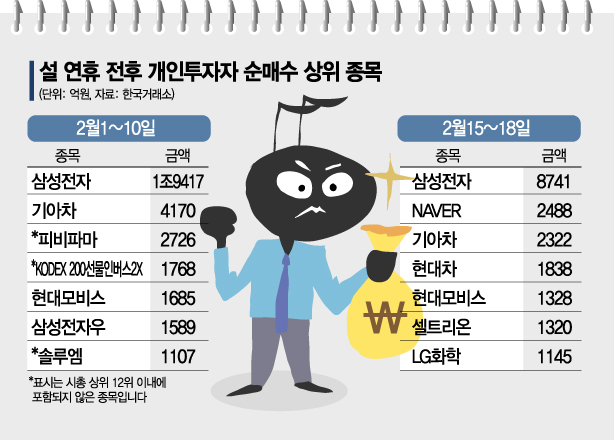
According to the Korea Exchange on the 19th, from the 15th after the Lunar New Year holiday until the previous day, the stock most net-purchased by individual investors was Samsung Electronics (KRW 874.1 billion). Following were Naver (NAVER, KRW 248.8 billion), Kia Motors (KRW 232.2 billion), Hyundai Motor (KRW 183.8 billion), Hyundai Mobis (KRW 132.8 billion), Celltrion (KRW 132.0 billion), and LG Chem (KRW 114.5 billion) in order of net purchase volume. Among the stocks net-purchased by individual investors over KRW 100 billion during this period, only Kia Motors and Hyundai Mobis were outside the top 10 in market capitalization (including preferred shares). Since these two ranked 11th and 12th in market cap as of the closing price on the 18th, it means that most purchases were concentrated on the top market capitalization stocks.
This is a markedly different atmosphere compared to before the Lunar New Year holiday. Until the 10th, before the holiday this month, individual investors also bought Samsung Electronics (KRW 1.9417 trillion) the most, but the order afterward was different. PVB Pharma, which was listed on the 5th, ranked third with a net purchase volume of KRW 272.6 billion, and the ETF product known as the "inverse leveraged ETF" called "KODEX 200 Futures Inverse 2X" ranked fourth with KRW 176.8 billion. Electronic component manufacturer SoluM, with a market cap of about KRW 1.2 trillion, was also net-purchased by KRW 110.7 billion (7th place), indicating that various stocks beyond large caps were among the top net purchases.
As the KOSPI struggles to rebound, it seems investors have decided to invest safely focusing on large-cap stocks. The KOSPI, which surpassed the 3,200 mark for the first time ever based on the closing price on the 25th of last month, continued to decline until the end of last month. On the 29th of the same month, it closed at 2,976.21, breaking below the 3,000 level for the first time in about a month. Since then, it recovered to the 3,100 level this month but has shown a downward trend again after the 16th, following the Lunar New Year holiday, falling to 3,086.66 as of the previous day.
This is interpreted as reflecting concerns that the liquidity-driven market phase is shrinking due to rising U.S. Treasury yields. On the 16th (local time), the U.S. 10-year Treasury yield rose by more than 10 basis points (bp, 1bp=0.01%) to 1.317%, the highest level since February last year. It had been moving below 1% until the end of last year but has risen by more than 30bp this year. Kim Dae-jun, a researcher at Korea Investment & Securities, explained, "While the domestic stock market was on holiday for the Lunar New Year last week, bond yields in the U.S. rose more sharply than expected, putting pressure on the stock market."
However, there is an outlook that there is no need to be overly sensitive to such interest rate hikes. The causes of rising interest rates are economic recovery and monetary tightening, and interest rate increases due to economic recovery, as seen this year, do not hinder stock market gains. As of the 18th, the U.S. 10-year Treasury yield was 1.29%, still below the average 1.92% yield during the tapering talk period in May 2013, indicating that monetary tightening is still distant.
Moon Nam-jung, a researcher at Daishin Securities, advised, "Although market interest rates are bound to rise due to economic recovery from COVID-19 vaccine distribution and increased fiscal spending following the Democratic Party's control of both houses in the U.S., even if the base interest rate remains unchanged, considering growth rates exceeding interest rates, the investment priority should be stocks. If growth stocks are shaken by temporary market volatility, it should be taken as an opportunity to increase their weighting."
© The Asia Business Daily(www.asiae.co.kr). All rights reserved.
!["The Woman Who Threw Herself into the Water Clutching a Stolen Dior Bag"...A Grotesque Success Story That Shakes the Korean Psyche [Slate]](https://cwcontent.asiae.co.kr/asiaresize/183/2026021902243444107_1771435474.jpg)
















