LG Energy Solution and KST Mobility Sign MOU
Expecting to Establish a Virtuous Cycle Ecosystem for Battery Reuse Operating Model
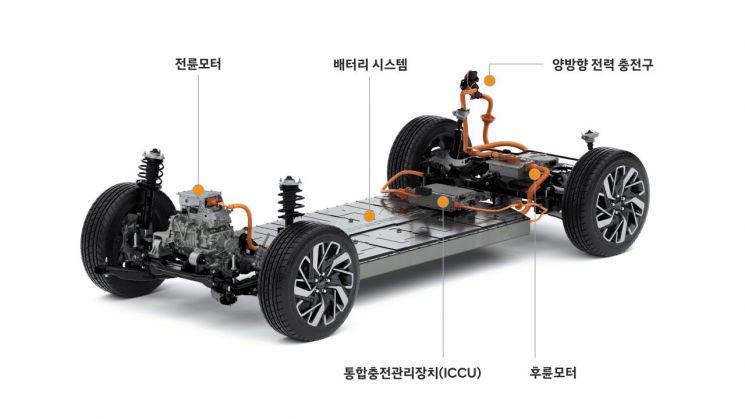
[Asia Economy Reporter Ki-min Lee] Hyundai Motor Company is joining forces with the government and the logistics, battery, and mobility industries to fully launch an electric vehicle (EV) battery rental (lease) business. Once the EV battery lease service is commercialized following a pilot project, it is expected to significantly reduce the initial cost burden of purchasing electric vehicles and establish a virtuous cycle ecosystem through battery reuse.
On the 18th, Hyundai Motor signed a memorandum of understanding (MOU) for a pilot project on electric taxi battery rental and used battery utilization with the Ministry of Trade, Industry and Energy, Hyundai Glovis, LG Energy Solution, and KST Mobility at Hyundai Motor and Kia’s Namyang Technology Research Center in Hwaseong, Gyeonggi Province. Attendees at the MOU signing ceremony included Prime Minister Chung Sye-kyun, Minister of Trade, Industry and Energy Sung Yun-mo, Hyundai Motor Group Chairman Chung Eui-sun, Hyundai Motor President Gong Young-woon, Hyundai Glovis President Kim Jung-hoon, LG Energy Solution President Kim Jong-hyun, KST Mobility CEO Lee Haeng-ryeol, and other government and industry representatives.
Through this pilot project, Hyundai Motor plans to establish a battery lease operation model and verify a battery circulation model that converts used batteries into energy storage systems (ESS).
According to the MOU signed that day, taxi platform operators will sell the ownership of the battery to the lease operator immediately after purchasing the electric vehicle. Subsequently, the operators will pay a monthly battery lease fee during the period they own the EV. Essentially, operators purchase the EV at a price excluding the battery cost. Used batteries obtained when replacing the batteries installed in electric taxis with new ones will be converted into ESS and used for fast charging of electric vehicles. ESS will be charged during nighttime hours when electricity rates are low and used to charge EVs during daytime hours when electricity rates are high, thereby reducing costs.
Hyundai Motor, which oversees the pilot project, will sell the electric vehicle ‘Kona Electric’ to the taxi platform operator KST Mobility and will also be responsible for battery warranty and sales of replacement batteries. Hyundai Glovis, which holds a patent for a dedicated container capable of efficiently transporting large quantities of used batteries, will operate the battery rental service and handle logistics for collecting used batteries. LG Energy Solution will purchase used batteries to analyze their safety and residual value. Additionally, LG Energy Solution will manufacture ESS from used batteries, install them in EV fast chargers, and sell these chargers to KST Mobility, the vehicle operator. KST Mobility will operate an EV-based taxi franchise service and utilize ESS fast chargers for taxi charging. Driving and battery data collected through electric taxi operations will be provided to the companies participating in the MOU. The Ministry of Trade, Industry and Energy will actively support the smooth progress of the project in consultation with related ministries and operate a task force to review quarterly progress and issues.
Once the battery lease service is commercialized, consumers are expected to be able to purchase electric vehicles at a lower cost than before. This is because consumers will buy vehicles at a price excluding the battery after receiving government subsidies and only pay the lease fee for the battery. The battery accounts for 30-40% of the EV price. For example, if purchasing a Kona (base model PTC·HP) priced in the 47 million KRW range through the battery lease program, the consumer can buy it for the late 20 million KRW range after excluding the battery cost, which accounts for 30-40% of the vehicle price. After deducting subsidies (national subsidy of 8 million KRW + local subsidy (Seoul City 4 million KRW)), consumers can purchase the vehicle for the high 10 million KRW to low 20 million KRW range. Thereafter, consumers only need to pay the monthly battery lease fee. This is also expected to lead to the expansion of EV adoption.
Moreover, this project will verify the safety of used EV batteries and establish methods for evaluating residual value, which is expected to promote the reuse of EV batteries. Additionally, sharing EV battery data may open up opportunities for related new businesses.
© The Asia Business Daily(www.asiae.co.kr). All rights reserved.

















