KAIST Startup Talent Development Specialized Master's Program 'K-school' Successful Entrepreneurship After Admission
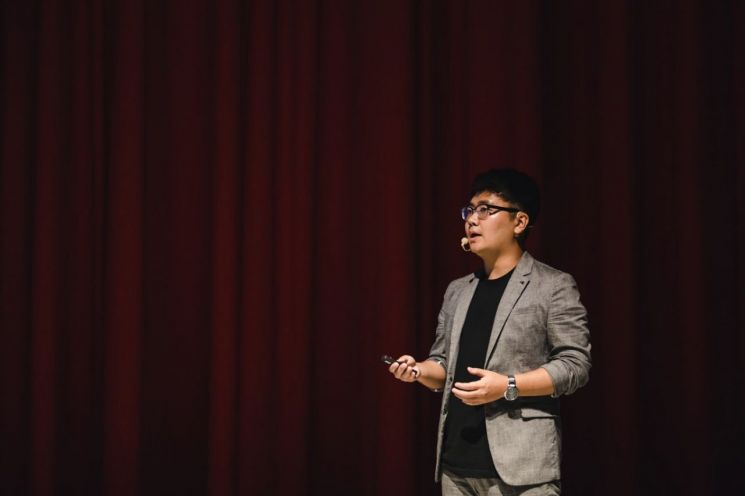
[Asia Economy Reporter Kim Bong-su] "The notion that failing at a startup means ending up on the streets is now a thing of the past. With the government and investors running various startup support programs, this is the best time to start a business."
This is the statement of Yeon Chang-hak (27, Department of Technology Management), who is graduating from the 'K-School' and receiving a Master of Entrepreneurship and Convergence at the Korea Advanced Institute of Science and Technology (KAIST) commencement ceremony on the 19th.
Yeon canceled his planned graduate school admission just before graduating from the Department of Industrial Management Engineering at POSTEC (Pohang University of Science and Technology) in 2016 and enrolled as a third cohort student in 2017. Since his school days, whenever people around him said, "You should enter a good university and get a job at a good company," he would ask back, "Why do I have to be an employee? Can't I start my own company?"?nurturing his dream of entrepreneurship.
He steadily prepared for startups by serving as the undergraduate representative manager of the campus startup incubator, but wanting to first learn on-the-job experience, he gave up further studies and moved to Seoul without a plan. Over the next two years, Yeon gained confidence by working as a developer at a fintech company and in new business planning and sales at an IT security company. While preparing seriously to start his own business, he enrolled in K-School, thinking it was the best place to find peers sharing the same dream of startups in a similar environment.
K-School is a specialized master's program at KAIST that combines KAIST's specialized engineering education with entrepreneurship to cultivate startup talent. It was established in 2016 as the first of its kind in Korea, allowing students to earn a degree based solely on startup achievements without writing a thesis.
About three months after entering in the fall semester, Yeon set a record as the first student to successfully secure investment since K-School's inception. Surpassing seniors from the first and second cohorts, he secured 200 million KRW in investment from well-known domestic accelerators, financial institutions, and large corporations.
In May of the following year, Yeon teamed up with two classmates, one junior from K-School, and a doctoral student from KAIST's Department of Computer Science to establish the blockchain technology-based startup 'Block Odyssey' and began full-scale business operations.
Focusing on the fact that over 200,000 people die annually in China from counterfeit drugs and that a single specific brand in the cosmetics industry suffers counterfeit damages amounting to 400 billion KRW annually, Yeon targeted the market with an 'electronic signature embedded QR code' that tracks logistics processes and prevents forgery and tampering based on blockchain technology.
The 'authenticity verification solution' was the only project Yeon had failed before starting his business, but with the team he met at K-School, he developed new technology and found a solution to target the market.
Previously used physical security technologies involved attaching special ink or holograms to genuine products, but the more sophisticated these were made to prevent counterfeiting, the more only expert authenticators could distinguish them, which was pointed out as a drawback.
Yeon's technology allows consumers to instantly verify product authenticity simply by scanning a QR code. Within one year of founding the startup, he formed business partnerships with global companies such as Amorepacific, LG Electronics, and Guerbet. Additionally, he secured and is currently building a national distribution blockchain project promoted by the Ministry of Trade, Industry and Energy to prevent counterfeit goods at the national level. As of February this year, the accumulated investment exceeded 3 billion KRW.
Yeon, who says "gathering good people is the real starting point of a startup," emphasized that he was able to quickly realize his entrepreneurial dream through K-School. This was because he met peers with top-notch technical development skills and entrepreneurial spirit through the specialized master's program.
He said, "There are many organizations supporting startups in Korea, but few places like K-School where investment company CEOs come directly to discover startups with investment potential. Thanks to KAIST's brand value and the trust built by startups founded by KAIST alumni, the credibility of specialized master's students preparing for startups has also risen."
Yeon also pointed out as advantages that through the startup field internship, a graduation requirement, students can overcome vague fears about entrepreneurship and gain confidence; that the startup convergence specialized master's program and the startup village on campus, where students related to startups can reside, facilitate active human networking and idea exchange; and that the CUop program, which hires KAIST undergraduates as interns, allows recruitment of talented personnel.
© The Asia Business Daily(www.asiae.co.kr). All rights reserved.

















