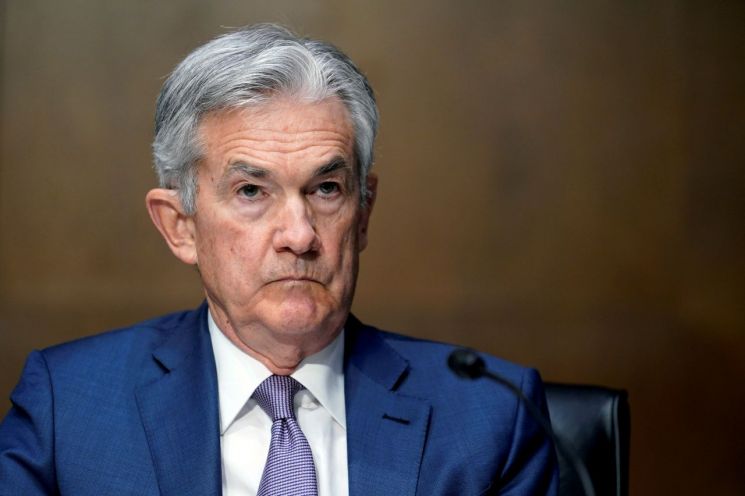
 Jerome Powell, Chairman of the Federal Reserve (Fed), the central bank of the United States [Yonhap News - Reuters]
[Asia Economy Reporter Junho Hwang] The yield on the U.S. 10-year Treasury note has returned to levels seen during the COVID-19 pandemic. The rate of increase since the beginning of the year (40 basis points) is the highest since 2013. The market views this rise in yields as driven by inflation expectations stemming from hopes for a large-scale U.S. economic stimulus package. However, if yields continue to rise steadily, it could hinder the stock market's upward momentum.
Sharp Rise in U.S. Bond Yields
The yield on the 10-year U.S. Treasury rose above 1.3% on the 16th (local time). This marks a return to the yield levels seen during the financial market turmoil caused by the COVID-19 shock last year, after about 11 months. On the 17th, yields fell back to the 1.2% range but fluctuated above 1.3% during the trading session.
Ahn Jaegyun, a bond researcher at Korea Investment & Securities, analyzed, "On the 17th, the 10-year yield approached 1.3% again after January U.S. retail sales were announced stronger than market expectations during the trading session, but the direction changed following the release of the January FOMC minutes from the Federal Reserve."
Bond Yields Approaching S&P 500 Average Dividend Yield
When the U.S. 10-year Treasury yield rises to 1.3%, it becomes comparable to the stock market. Currently, the average dividend yield of the U.S. S&P 500 is 1.5%. When the risk-free asset yield of government bonds approaches this level, investment funds in the stock market may flow into the bond market.
U.S. economic news service Bloomberg attributed the rise in bond yields to economic outlooks driven by the U.S. House leadership's push for a $1.9 trillion stimulus package, expectations of herd immunity due to vaccine rollouts, inflation forecasts, and rising oil prices.
Bank of America, a U.S. investment bank, noted that currently 70% of companies included in the S&P 500 offer returns higher than bond yields, but if yields rise to 1.75%, this proportion is expected to sharply drop to 40%. Goldman Sachs predicted that regardless of the absolute level of yields, if the pace of rate hikes exceeds 36 basis points per month, it could significantly damage the stock market's upward trend.
Still Stable for Now
Regarding these concerns, researcher Ahn explained, "It is not possible to discuss asset strength or weakness solely based on whether yields surpass a certain absolute level, but the market atmosphere suggests that yields above a certain level are still unwelcome."
Economist Gong Dongrak of Daishin Securities stated, "The current rise in yields is unlikely to cause a large-scale shock that would warrant concerns about increased volatility risk in the bond market."
Despite the burden from rising yields, the MOVE index, which measures fear in the bond market, remains generally stable, and as a result, the VIX index, which measures fear in the stock market, also stays at a limited level. Especially judging from remarks by Federal Reserve Chair Jerome Powell and various regional Fed presidents, the economy is still on a path to recovery from the COVID-19 shock. According to him, this recent rise in yields can rather be seen as directly caused by factors such as the supply-demand burden from the stimulus package and heightened inflation expectations.
© The Asia Business Daily(www.asiae.co.kr). All rights reserved.
![User Who Sold Erroneously Deposited Bitcoins to Repay Debt and Fund Entertainment... What Did the Supreme Court Decide in 2021? [Legal Issue Check]](https://cwcontent.asiae.co.kr/asiaresize/183/2026020910431234020_1770601391.png)















