Exhibition at the National Palace Museum's Royal Court Painting Room Starting Today
Magnificent Landscape Depictions and Detailed Portraits, High-Level Royal Court Painting Style
"The Most Artistically Accomplished Hunting Scene Known So Far"
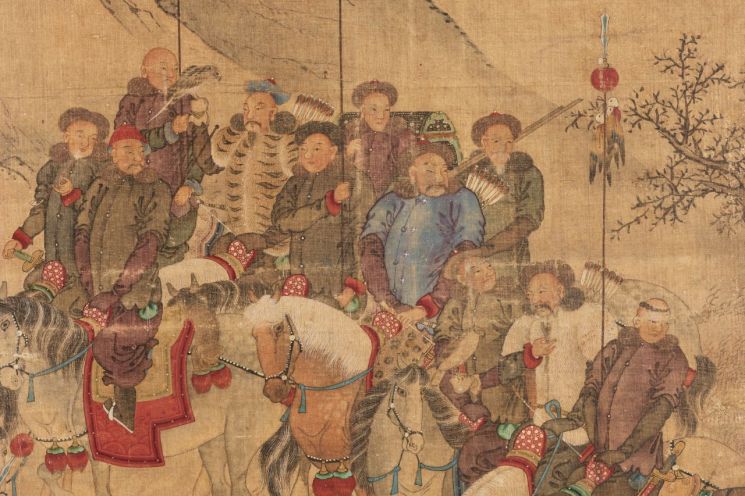
Joseon suffered great damage from the Jeongmyo Horan (1627) and Byeongja Horan (1636). The Qing dynasty was an object of hatred and rejection. However, in the late 18th century, as many of their cultural artifacts were introduced, interest in new cultures began to grow. A representative example is the Horyeopdo (胡獵圖), which means "painting of barbarian hunting." It depicts the hunting scenes of the Qing emperor and was produced increasingly in line with King Jeongjo's (1752-1800) military policies that emphasized martial preparedness.
The Cultural Heritage Administration and the Overseas Korean Cultural Heritage Foundation unveiled the "Horyeopdo Eight-Panel Folding Screen (胡獵圖 八幅屛風)" purchased at an American auction last September on the 18th at the Palace Painting and Calligraphy Room of the National Palace Museum of Korea. It is a folding screen measuring 392 cm in length and 154.7 cm in height, composed of eight connected silk panels. The landscape depiction and composition are excellent, and the figures and animals are portrayed vividly.
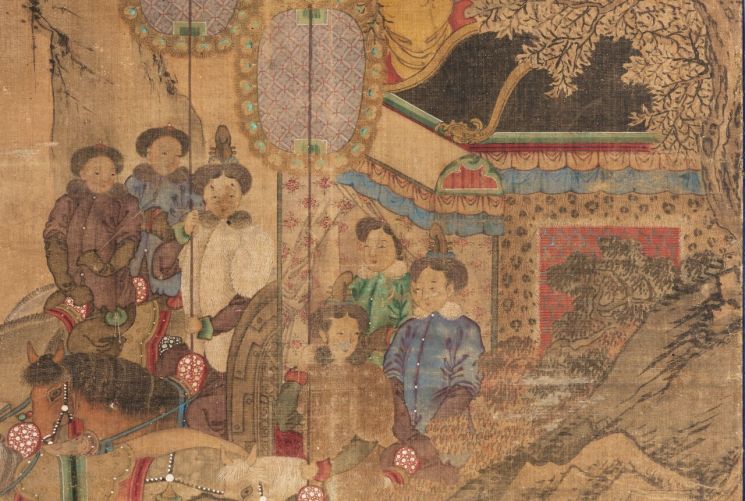
Professor Jeong Byeong-mo of the Department of Cultural Heritage at Gyeongju University explained, "It depicts the autumn hunting scene of the Qing emperor and is the most artistically accomplished among the known Horyeopdo paintings." He added, "It portrays exotic themes and figures within the landscape style of the Joseon era influenced by Kim Hong-do's painting style, reflecting King Jeongjo's attitude toward accepting foreign culture while maintaining self-esteem under the Northern Learning policy."
The first and second panels feature landscapes imbued with a chilly autumn atmosphere. The third panel shows royal women setting out in a splendid palanquin, while the fifth panel depicts the Qing emperor dressed in robes embroidered with white dragons on a blue background, along with various mounted figures in different postures. The seventh and eighth panels dynamically portray hunters aiming bows and wielding spears and weapons at tigers and deer. Professor Jeong elaborated, "The rhythmic progression starts from the majestic mountains on the right and continues to the plains on the left."
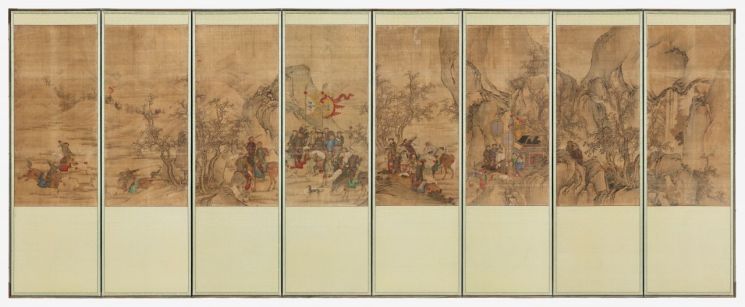
Although the first painter of Horyeopdo is said to be Kim Hong-do, his works survive only in records such as the "Imwon Gyeongjeji (林園經濟志)." Most Horyeopdo folding screens remaining in Korea today are painted in a folk art style. However, the Horyeopdo unveiled this time demonstrates a high-level court painting style through its grand landscape depiction and detailed figure portrayal.
The Cultural Heritage Administration stated, "This work offers a glimpse into the beginning of Joseon Horyeopdo, making this repatriation particularly meaningful," and added, "We will expand the scope of Horyeopdo research, which has been centered on folk paintings, and utilize it widely in exhibitions and education."
© The Asia Business Daily(www.asiae.co.kr). All rights reserved.
![From Hostess to Organ Seller to High Society... The Grotesque Scam of a "Human Counterfeit" Shaking the Korean Psyche [Slate]](https://cwcontent.asiae.co.kr/asiaresize/183/2026021902243444107_1771435474.jpg)


















