Professor Seokyeongdeok "Baidu labels poet Yoon Dong-ju as Chinese Joseonjok... Repeatedly demands correction"
"Hanbok = Chinese culture" Xiaomi controversy over wallpaper
Citizens "Government must respond actively"
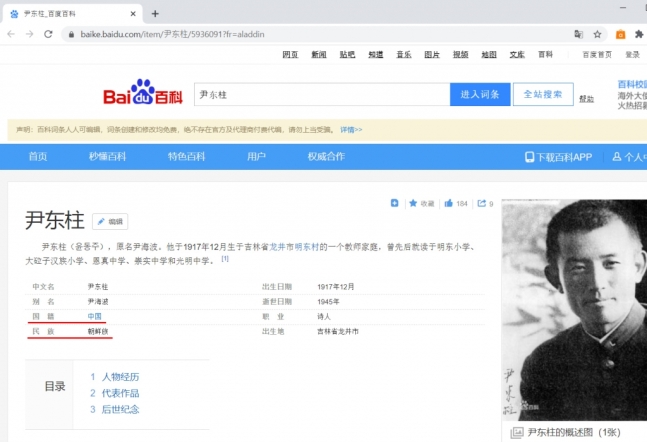 The Chinese online encyclopedia site 'Baidu' lists the nationality of poet Yun Dong-ju as 'Chinese' and his ethnicity as 'Joseonjok'. Photo by Seokyungdeok, Professor at Sungshin Women's University.
[Asia Economy Reporter Heo Midam] As China continues to claim Korea's unique cultures such as Hanbok and Kimchi as its own, disputes between the two countries persist. In particular, the recent labeling of poet Yun Dong-ju's nationality as 'Joseonjok' on China's largest portal site 'Baidu,' along with the incorrect notation of both ethnicity and nationality of independence activists like Yun Bong-gil and Lee Bong-chang, has further fueled public anger.
Additionally, when Hallyu stars such as Kim Yuna and Lee Young-ae were also introduced as 'Joseonjok,' citizens raised their voices demanding that the government take direct action to resolve the issues with China.
On the 16th, Professor Seo Kyung-duk of Sungshin Women's University sent a protest email to Baidu, urging them to correctly revise the nationality and ethnicity notations of the independence activists.
After starting protests on December 30th last year, coinciding with poet Yun Dong-ju's birthday, and seeing no changes even by February 16th, the anniversary of his martyrdom, he made a renewed request for correction.
Currently, Baidu lists Yun Dong-ju's nationality as 'China' (中國) and ethnicity as 'Joseonjok' (朝鮮族). The nationalities of independence activists Lee Bong-chang and Yun Bong-gil are also introduced as 'Joseon' (朝鮮), with their ethnicity noted as 'Joseonjok.'
Yu Gwan-sun, Kim Gu, Ahn Chang-ho, Lee Hoe-young, and Hong Beom-do are correctly listed with Korean nationality, but their ethnicity is not separately indicated. Notably, Shin Kyu-sik has no nationality entry, and Lee Dong-nyeong lacks both nationality and ethnicity entries.
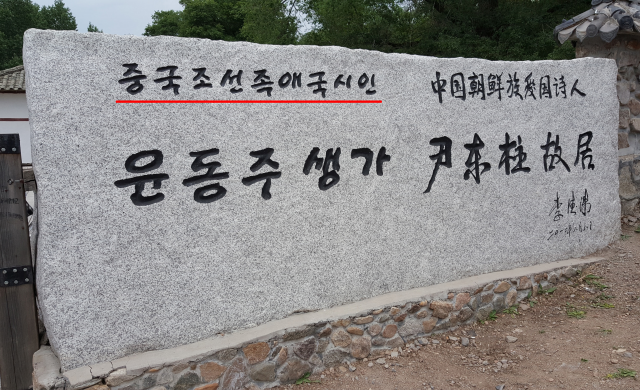 The birthplace of poet Yun Dong-ju in Yongjeong Village, Yanbian Korean Autonomous Prefecture, China. The entrance marker reads "Chinese Korean Patriotic Poet." Photo by Seokyungdeok, Professor at Sungshin Women's University.
Regarding this, Professor Seo pointed out on his Facebook, "In Yongjeong Village, Yanbian Korean Autonomous Prefecture, Jilin Province, China, where Yun Dong-ju's birthplace is located, the sign at the entrance reads 'Chinese Joseonjok patriotic poet,' which is a significant problem."
He added, "The Chinese version of the online encyclopedia Wikipedia also introduces historical figures such as King Sejong and Kim Gu, as well as Hallyu stars like Kim Yuna and Lee Young-ae, as Joseonjok, which is causing controversy."
This is not the first time China has distorted history. Previously, China has sparked controversy by claiming Kimchi and Hanbok as its own indigenous culture and engaging in historical distortion.
In particular, China has claimed that Hanbok from the Joseon Dynasty is actually 'Hanfu' worn during the Ming Dynasty, and asserted that Kimchi originated from the Chinese-style pickled vegetable 'Pao cai,' which drew criticism.
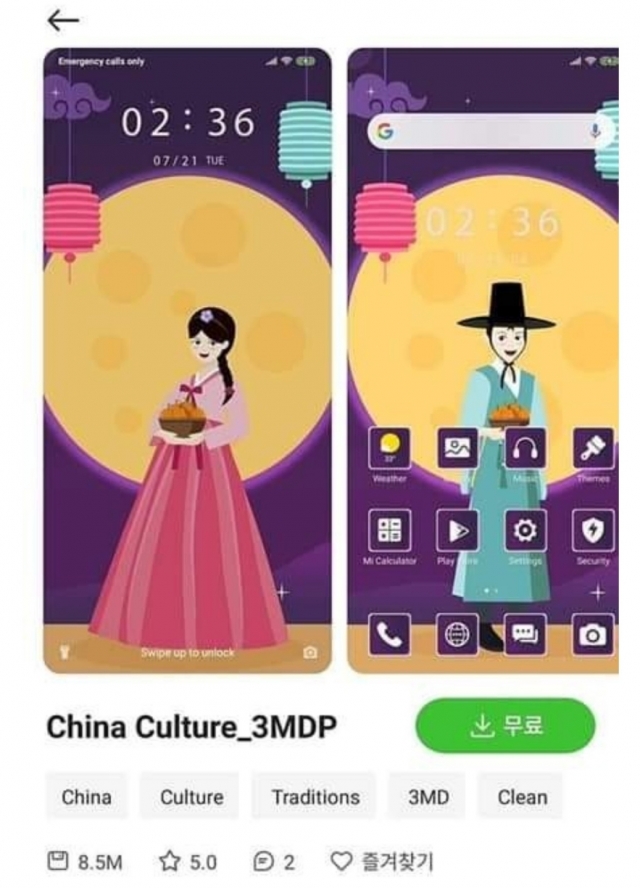 Image uploaded to the Xiaomi wallpaper store. The image of a man and woman wearing hanbok is described under the title "China Culture." Photo by Online Community.
There have also been cases where Chinese companies labeled Hanbok as Chinese culture. Recently, the Chinese electronics company 'Xiaomi' posted an image introducing Hanbok as Chinese culture in its smartphone wallpaper store, sparking controversy.
The image featured a man and woman wearing Hanbok, but Xiaomi uploaded it under the title 'China Culture,' which led to widespread criticism among domestic netizens. Some even expressed intentions to boycott the products, prompting Xiaomi to eventually revise the content and issue an official apology.
As China continues to claim Korean culture as its own, calls for government-level responses are also growing louder.
One netizen said, "Why does the government remain silent on China's historical distortion? No matter how many times we speak, I don't think China will correct the misinformation. The government needs to officially respond to China."
Another netizen stated, "We must protect our history ourselves. Cultural invasion can ultimately lead to a national crisis. We need to think about what our ancestors risked their lives for to protect the country and preserve Hangul."
Voices urging government action have also emerged in the political sphere. Former People Power Party lawmaker Yoo Seung-min raised his voice on Facebook, saying, "China is distorting our history and culture and claiming it as its own, so why can't our government respond strongly?"
He also pointed out Baidu's incorrect notation of independence activists' nationalities, asking, "What are our Ministry of Foreign Affairs and the embassy in China doing? We must speak up to China. I urge the Ministry of Foreign Affairs and the embassy in China to immediately step in and correct these issues."
© The Asia Business Daily(www.asiae.co.kr). All rights reserved.
![User Who Sold Erroneously Deposited Bitcoins to Repay Debt and Fund Entertainment... What Did the Supreme Court Decide in 2021? [Legal Issue Check]](https://cwcontent.asiae.co.kr/asiaresize/183/2026020910431234020_1770601391.png)


















