Professor Seokyeongdeok Corrects Yoon Dong-ju Errors on Baidu, Chinese Media Makes Absurd Claims
Mentions Musician Jeong Yulseong Who Naturalized in China After Anti-Japanese Movement
[Asia Economy Beijing=Special Correspondent Jo Young-shin] A controversy has erupted once again between South Korea and China over the nationality designation of poet Yun Dong-ju (1917?1945). On the morning of the 17th, a hashtag titled '#A Korean professor demanded that the nationality of the Joseonjok poet be corrected to Korean#' trended on Weibo, known as the Chinese version of Twitter, garnering over 300 million views.
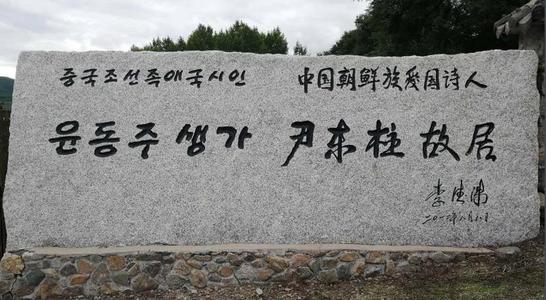 Monument of poet Yun Dong-ju at the entrance of Yongjeong Village, Yanbian Korean Autonomous Prefecture, Jilin Province, China. (Photo by Baidu capture)
The hashtag was triggered by Professor Seo Kyung-duk of Sungshin Women's University protesting on the Chinese portal Baidu on the 16th, claiming that Yun Dong-ju's nationality was incorrectly listed as Chinese and his ethnicity as Joseonjok. Professor Seo had protested to Baidu on December 30 last year, coinciding with Yun Dong-ju's birthday, and again demanded corrections on the 16th, the anniversary of Yun Dong-ju's death.
The Chinese nationalist newspaper Global Times, reporting on Professor Seo's protest, stated that considering China's Nationality Law and historical circumstances, it is difficult to recognize the nationality of historical figures like Yun Dong-ju. The outlet cited that Yun Dong-ju was born in China and that Korea was under Japanese colonial rule at the time of his birth, prior to its formal establishment as a nation.
Chinese media also pointed out that historical figures with transnational backgrounds like Yun Dong-ju actually exist, citing musician Zheng Yulseng as an example. He was born in 1914 in Gwangju, participated in student movements from middle school, fled to China to escape Japanese oppression, and fought against Japan as a member of the Uiyoldan. The "March of the Eighth Route Army," currently the anthem of the Chinese People's Liberation Army, was composed by him. After liberation, he was active in North Korea and later naturalized as a Chinese citizen.
The Global Times argued, "Experts from both countries should conduct verification and analysis to determine Yun Dong-ju's nationality."
In 2012, Chinese authorities restored Yun Dong-ju's birthplace in Longjing, Yanbian Korean Autonomous Prefecture, Jilin Province, erecting a monument at the entrance inscribed with "Chinese Joseonjok Patriotic Poet." The controversy over Yun Dong-ju began with the inscription on this monument.
Within South Korean academia, there is a view that due to the historical uniqueness of Yun Dong-ju's birth time and place, emphasis should be placed on his ethnic orientation rather than nationality. Experts say Yun Dong-ju wrote poetry in Hangul and had a clear ethnic identity as a Korean.
In Yun Dong-ju's poem "Counting the Stars at Night," the line "names like Pae, Gyeong, Ok, these foreign girls" is cited as evidence that he did not consider himself Chinese, referring to Han Chinese girls as "foreign girls," thus demonstrating his Korean identity.
A diplomatic source in Beijing said, "We are continuously communicating with the Chinese side to rectify this issue," adding, "We are approaching this comprehensively, taking into account historical facts and Korean sentiments."
© The Asia Business Daily(www.asiae.co.kr). All rights reserved.

















