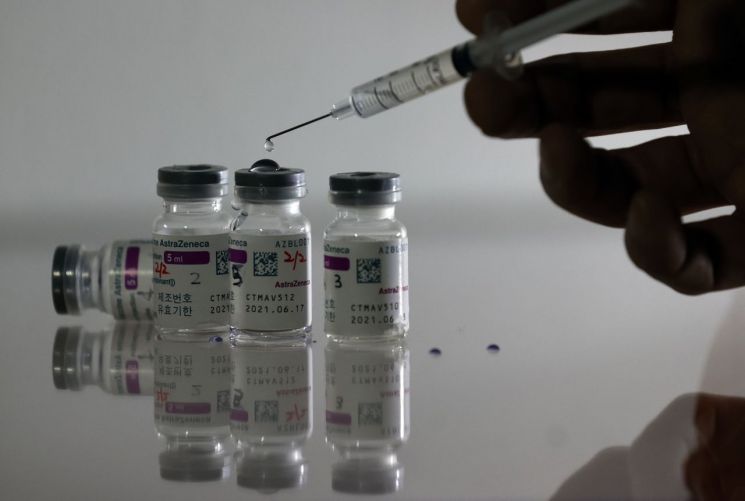
 On the afternoon of the 16th, at the Korea Nurses Association Seoul·Gangwon Employment Workforce Training Center in Jung-gu, Seoul, AstraZeneca (AZ) vaccine vials and integrated syringes were unveiled ahead of COVID-19 vaccination training for nurses.
 [Image source=Yonhap News]
[Asia Economy Reporter Chunhee Lee] AstraZeneca's COVID-19 vaccine, 'Korea AstraZeneca COVID-19 Vaccine Injection,' has become the first COVID-19 vaccine to receive national batch release approval.
The Ministry of Food and Drug Safety (MFDS) announced on the 17th that it has granted national batch release approval for approximately 787,000 doses (about 1,574,000 shots) of AstraZeneca's COVID-19 vaccine.
This national batch release approval was granted 20 days after Korea AstraZeneca applied for approval on the 29th of last month. Normally, national batch release approval takes 2 to 3 months. However, since the vaccine is scheduled to be used for domestic vaccinations starting on the 26th, the MFDS designated the AstraZeneca vaccine as a priority for expedited batch release approval last month and processed it ahead of other approvals.
'National batch release approval' is a system where the government conducts an additional quality check on vaccines before distribution by comprehensively evaluating the 'inspection test' for each manufacturing lot and the 'data review' of the manufacturer's submitted results confirming manufacturing and testing according to the approved standards.
The AstraZeneca vaccine in question was manufactured entirely under contract by SK Bioscience. Since August of last year, the MFDS has received detailed testing methods from the manufacturer, prepared necessary equipment and reagents for inspection tests, and established inspection test methods. Additionally, anticipating a surge in national batch release approval applications for COVID-19 vaccines, the MFDS expanded specimen storage facilities and secured additional storage freezers.
Through this process, the MFDS confirmed the safety and efficacy of each manufacturing lot of the vaccine and determined that all met the approved standards.
Specifically, regarding safety, sterility tests and endotoxin tests confirmed no microbial contamination such as bacteria during the manufacturing process. Regarding efficacy, potency tests, identity tests, and viral vector content tests were conducted to measure the expression level of proteins indicating efficacy, the maintenance of target genetic material, and the amount of the genetic material delivery vector. Additionally, general vaccine quality tests such as appearance tests, pH measurement tests, and practical dose tests for injections were performed.
Furthermore, the review of detailed information on vaccine raw materials such as cell banks and virus strains, intermediates like bulk drug substances, and finished pharmaceutical products, as well as manufacturing and quality control records, confirmed compliance with Good Manufacturing Practice (GMP) and approved specifications. Information on the passage history of cell lines and virus strains used as vaccine materials, manufacturing and storage information at each process stage, test methods, test standards, and results were also verified.
An MFDS official stated, "We will continue to make every effort to thoroughly verify COVID-19 vaccines introduced domestically by fully utilizing the necessary experts, equipment, and related infrastructure for national batch release approval so that our citizens can receive vaccinations with confidence."
© The Asia Business Daily(www.asiae.co.kr). All rights reserved.

















