NXP, Infineon and Nearby Semiconductor Companies Also Shut Down Factories
First Operation Halt Since Establishing US Factory... "Measures Taken to Prevent Damage"
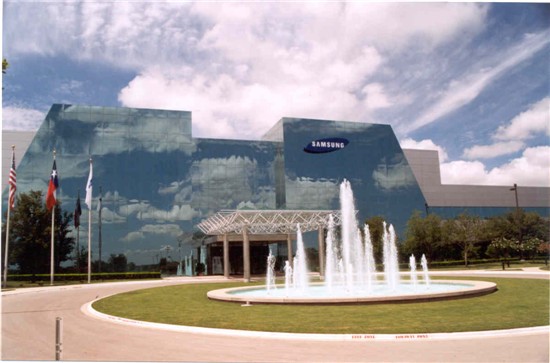
[Asia Economy Reporter Jeong Hyunjin] Samsung Electronics' semiconductor plant in Austin, USA, has halted operations due to power shortages caused by severe cold and heavy snowfall. This action follows a request from the city of Austin to suspend factory operations of major local companies, including Samsung Electronics, Dutch NXP, and German Infineon, due to large-scale blackouts and power shortages caused by the extreme cold. For Samsung Electronics, which was considering expanding the Austin plant, this is expected to become another factor to consider regarding its investment in the United States.
According to related industries and local foreign media on the 17th, Austin Energy informed its major corporate customers on the 16th (local time) about difficulties in power supply and requested them to reduce or stop power usage. In response, the consortium 'Coalition for Clean, Affordable, and Reliable Energy (CARE),' which negotiated on behalf of companies using local power, confirmed that "Austin Energy requested all industrial and semiconductor manufacturers to halt factory operations in response to the severe situation of the Texas power grid," and that all companies agreed to comply.
Accordingly, Samsung Electronics' Austin semiconductor plant has stopped operations starting from that day. Samsung Electronics currently operates a line producing 14-nanometer (nm, 1 nm equals one-billionth of a meter) class system semiconductors at the Austin plant. Previously, when a power outage of less than 30 minutes occurred at Samsung Electronics' Pyeongtaek plant in March 2018, the damage amounted to about 50 billion KRW, and in December 2019, the Hwaseong plant also suffered tens of billions of KRW in damages due to a blackout. A Samsung Electronics official explained, "Austin Energy sought prior understanding and gave advance notice, allowing all measures to be taken before the blackout and shutdown, ensuring no disruption to production and preventing damage."
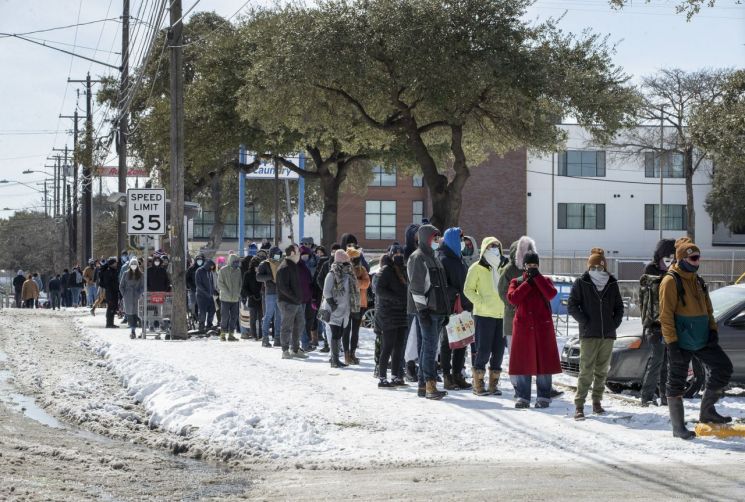 As Austin, Texas, faces power supply shortages, people line up on a street in Austin on the 16th (local time) to purchase daily necessities.
 [Image source=AP Yonhap News]
This is the first time since its establishment in 1998 that Samsung Electronics' Austin semiconductor plant has halted operations due to power shortages. Samsung Electronics is discussing with authorities and hopes to resume production as soon as possible, but due to the unfavorable local power supply situation, it is difficult to predict when operations will restart. The longer the shutdown period, the more inevitable the damage will be. In addition to Samsung Electronics, nearby semiconductor manufacturers such as NXP and Infineon have also stopped operations, and automobile manufacturer General Motors (GM) has suspended operations at its plants in the United States.
Recently, the United States has suffered damage from Arctic-origin severe cold. In Texas, power supply was cut off to 4.3 million households, causing the greatest damage. Including this, power outages affected 5.5 million households across 18 states in the U.S., including Oregon, Kentucky, West Virginia, and Virginia. As residents faced difficulties in daily life due to the blackout, power providers deemed it appropriate to request companies to halt factory operations and conveyed this intention to the companies.
With Samsung Electronics, NXP, Infineon, and many other semiconductor manufacturers temporarily suspending factory operations, it is expected to impact the global semiconductor supply shortage situation. The semiconductor shortage, which began during the semiconductor boom, is spreading from automotive to smartphones and TVs.
There is analysis that this could also affect Samsung Electronics' decision to expand the Austin plant. Samsung Electronics recently requested tax benefits of around 1 billion USD on the condition of investing 17 billion USD (approximately 18.8 trillion KRW) in the Austin area. Although the location for new or expanded U.S. plants has not yet been finalized, the power supply issue occurring in a region that was a strong candidate is expected to influence future investment decisions.
© The Asia Business Daily(www.asiae.co.kr). All rights reserved.
![Clutching a Stolen Dior Bag, Saying "I Hate Being Poor but Real"... The Grotesque Con of a "Human Knockoff" [Slate]](https://cwcontent.asiae.co.kr/asiaresize/183/2026021902243444107_1771435474.jpg)
















