Considering Competition with UAE Dubai... Applied from 2024
Global Companies Confused... May Only Display Middle East Headquarters Signboard
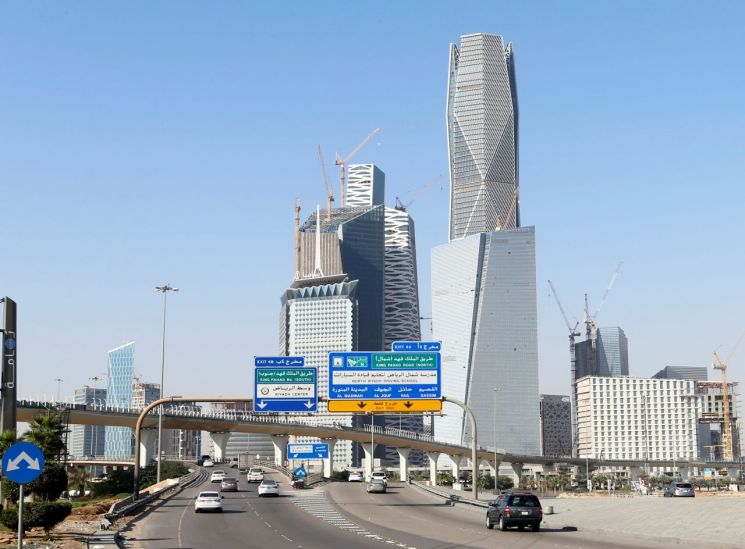
[Asia Economy Reporter Hyunwoo Lee] The Saudi Arabian government announced that starting in 2024, it will halt transactions with companies that do not have their Middle East regional headquarters in its capital, Riyadh, causing confusion among global corporations. With over 90% of foreign companies' Middle East regional headquarters already concentrated in Dubai, United Arab Emirates (UAE), it is expected that most companies will likely maintain ghost offices in Riyadh that serve only as nominal headquarters.
According to foreign media including CNBC, on the 15th (local time), Saudi state news agency SPA reported that the Saudi government will stop contracts and transactions with corporations and institutions whose Middle East regional headquarters are not located in Riyadh starting January 1, 2024. Saudi Investment Minister Khalid Al-Falih emphasized, "This decision will have effects such as job creation, transfer of expertise, and localization of knowledge," adding, "It is also expected to aid in domestic content development and attracting investment."
However, CNBC reported that global companies are considerably confused by Saudi Arabia's decision. Since over 90% of global companies operating in the Middle East have their regional headquarters in Dubai, splitting headquarters into two locations is seen as unnecessary. Citing an anonymous venture capitalist, CNBC noted, "Saudi Arabia does not have the freedoms that Dubai offers. Dubai is a global city, whereas Riyadh is far from that," and pointed out, "Companies might split their headquarters, keeping employees in Dubai while only putting up a nominal headquarters sign in Riyadh."
Saudi Arabia is known as the most conservative country among the Arab League nations in the Middle East, strictly adhering to Islamic law and social customs. Foreigners cannot purchase alcohol under Islamic law, and women must cover their bodies completely, among many other regulations. In contrast, Dubai is a free city where such customs do not apply, attracting numerous foreign investors. According to the UN trade database, as of 2019, the UAE's economic size was about half that of Saudi Arabia, but foreign direct investment was recorded at more than three times that of Saudi Arabia.
Nevertheless, Crown Prince Mohammed bin Salman, the de facto ruler of Saudi Arabia, is reportedly pushing this policy as part of reforms aimed at openness and economic diversification. Previously, the Saudi government reported that 24 foreign companies, including PepsiCo and Canadian coffee brand Tim Hortons, expressed intentions to open local offices in Riyadh, and announced that incentives such as tax benefits would be provided.
© The Asia Business Daily(www.asiae.co.kr). All rights reserved.
![Clutching a Stolen Dior Bag, Saying "I Hate Being Poor but Real"... The Grotesque Con of a "Human Knockoff" [Slate]](https://cwcontent.asiae.co.kr/asiaresize/183/2026021902243444107_1771435474.jpg)
















