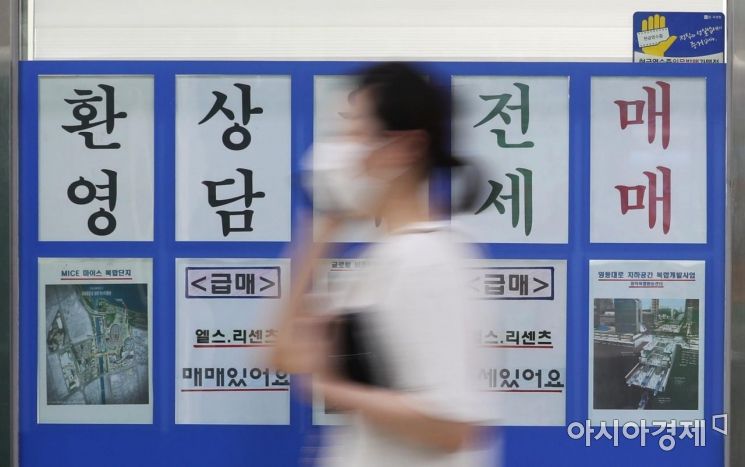
 On the 19th, the government decided to lower the jeonse-to-monthly rent conversion rate from the existing 4% to around 2.5%. Hong Nam-ki, Deputy Prime Minister and Minister of Economy and Finance, stated at the related ministers' meeting on real estate market inspection that the current 4% conversion rate could accelerate the trend toward monthly rent and increase the burden on tenants, leading to this decision. The photo shows a real estate agency in Jamsil, Seoul on the same day. Photo by Moon Honam munonam@
[Asia Economy Reporter Kim Hyemin] The so-called 'Jeonwolse Prohibition Act,' which imposes a 2-3 year mandatory residence period on newly supplied apartments in private residential areas subject to the price ceiling system, has raised concerns about a rental housing shortage. Experts say there will be no immediate impact, but the rental housing shortage could worsen three years after move-ins begin.
The core of the recently passed amendment to the 'Housing Act Enforcement Decree' is to apply a mandatory residence period of 2 to up to 5 years to apartments subject to the price ceiling system that apply for recruitment announcement approval after the 19th. Previously, this regulation applied only to public supply apartments, but going forward, private supply within public land and apartments in private residential areas will also require buyers to move in after completion for a certain period.
The intention is to prevent speculation aiming for prices lower than market value, but the market perceives it as a 'Jeonwolse Prohibition Act' since rental listings of new apartments will be locked during the mandatory residence period.
Experts believe the rental market is unlikely to react immediately to the implementation of the system due to the roughly three-year gap between supply and move-in. Park Wongap, Senior Real Estate Specialist at KB Kookmin Bank, said, "Rentals require the actual property to appear for people to move, and prices or sentiment are not reflected in advance."
However, from tenants' perspectives, the so-called 'move-in wave' effect can no longer be expected, inevitably affecting supply and demand in the mid to long term. Previously, when new apartments moved in, a large number of rental listings would temporarily flood the market, lowering surrounding rental prices for 3 to 6 months, but this effect is now difficult to expect.
Yeo Kyunghee, Senior Researcher at Real Estate 114, predicted a worsening rental supply and demand situation due to the new system, saying, "It was customary for many new apartment residents to rent out their units to cover insufficient funds." She added, "Existing apartment owners are also shifting rental listings to semi-rent or monthly rent, and considering many tenants prefer Jeonse, the rental market could become more difficult."
Park also said, "The previous formula of first Jeonse then move-in in the homeownership ladder has been broken," adding, "The notion that rental prices are cheap in newly moved-in complexes will become a thing of the past, and rental prices in popular areas will decrease significantly, making the rental market stabilization effect minimal."
Opinions were divided on the circulation effect due to the increase in supply itself. Yoon Jihae, Senior Researcher at Real Estate 114, said, "Unlike now, supply will be smooth in three years, so the Jeonwolse market may be relatively stable." However, Professor Kwon Daejung of Myongji University’s Department of Real Estate said, "The expectation that when buyers move in, their previous residences will be listed for sale or rent, creating a circulation effect, is only an assumption in a situation where the number of households does not increase, but demand continues to rise as the number of households increases."
© The Asia Business Daily(www.asiae.co.kr). All rights reserved.

















