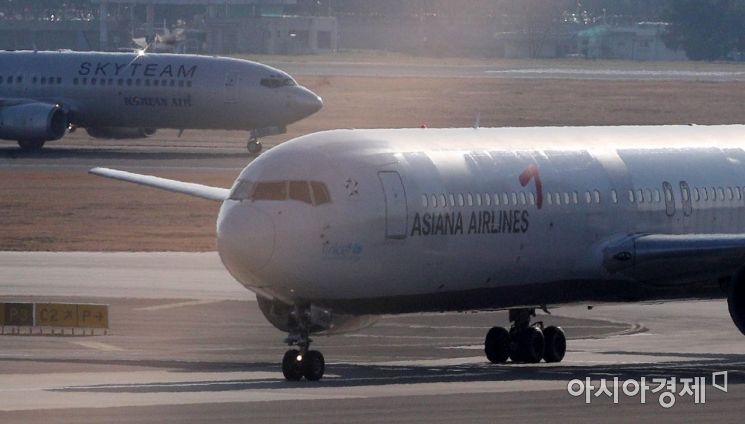
 As the court's decision on Korean Air's acquisition of Asiana Airlines approaches, on the 30th, Korean Air and Asiana Airlines passenger planes were moving toward the runway at Gimpo Airport apron in Gangseo-gu, Seoul. The Seoul Central District Court is expected to deliver a ruling today or tomorrow on the injunction request filed by the activist private equity fund KCGI against Hanjin KAL to prohibit the issuance of new shares. If the court dismisses the injunction request, the acquisition process will accelerate, but if the injunction is granted, the acquisition is likely to be canceled. Photo by Kim Hyun-min kimhyun81@
[Asia Economy Reporter Dongwoo Lee] Asiana Airlines managed to reduce its operating losses and performed well despite the impact of COVID-19.
Asiana Airlines announced on the 16th that its operating loss for last year, based on separate financial statements, was preliminarily estimated at 70.3 billion KRW. During the same period, sales amounted to 3.5599 trillion KRW, down 39.9% from the previous year, but the net loss decreased to 264.8 billion KRW compared to the previous year.
In the fourth quarter of last year, sales were 880.8 billion KRW and operating profit was 17 billion KRW, marking a profit for three consecutive quarters. Although sales decreased compared to the previous year (1.4413 trillion KRW), the operating loss (322.8 billion KRW) turned into a profit.
Asiana Airlines analyzed that the strong performance in the cargo sector compensated for the sluggish passenger demand.
The company explained that amid the ongoing global cargo supply shortage due to COVID-19, it actively expanded cargo transportation, resulting in a 64% increase in cargo sales compared to the previous year.
In particular, through regional cargo transport analysis, it transported IT products, pharmaceuticals, and personal protective equipment to the Americas, Europe, and Southeast Asia, recording sales of 2.1432 trillion KRW, setting a record high in the cargo sector.
The company actively utilized its geographic advantage centered on Northeast Asia and focused on operating flights departing from China and Southeast Asia and arriving in the Americas and Europe, which played a key role in its solid performance.
It actively transported masks and personal protective equipment produced in China and Southeast Asia to the Americas and Europe, and, supported by the rapid growth of the e-commerce market due to the spread of non-face-to-face culture, also worked hard to secure volumes of IT and electronic device components. Additional charter flights were deployed on the high-demand Americas routes, increasing sales on these routes by 86% compared to the previous year.
Asiana Airlines converted two A350-900 passenger aircraft into cargo planes and utilized some idle passenger aircraft exclusively for cargo, operating an additional total of 849 flights, resulting in sales of 88.5 billion KRW. The airline plans to convert two more A350-900 passenger aircraft into cargo planes in 2021.
Last year, the operation rate of international passenger regular flights decreased by 79% compared to the previous year, but the airline secured alternative routes through special charter flights and planned tourism products such as A380 flights around the Korean Peninsula, focusing on recovering passenger demand. Asiana Airlines plans to strategically expand routes in line with the pace of passenger recovery according to changes in the spread of COVID-19.
An Asiana Airlines official said, “Although the first quarter results temporarily slowed due to the impact of COVID-19, thanks to the employees who actively participated in self-help efforts to overcome the crisis, we were able to achieve profits for three consecutive quarters,” adding, “We hope that with the full-scale vaccination in 2021 and the easing of entry restrictions by country, passenger demand will recover and we can continue to maintain profitability.”
© The Asia Business Daily(www.asiae.co.kr). All rights reserved.

















