Workplaces with 4 or fewer employees
to comply with Labor Standards Act including 52-hour workweek and dismissal prohibition
Amendment submitted to Environment and Labor Committee
Ruling party and government face criticism over loss compensation system conflicting with disaster relief funds
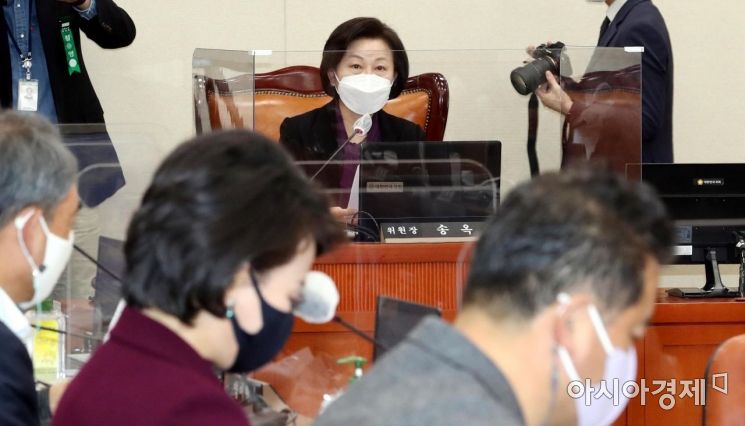 Song Ok-ju, Chairperson of the National Assembly Environment and Labor Committee, is presiding over the full committee meeting held at the National Assembly on the 14th. Photo by Yoon Dong-ju doso7@
[Asia Economy Reporter Koo Chae-eun] A bill to apply the Labor Standards Act to workplaces with four or fewer employees has been submitted to the National Assembly’s standing committee and is awaiting approval.
The current Labor Standards Act includes a clause that exempts workplaces with fewer than five employees from the law’s application. If this clause is removed, the Labor Standards Act will apply to all workplaces. However, there are strong concerns that this amendment could severely impact small business owners and micro-enterprises, which have been hit hard by COVID-19. Actual passage of the bill is expected to face difficulties.
According to the National Assembly on the 16th, the Environment and Labor Committee held a plenary meeting that day to submit the Labor Standards Act amendment bills proposed between September 29 and December 29 of last year. The contentious bills were respectively introduced by Kang Eun-mi of the Justice Party and Yoon Joon-byung and Lee Soo-jin of the Democratic Party of Korea.
The core of the bill is to expand the scope of the Labor Standards Act to workplaces with four or fewer employees. If this bill passes through the Environment and Labor Committee plenary meeting, the Legislation and Judiciary Committee, and the plenary session, workplaces with four or fewer employees will also be required to comply with the Labor Standards Act. This means adhering to restrictions on dismissal, a 52-hour workweek, a 50% premium on ordinary wages for overtime, night, and holiday work, as well as provisions for annual leave and vacation pay.
In her explanation of the bill proposal, Representative Kang said, "In workplaces with fewer than five employees, even if workers suffer unfair dismissal, they cannot file for relief, and workplace harassment prohibitions do not apply. Even if deaths from overwork increase, overtime restrictions cannot be enforced, and pregnant or postpartum workers may be forced to perform dangerous tasks," adding, "These are workers in the most vulnerable environments due to the prolonged COVID-19 pandemic."
The opposition party also supported the bill in December last year, increasing the likelihood of its passage. Members of the People Power Party stated in a position paper at the time, "We support applying the Labor Standards Act to workplaces with fewer than five employees," and added, "Small business owners are also vulnerable, so protective measures for them are necessary."
The key issue is that this conflicts with the government and ruling party’s efforts to legislate a loss compensation system and provide the fourth round of disaster relief funds to protect small business owners. A National Assembly Environment and Labor Committee official said, "If the scope of the Labor Standards Act is set to four or fewer employees, the impact on the self-employed ecosystem will be significant, and the interests involved are highly sensitive, so the deliberation process is expected to be difficult."
Meanwhile, according to an analysis by the Korea Labor Institute last year based on Ministry of Employment and Labor data, as of 2018, the number of workers in workplaces with fewer than five employees was approximately 4.55 million, accounting for 28% of all workers. Labor groups estimate that the actual number of affected workers could be much higher, reaching around 6 million.
© The Asia Business Daily(www.asiae.co.kr). All rights reserved.
![Clutching a Stolen Dior Bag, Saying "I Hate Being Poor but Real"... The Grotesque Con of a "Human Knockoff" [Slate]](https://cwcontent.asiae.co.kr/asiaresize/183/2026021902243444107_1771435474.jpg)
















