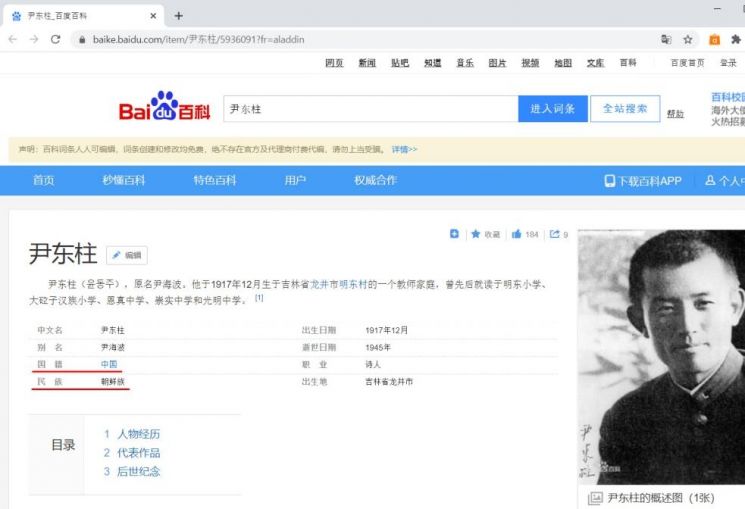
 Nationality and Ethnicity of Yun Dong-ju in Baidu Encyclopedia of China [Image source=Professor Seokyung Deok's Facebook]
[Asia Economy Intern Reporter Kim Choyoung] It was confirmed on the 16th that the Chinese encyclopedia site 'Baidu' still lists poet Yun Dong-ju's nationality as 'China (中國)' and his ethnic group as 'Joseonjok (朝鮮族)'. Although this fact became known last December and public opinion surged demanding corrections, Baidu has yet to take any corrective action.
Professor Seo Kyung-deok of Sungshin Women's University announced on the 16th via his Facebook that he sent a protest email to Baidu demanding the correct revision of the nationality and ethnicity listings of Korean independence activists including Yun Dong-ju, which were inaccurately stated.
Currently, Baidu lists not only Yun Dong-ju but also Lee Bong-chang and Yun Bong-gil's nationality as 'Joseon (朝鮮)' and their ethnic group as 'Joseonjok (朝鮮族)'.
Additionally, the nationalities of Yu Gwan-sun, Kim Gu, Ahn Chang-ho, Lee Hoe-young, and Hong Beom-do are correctly listed as 'Korea', but their ethnicities are not specified. Shin Kyu-sik has no nationality entry, and Lee Dong-nyeong has neither nationality nor ethnicity entries.
Previously, Professor Seo had requested corrections from Baidu on December 30th last year, coinciding with Yun Dong-ju's birthday. However, as no corrections were made even by today, the anniversary of Yun Dong-ju's death, he has made a renewed request.
Professor Seo emphasized, "Instead of only expressing anger at China's distortion of history, it is more important to accurately inform what is wrong and take measures to ensure proper corrections."
He also pointed out that at the entrance of Yun Dong-ju's birthplace village in Yongjeong, Yanbian Korean Autonomous Prefecture, Jilin Province, China, there is a sign reading 'Chinese Joseonjok Patriotic Poet', and that the Chinese version of the online encyclopedia Wikipedia introduces historical figures such as King Sejong and Kim Gu, as well as Hallyu stars like Kim Yuna and Lee Young-ae, as 'Joseonjok'.
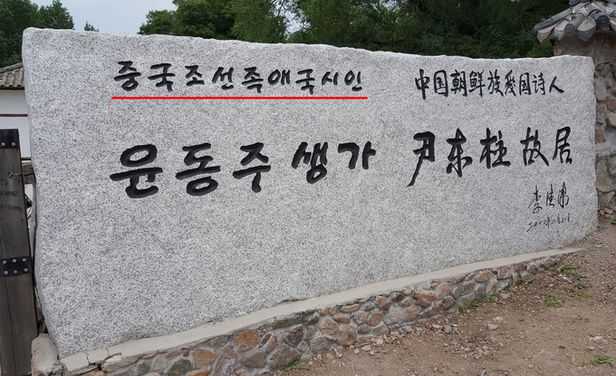 Entrance marker stone of Yun Dong-ju's birthplace in Yongjeong Village, Yanbian Korean Autonomous Prefecture, China [Image source=Professor Seokyungdeok's Facebook]
Meanwhile, Baidu, China's largest internet site, sparked controversy last December by publishing content claiming that kimchi originated in China. At that time, Professor Seo sent a protest email, and the problematic phrase was deleted.
As cases of China claiming Korea's unique culture as their own have recently occurred repeatedly, various efforts are actively underway domestically to promote Korean culture worldwide. Some voices are calling for the government to take a more proactive stance.
© The Asia Business Daily(www.asiae.co.kr). All rights reserved.


















