[Asia Economy Reporter Eunmo Koo] In the second year of 5G commercialization, the average revenue per user (ARPU) of domestic mobile carriers, which was expected to rise, remained stagnant last year. Although wireless communication revenue is expected to increase this year along with the continuous growth of 5G service subscribers, the rise in ARPU is expected to be limited.
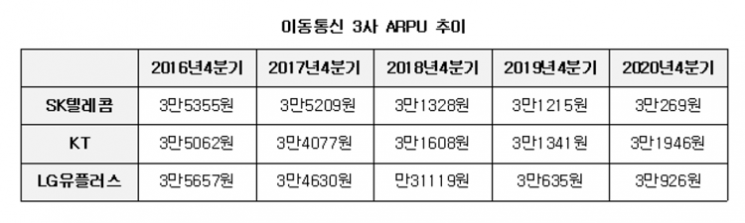
According to the industry on the 16th, SK Telecom's ARPU in the fourth quarter of last year was 30,269 KRW, up 0.7% quarter-on-quarter but down 3.0% year-on-year. During the same period, KT and LG Uplus also prevented a decline in ARPU but showed sluggish performance with increases of around 1%. KT's ARPU was 31,946 KRW, up 1.0% quarter-on-quarter and 1.9% year-on-year, while LG Uplus recorded 30,926 KRW, up 0.7% quarter-on-quarter and 0.9% year-on-year. Despite being the second year of 5G commercialization, ARPU has remained flat, raising concerns about ARPU this year. The mid-to-low priced 5G plans competitively introduced by the three carriers recently could lead to a decline in ARPU.
Contrary to concerns, the probability of ARPU falling due to the launch of low-priced 5G plans is considered low. Rather, it is analyzed that revenue for carriers is likely to increase as subscribers of low-priced 3G and LTE plans rapidly migrate to 5G. Hongshik Kim, a researcher at Hana Financial Investment, explained, “Considering the basic data allowance, it is unlikely that subscribers of high-priced 5G plans will downgrade their plans. Given that domestic 3G and LTE subscribers mainly use plans priced between 20,000 and 40,000 KRW, excluding unlimited LTE plans, the launch of mid-to-low priced 5G plans will be another catalyst for ARPU growth due to the shift to 5G.” KT also stated in its earnings conference call on the 9th that “As LTE mid-to-low priced plan subscribers move to 5G mid-to-low priced plans, the overall 5G subscriber penetration rate will expand,” forecasting about 3% ARPU growth this year.
However, the increase is expected to be limited. Even if LTE low-priced plan subscribers switch to 5G low-priced plans, dramatic revenue growth is difficult to expect. Jaemin Ahn, a researcher at NH Investment & Securities, said, “The ARPU increase this year is expected to be around 1-2% year-on-year. Demand for high-priced 5G plans seems to have already been largely absorbed into 5G, and customers who used low-priced LTE plans will not significantly raise the overall average even if they switch to 5G.”
Although wireless revenue is increasing, the rise in relatively inexpensive second device lines is also a factor limiting the growth. ARPU is calculated by dividing wireless revenue by the number of wireless lines. Recently, demand for second devices and Internet of Things (IoT) devices has increased alongside traditional mobile phones, leading to a rising number of lines. However, since the fees for these devices are less than 10,000 KRW per month, they negatively affect ARPU growth. Among the three carriers, SK Telecom, the only one whose ARPU declined, had 3,773,567 IoT lines as of the end of last year, an 18.4% (585,867 lines) increase year-on-year?the largest growth rate among competitors.
While some voices argue that the value of ARPU has diminished due to the diversification of wireless line components, there is no disagreement that it remains a meaningful comparative indicator. This is because the market trusts that an increase in mobile revenue ultimately leads to profit growth. Over the past 20 years, fluctuations in mobile ARPU have shown a clear correlation with telecom stock prices. When mobile ARPU rises, stock prices go up; when ARPU falls, stock prices decline or stagnate. Researcher Kim explained, “Operating expenses are variables that telecom management can control, whereas mobile ARPU is not easily increased due to the environment.”
© The Asia Business Daily(www.asiae.co.kr). All rights reserved.

















