Yellen "Economic Recovery Comes Before Debt and Inflation Control"
No Inflation Occurred Even After Overcoming the 2008 Financial Crisis
NYT, "Despite Some Concerns, Inflation Is Not Seen as Highly Likely"
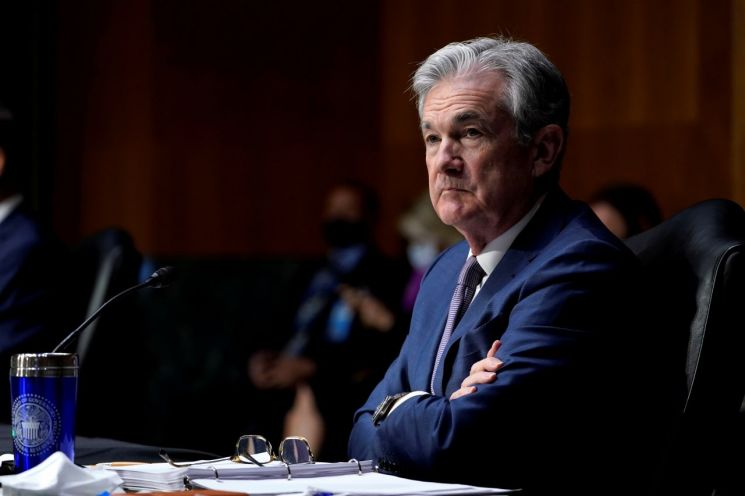
[Asia Economy Reporter Kim Suhwan] As the Biden administration in the United States pushes for the passage of a massive $1.9 trillion (approximately 2,100 trillion KRW) economic stimulus package, concerns about inflation have been raised, but the U.S. Federal Reserve (Fed) is expected to continue its aggressive 'money printing' policy. The Fed views the risks of rising prices as short-term and prioritizes boosting economic growth over controlling inflation.
On the 15th (local time), The New York Times (NYT) analyzed that "the Biden administration and Fed Chair Jerome Powell will focus on raising economic growth through aggressive fiscal deficit policies such as zero interest rate policy."
According to the NYT, the Fed expects that supplying massive liquidity to the market through debt will not lead to inflationary pressure. It sees little chance of a 'stagflation' phenomenon, where recession and inflation occur simultaneously as in the 1970s.
Therefore, there is speculation that the Fed is unlikely to shift to tightening policies such as interest rate hikes or tapering (reducing bond purchases) in the near term. According to The Wall Street Journal (WSJ), on the 10th, Fed Chair Powell attended an online seminar and stated, "Wages and employment are recovering without inflation," and "Do not expect rapid or long-term inflation." He dismissed concerns about the possibility of inflation raised by some.
U.S. Treasury Secretary Janet Yellen also appeared on CNN on the 7th and said, "Low-wage earners, minorities, and women are suffering the most, and long-term recessions could cause damage that is difficult to recover from," emphasizing that economic recovery should take precedence over debt and inflation management. She also countered criticism that President Biden's stimulus plan would fuel inflation by saying the government can manage it.
Some voices argue that the scale of the Biden administration's stimulus package is excessive and that inflation control policies should be implemented concurrently. Former Treasury Secretary Larry Summers wrote in an editorial for The Washington Post (WP) on the 5th, "President Biden's stimulus package is excessively large compared to the loss of national income caused by COVID-19," and warned, "There is a risk of inflationary pressure not experienced in decades."
In fact, as of the 12th, the 10-year U.S. Treasury yield recovered to 1.21%, the pre-COVID-19 level, and the 30-year yield exceeded 2%, reaching the 2% range for the first time since February last year, reflecting increased inflation expectations in the bond market. Especially this month, the breakeven inflation rate, calculated by subtracting the yield of 10-year Treasury Inflation-Protected Securities (TIPS) from the 10-year Treasury yield, rose to 2.21%, marking the highest level since 2014.
Nevertheless, the background behind the Biden administration and the Fed's aggressive fiscal policies is interpreted as lessons learned from overcoming the 2008 financial crisis. The $800 billion stimulus package pushed by the Obama administration was criticized by Republicans and conservative economists as excessively large. However, it did not lead to actual inflation and was instead evaluated as a passive stimulus that slowed the recovery of the middle class.
The Fed is also cautious about shifting to tightening policies due to trauma from the 'taper tantrum' in 2013, when the announcement of tapering caused a sharp rise in Treasury yields and a plunge in emerging market stocks and currencies, throwing global financial markets into chaos.
The NYT reported, "Even after overcoming the 2008 financial crisis, the average inflation rate did not consistently meet the Fed's target inflation rate of 2%," and "The Biden administration is currently confident that the economy will recover after COVID-19 without leading to excessive inflation."
Experts also agree that while short-term price increases may occur, concerns that this will lead to prolonged inflation over several years lack sufficient basis. Citing experts, the NYT stated, "Costs for clothing, airlines, and hotels may surge after economic recovery," but "prices of electronics and home appliances, such as computers, which saw increased demand due to the rise of remote work during COVID-19, will fall again, stabilizing overall prices."
© The Asia Business Daily(www.asiae.co.kr). All rights reserved.
![Clutching a Stolen Dior Bag, Saying "I Hate Being Poor but Real"... The Grotesque Con of a "Human Knockoff" [Slate]](https://cwcontent.asiae.co.kr/asiaresize/183/2026021902243444107_1771435474.jpg)











