Applied to complexes recruiting residents from the 19th onward
Applicable throughout Seoul...Mandatory residence for 2-5 years after move-in
Violation punishable by up to 1 year imprisonment or a 10 million won fine
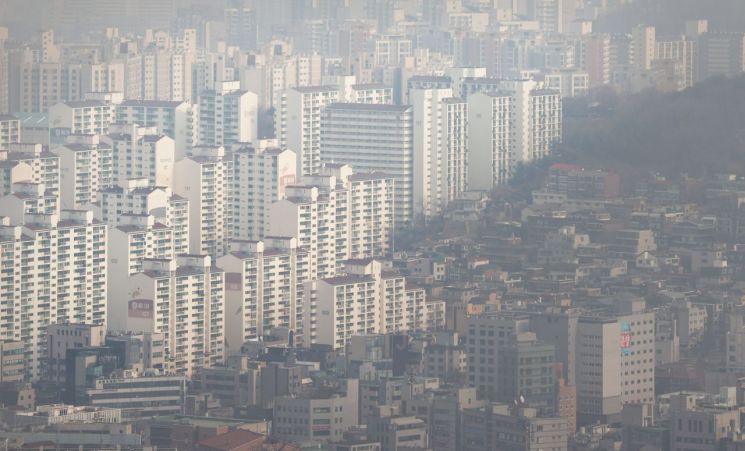
[Asia Economy Reporter Moon Jiwon] Starting from the 19th, those who purchase apartments subject to the price ceiling system in the metropolitan area must reside in them for up to five years after completion. While the intention is to restructure the sales market to focus on actual residents, concerns are being raised that the barrier to subscription will become higher for non-homeowners with insufficient funds.
On the 16th, the government approved an amendment to the Housing Act Enforcement Decree at the Cabinet meeting. The amended enforcement decree will apply to complexes that apply for resident recruitment announcements from the 19th onward.
With this amendment, a so-called "Jeonwolse Prohibition Act" imposing a mandatory residence period on residents will be introduced for metropolitan area housing subject to the price ceiling system. In Seoul, the entire area is subject to mandatory residence.
The mandatory residence period is five years if the sale price on public land is less than 80% of the nearby market price, and three years if it is between 80% and less than 100%. For private land, it is three years if less than 80% of the nearby market price, and two years if between 80% and less than 100%.
Accordingly, new apartment buyers entering after 2023 will, in principle, not be allowed to rent out their units as jeonse or monthly rent at the time of move-in. Violations without justifiable reasons will result in imprisonment of up to one year or a fine of up to 10 million won. Apartments purchased must also be sold back to the Korea Land and Housing Corporation (LH) at the sale price.
However, during the mandatory residence period, exemptions may be granted upon confirmation by LH or others if there are unavoidable reasons such as overseas stay for work, livelihood, schooling, or medical treatment, or if all household members reside in another housing construction area.
The amendment also includes provisions that exclude small-scale housing maintenance projects from the price ceiling system if LH or others participate as implementers in maintenance areas smaller than 20,000㎡ or with fewer than 200 households, and if at least 10% of the total households are constructed as rental housing.
Additionally, resale restrictions on housing specially supplied to employees of institutions relocating to the Administrative City will be strengthened. In speculative overheated districts, resale restrictions will increase from 5 to 8 years, and in other areas from 3 to 5 years.
The Cabinet also passed an amendment to the Enforcement Decree of the Act on the Recovery of Excessive Profits from Reconstruction, which lowers the burden of excess profits for reconstruction promotion associations.
Excess profits from reconstruction are calculated as the difference in price before and after reconstruction: 'housing value at the end point - {(housing value at the start point + normal housing price increase + development costs)}'.
Previously, the housing value at the end point increased due to annual official price rises, causing excessive burdens on associations. The amendment reduces this burden by applying the official price rate at the project completion time to the housing value at the start point as well.
© The Asia Business Daily(www.asiae.co.kr). All rights reserved.

















