'Minimizing Blind Spots' Speeding Up 4th Disaster Relief Fund
Expected to Exceed 9.3 Trillion of 3rd Round
Democratic Party Key Official "Will Prepare for Side Effects of Market Interest Rate Rise Due to National Debt Issuance"
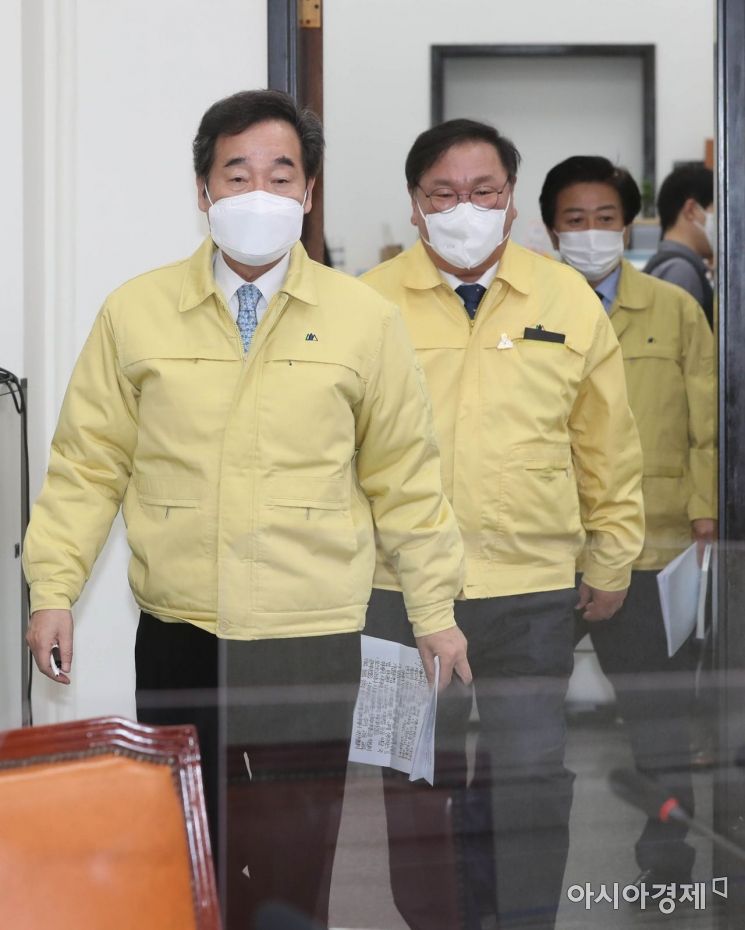 Lee Nak-yeon, leader of the Democratic Party of Korea, and Kim Tae-nyeon, floor leader, are attending the Supreme Council meeting held at the National Assembly on the 15th. Photo by Yoon Dong-ju doso7@
[Asia Economy Reporter Koo Chae-eun] The major obstacle to the selective distribution of the 4th disaster relief fund is expected to be the future financing methods, such as government bond issuance. The ruling party's stance has shifted to 'select first, universal later' for the recipients, but they believe that the beneficiaries and the scale should be larger than the 3rd round. Even if they go with selective distribution, issuing deficit government bonds is inevitable.
On the 15th, a key official from the Democratic Party said, "We see government bond issuance as an unavoidable part," adding, "We will carefully review the side effects such as rising market interest rates through simulations with the fiscal authorities."
The Democratic Party is united in the view that the scale and recipients of the 4th disaster relief fund should be expanded. Lee Nak-yeon, leader of the Democratic Party of Korea, stated at the Supreme Council meeting, "As the pain of the affected and vulnerable groups due to (COVID-19) has increased, I demanded the government to provide stronger support." Kim Tae-nyeon, floor leader of the Democratic Party, also mentioned, "At yesterday's high-level party-government meeting, we agreed on the principle of minimizing blind spots in the 4th disaster relief fund."
The background behind the Democratic Party's retreat from a combined selective + universal support to prioritizing selective support is interpreted as the heavy burden of securing funds and avoiding exposure of conflicts between the party and government. A Democratic Party official said, "Since coordination with the fiscal authorities is necessary, discussions are ongoing," adding, "The main principle is to expand the recipients compared to the 3rd (disaster relief fund) and eliminate blind spots."
The problem is that even if they proceed with selective support, securing funds remains a difficult task. Currently, the ruling party plans to secure some funds by adjusting parts of the unused budget and the rest through government bond issuance. However, due to the large expenditures on the 3rd disaster relief fund and vaccine advance payments since last month, the remaining contingency fund for this year is about 2 trillion won.
This is because of the large spending on the 3rd disaster relief fund and vaccine advance payments since last month. Ultimately, the proportion of funds raised through government bond issuance, which is 'national debt,' may increase. In particular, the scale of the 4th disaster relief fund is expected to exceed the 9.3 trillion won of the 3rd round and even the 14.3 trillion won of the 1st round.
If large-scale government bond issuance proceeds, side effects such as 'increase in government bond issuance → decline in bond prices → rise in market interest rates → increase in loan interest rates' may occur. The party leadership also openly expressed such concerns. At the Supreme Council meeting, Kim Jong-min, a Supreme Council member, said, "While reviewing expenditure restructuring, large-scale government bond issuance should be handled urgently through a procedure that seeks public consent," adding, "Active party-government consultations are necessary."
© The Asia Business Daily(www.asiae.co.kr). All rights reserved.
![User Who Sold Erroneously Deposited Bitcoins to Repay Debt and Fund Entertainment... What Did the Supreme Court Decide in 2021? [Legal Issue Check]](https://cwcontent.asiae.co.kr/asiaresize/183/2026020910431234020_1770601391.png)
















