Military Blocks Internet and Deploys Armored Vehicles
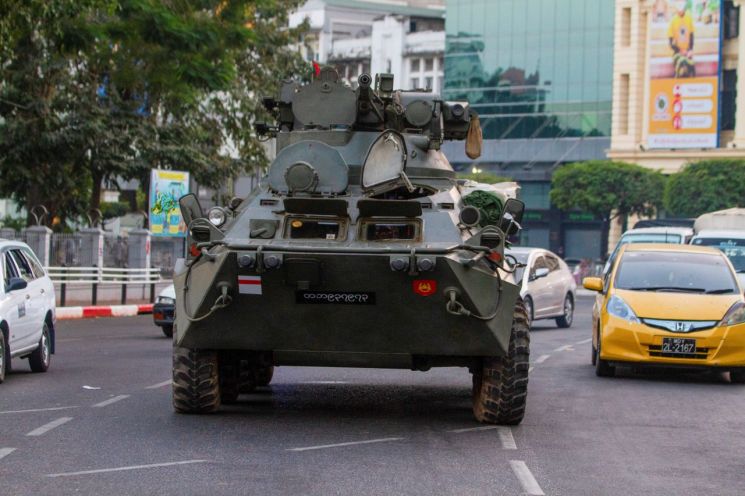
[Asia Economy Reporter Cho Hyun-ui] As protests against the coup continue in Myanmar, the military has cut off the internet and deployed armored vehicles in major cities, including the largest city Yangon. This is interpreted as the military taking a hardline stance as the detention deadline for State Counsellor Aung San Suu Kyi approaches.
Network monitoring organization NetBlocks reported on the 15th (local time) that Myanmar's internet has been virtually completely cut off since 1 a.m. Myanmar's internet access rate reportedly dropped to 14% of normal levels. Currently, the four major telecommunications networks in Myanmar are inaccessible. The British daily The Guardian reported, "It is impossible to connect with people in Myanmar via email or messenger applications."
Since the military coup on the 1st, young people in Myanmar have been posting photos and videos of military and police violence on social media. In fact, images of military armored vehicles deployed and troops firing at protesters in major cities such as Yangon, Myitkyina, and Sittwe spread on social networking services (SNS) the day before.
The situation is serious enough for the military to resort to internet shutdowns. According to local media such as Myanmar Now, three armored vehicles appeared in downtown Yangon the previous afternoon. This was the first appearance in 14 days since the coup on the 1st. The U.S. Embassy in Myanmar also urged its citizens to stay at home.
Signals indicating that tensions have reached a peak also emerged in various places. Major foreign media reported that the military fired water cannons and firearms to disperse protesters near a power plant in northern Kachin State the day before. However, it is unclear whether the firearms used were rubber bullets or live ammunition, and whether there were any casualties.
The military's hardline response was also influenced by the approaching legal deadline to detain State Counsellor Suu Kyi, who is under house arrest. Myanmar police charged Suu Kyi with using illegally imported wireless equipment without permission (violation of export-import laws) and decided to detain her until this day. This effectively created grounds for detention, with a maximum sentence of three years in prison if convicted. There are rumors locally that the military government is considering charging Suu Kyi with treason.
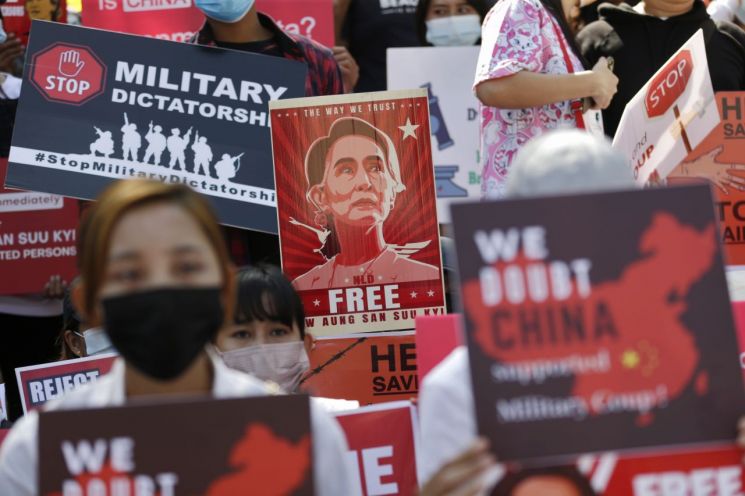
Protests against the coup continued across Myanmar on the same day. Protesters demanded the release of State Counsellor Suu Kyi and other civilian government officials and called for an end to nighttime abductions of democracy activists. Embassies of 11 Western countries, including the European Union (EU), the United Kingdom, and Canada, issued a statement the day before urging "restraint from violence against protesters and civilians."
© The Asia Business Daily(www.asiae.co.kr). All rights reserved.


















