[Monthly Defense Times Editor-in-Chief An Seung-beom] Since the Marawi Battle from May to October 2017, which resulted in 168 casualties, the Philippines has been accelerating the acquisition of new weapons to enhance its military capabilities.
The Air Force is strengthening its close air support (CAS) and transport aircraft capabilities. For CAS, it acquired six Brazilian-made A-29 Super Tucano light attack aircraft by the end of 2020, bolstering its air support capabilities for counter-guerrilla operations. These complement the 12 FA-50 Golden Eagle light fighters, which are considered high-grade assets in the Philippine Air Force.
Regarding transport aircraft, the Philippines received one C-130H transport aircraft from the United States at the end of January, addressing difficulties experienced in troop and ammunition transport during the 2017 conflict. An additional aircraft will be procured to establish a fleet of six medium transport aircraft.
For rotary-wing assets, six S-70i Black Hawk utility helicopters were introduced at the end of 2020, with plans to acquire ten more. This will help alleviate previous shortages that hampered the transport of ammunition and casualties. Additionally, two AH-1S Cobra attack helicopters were procured, and crew training has begun, with plans to form units through further acquisitions.
Notably, under U.S. leadership, the Philippines quickly secured surveillance and reconnaissance capabilities following strike capabilities. The country operates two Cessna 208B light reconnaissance aircraft, four Israeli-made Hermes 450/900 medium-altitude unmanned reconnaissance systems, and ScanEagle unmanned reconnaissance drones.
The Navy received the second Jose Rizal-class frigate, ordered from Hyundai Heavy Industries, on February 5. The first phase of the Philippine Navy’s surface ship modernization is nearing completion, with a second phase planned to include six Australian OPVs (Offshore Patrol Vessels), nine Israeli fast patrol boats, and two Indonesian-made LPD (Landing Platform Dock) amphibious ships.
Maritime aviation assets include five TC-90B small patrol aircraft acquired from Japan and two Wildcat maritime operation helicopters. Subsequently, eight TC-12B small patrol aircraft were procured from the United States, with five more planned. The Navy also secured eight ScanEagle unmanned reconnaissance drones to strengthen interdiction of insurgent infiltration or escape by sea. These new surface ships and small patrol aircraft enhance the capability to monitor the Chinese Navy’s movements near Philippine waters. The Philippine Navy has requested additional Pohang-class patrol ships, which were donated by the Republic of Korea Navy. Although the Pohang-class is considered outdated by the ROK Navy, it is suitable for coastal surveillance in the Philippines.
The Army received 100 TOW 2A anti-tank missile launchers as U.S. military aid at the end of November 2020. The Philippine Army, which faced difficulties eliminating insurgents entrenched in concrete buildings during the 2017 Marawi urban battle, highly valued the TOW 2A missiles, which played a decisive role in battles such as the elimination of Saddam Hussein’s sons during the Iraq War.
However, in January 2021, the light tank and armored vehicle procurement project led by Israeli Elbit Systems was a regrettable opportunity for domestic defense companies.
Elbit Systems secured a contract for 12 truck-mounted 155mm self-propelled artillery pieces (ATMOS) scheduled for delivery in 2022, along with 18 Ascod Sabra light tanks armed with 105mm main guns, 10 Pandur 2 8×8 wheeled armored vehicles equipped with 105mm turrets, and 28 Guarani 6×6 wheeled armored personnel carriers, all procured simultaneously. Command and recovery vehicles are to be acquired separately. Korean defense companies participated with the K808 and Tigon but were reportedly eliminated early due to price competition.
Nevertheless, opportunities remain for Korean defense firms.
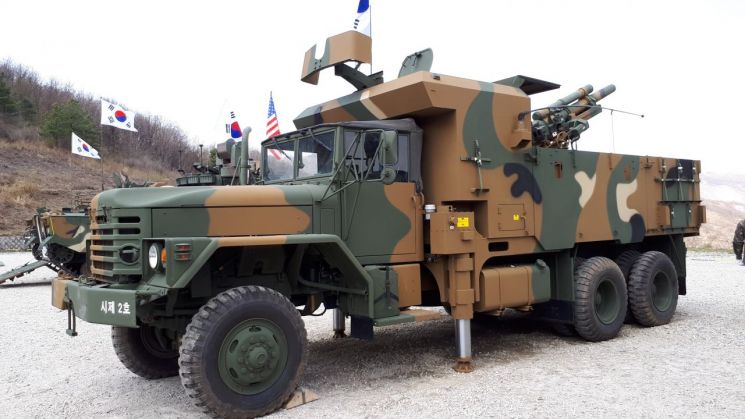
Hanwha Defense is exploring the introduction of the K105A1 105mm truck-mounted self-propelled howitzer, integrating the truck and fire control system, to enhance urban combat capabilities based on the Philippine military’s experience using 105mm towed howitzers to devastate insurgents. This is expected to be a highlight at the upcoming ADAS 2021 Philippine Defense Industry Exhibition scheduled for this summer.
There is also a possibility that the Philippines will request local modification and mass production of 118 M101 105mm towed howitzers, originally acquired through U.S. military aid in the late 1950s. Although 155mm truck-mounted self-propelled artillery is the current trend, Korea’s 105mm truck-mounted self-propelled howitzer is a competitively suitable defense product for the Philippine Army’s requirements. The donation of the K136 Kuryong 130mm multiple rocket launcher can be seen as a preliminary step toward exporting the K105A1.
© The Asia Business Daily(www.asiae.co.kr). All rights reserved.

















