[Asia Economy Reporter Suyeon Woo] As Samsung Electronics recently considers expanding its semiconductor foundry plant in the United States, interest in Austin, Texas, a leading candidate site, is growing. Austin is gaining attention as a new settlement for global tech companies, promoting itself as the "post-Silicon Valley" with abundant human resources, low taxes and living costs, and tech-friendly policies.
According to the Austin Chamber of Commerce on the 14th, 39 global companies, including IT firms, relocated their headquarters to Austin, Texas, as of last November. In July last year, Tesla, the world's number one electric vehicle company, confirmed the establishment of a Cybertruck production base, and in December, global software company Oracle decided to move its headquarters from Redwood City in Silicon Valley to Austin.
This year, Digital Realty, the world's second-largest data center company, announced plans to relocate its headquarters to Austin. In addition, CEOs of global tech companies such as Elon Musk of Tesla, Drew Houston of Dropbox, and Douglas Merritt of Splunk have announced plans to leave California and move to Austin, drawing attention.
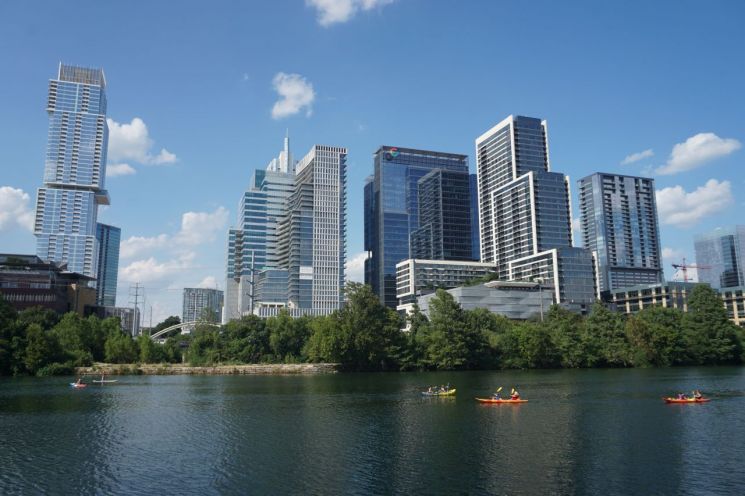
Austin, Ranked No.1 Most Livable US City... Attracting Young Talent
The reasons Austin is gaining attention as the "next-generation Silicon Valley" include affordable housing and taxes compared to San Francisco, abundant human resources, advanced technology development, and pristine natural environment. Additionally, it is analyzed that the increase in remote work due to COVID-19 has accelerated the "de-California" migration of workforce concentrated in Silicon Valley, California.
According to statistics from KOTRA and the US Census Bureau, Austin saw a net inflow of about 1,600 people per 10,000 population between 2010 and 2019, making it the US city with the highest net population inflow among the top 50 metropolitan areas. Among them, Austin is recognized as a city attracting young, highly educated, and quality human resources.
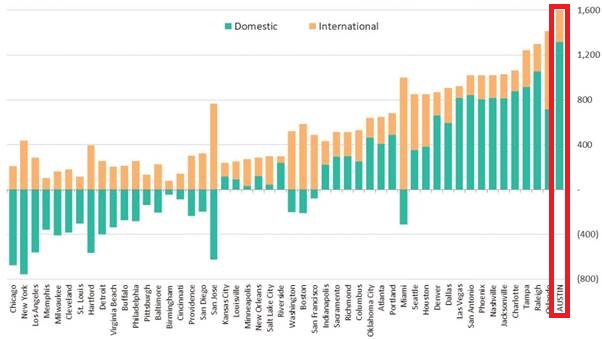 Net Population Inflow per 10,000 People by U.S. State, 2010-2019 (Unit: Number) / Source: U.S. Census Bureau, KOTRA
While the proportion of people aged 18 to 44 in the entire US population is 36%, Austin's is much higher at 43%, and the median age in the Austin area is 34.9 years, younger than the US city average of 38.2 years. Especially, prestigious universities such as the University of Texas and Baylor University are located around Austin, making it easy to secure excellent talent, and the proportion of the population aged 25 and over with a bachelor's degree is 46.2%, higher than the US average of 33.1%.
Another reason Silicon Valley companies choose to relocate to Austin is the affordable living costs and taxes. Silicon Valley near San Francisco is notorious for its exorbitant housing costs. According to the US Community and Economic Research Advisory Board, assuming the average living cost of US cities is 100, Austin's living cost is 99.3, below the average. In particular, housing costs in San Francisco are 364.8, more than three times that of Austin (104.3).
Samsung Electronics Considers Austin Expansion... Final Tax Negotiations Underway
Austin, nicknamed "Silicon Hills," is already home to global leading companies such as Samsung Electronics, 3M, Apple, Dell Technologies, Intel, Nvidia, IBM, and Oracle. Especially, Texas's proactive tax incentive policies are considered a decisive factor in attracting global companies.
Samsung Electronics, which established a semiconductor plant in Austin in 1998, is recently reviewing the expansion of its foundry plant. Major foreign media reported that Samsung Electronics is scouting for a new semiconductor plant site in the Austin area worth $17 billion (about 19 trillion KRW). Earlier, in October last year, Samsung Electronics purchased land near the Austin plant and completed the land-use change.
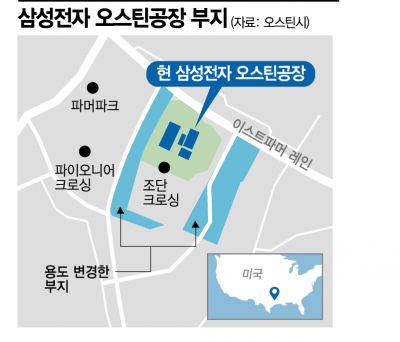
Recently, Samsung Electronics requested Austin city to reduce taxes by $805.5 million (about 900 billion KRW) over the next 20 years, conditional on additional facility investments. While other US states such as Arizona and New York are also actively courting Samsung, it is analyzed that Samsung Electronics is in final negotiations with Austin city, leveraging such tax benefit conditions.
According to local consulting firm Impact DataSource, if Samsung Electronics invests $17 billion, the direct and indirect economic effects generated in the Austin community are known to amount to a total of $8.6 billion (about 9.7 trillion KRW).
Texas's pro-business policy through unprecedented tax reductions has been effective in attracting leading global companies to Austin. Industry attention is focused on whether Austin city will accept Samsung Electronics' negotiation conditions and lead to the final investment. A Samsung Electronics official said, "We are reviewing multiple candidate sites for investment, and nothing has been decided yet."
© The Asia Business Daily(www.asiae.co.kr). All rights reserved.



















