Renewed Debate Over the Abolition of the Death Penalty Ignites Again
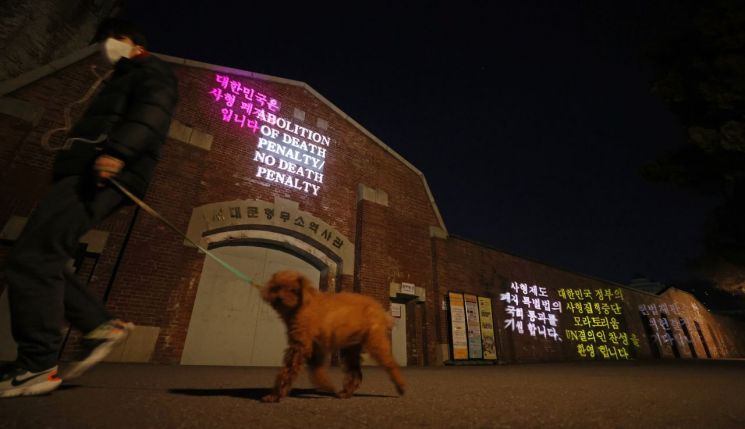 On November 30 last year, in front of the Seodaemun Prison History Hall in Seodaemun-gu, Seoul, representatives from the Joint Conference of Religious, Human Rights, and Civic Groups for the Abolition of the Death Penalty held a lighting performance urging the abolition of the death penalty.
 [Image source=Yonhap News]
[Asia Economy Reporter Lee Gwan-ju] As the Constitutional Court is expected to decide on the constitutionality of the death penalty within this year, social debate over the retention or abolition of the death penalty is reigniting. Following the government's first-ever support last year for the international community's 'Moratorium on the Death Penalty Resolution,' the National Human Rights Commission recently submitted an opinion to the Constitutional Court advocating for the abolition of the death penalty. Civic groups, including religious organizations and human rights organizations, are striving for the 'complete abolition' of the death penalty legally and institutionally, beyond just a suspension of executions.
However, opposition to the abolition of the death penalty remains strong. As heinous crimes against children continue, including the 16-month-old adopted child abuse death case in Yangcheon, Seoul (known as the 'Jung In case'), demands for severe punishment are also ongoing. In fact, on the Blue House's National Petition Board, posts requesting the death penalty for the perpetrators of the 'Jung In case' and the 'Dangjin sisters murder case' have garnered approximately 50,000 and 260,000 signatures respectively. Attention is focused on whether the long-standing social controversy over the death penalty will reach a conclusion this year.
The Death Penalty Returns to the Constitutional Court... Civic Society Strengthens 'Abolition' Movement
In February 2019, the Death Penalty Abolition Subcommittee of the Justice and Peace Committee of the Catholic Bishops' Conference of Korea filed a constitutional complaint regarding the death penalty. This is the third time the Constitutional Court has dealt with the death penalty. However, the most recent decision was 11 years ago in 2010, when the Court dismissed the request for unconstitutionality of the death penalty by a narrow 5-4 vote (upholding constitutionality).
Civic groups and religious organizations advocating for the abolition of the death penalty believe that times have changed and public consensus for abolition has expanded, making this year an opportune moment for complete abolition. International support has continued, with organizations such as Amnesty International, the International Commission Against the Death Penalty, and the European Union (EU) submitting official opinions to the Constitutional Court in favor of Korea abolishing the death penalty. Notably, in December last year, the Korean government supported the 'Moratorium on Executions Resolution' for the first time at the 75th United Nations General Assembly in New York, effectively declaring itself a de facto abolitionist country to the world.
The National Human Rights Commission is also lending support to the abolition movement. On the 3rd of this month, the Commission submitted an opinion to the Constitutional Court stating, "The death penalty infringes on the essential content of the right to life and must be abolished." The Commission emphasized, "Life, once lost, can never be restored and is an absolute value that cannot be exchanged for anything in this world. The right to life is the most fundamental of fundamental rights, and the state has only the duty to protect and guarantee it, not the authority to deprive it." Furthermore, it pointed out, "From the perspective of rehabilitation, one of the purposes of punishment, the death penalty is the only punishment that cannot achieve the goal of education and reform," and added, "There is a need to prepare various alternative measures that can achieve the policy objectives pursued by the penal system as a substitute for the death penalty."
Yoon Seong-yeo, Choi In-cheol, Jang Dong-ik: What If They Had Been Sentenced to Death?
Yoon Seong-yeo (54), who was wrongfully imprisoned for 20 years after being falsely accused as the true culprit in the 8th serial murder case of Lee Chun-jae, and Choi In-cheol (60) and Jang Dong-ik (63), who were wrongfully imprisoned for 21 years after being falsely accused of the 'Nakdong River Murder Case,' were all acquitted through retrials after 30 years. It was recognized that all of them had made false confessions due to harsh treatment by the police and other investigative agencies.
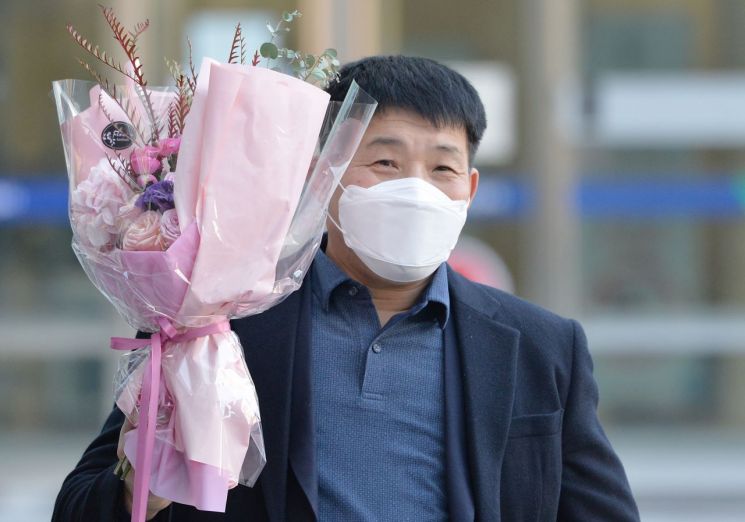 At the retrial sentencing hearing for the 8th serial murder case of Lee Chun-jae, retrial petitioner Yoon Sung-yeo was acquitted and is leaving the courtroom.
 [Image source=Yonhap News]
Another commonality among them is that they were sentenced to life imprisonment at their trials. Although history has no 'what ifs,' what if they had been sentenced to death and executed? They would never have been able to clear their names, and the truth of the cases would have been buried forever. Jang Dong-ik emphasized the fundamental principle of criminal procedure law, stating, "There should be no more people like me. Even if 100 true culprits are missed, we must not create one innocent person who suffers injustice."
This is one of the strongest arguments made by those advocating for the abolition of the death penalty: once the death penalty is carried out, the result cannot be reversed. The Joint Conference of Religious, Human Rights, and Civic Groups for the Abolition of the Death Penalty issued a statement on December 30 last year, marking 23 years since the suspension of executions, saying, "It is obvious that those who commit crimes must be caught and receive appropriate punishment," but also, "Our hope for the abolition of the death penalty is based on the belief that the state should not take life in the same brutal way as the crime itself, as a form of revenge." They added, "It is essential to carefully identify the root causes of crime and implement policies that reduce crime by resolving many contradictions in our society, thereby making our society safer."
The Difficult Path to Abolishing the Death Penalty... Overcoming Public Sentiment
The abolition of the death penalty is not expected to be easy. Public sentiment has consistently favored retaining the death penalty. According to a 2019 Realmeter poll, 51.7% supported carrying out executions, while 37.9% responded that executions should not be carried out but the system itself should be maintained.
Especially when heinous crimes occur socially, demands for executions increase significantly. Recently, petitions on the Blue House National Petition Board requesting the death penalty for the perpetrators of the 'Jung In case' and the 'Dangjin sisters murder case' received approximately 50,000 and 260,000 signatures respectively. This phenomenon is likely to repeat whenever incidents that provoke strong public outrage occur.
Meanwhile, executions in South Korea have not been carried out for over 23 years since the last executions of 23 death row inmates on December 30, 1997, at the end of the civilian government era. Currently, there are 60 'death row inmates' who have been sentenced to death but whose executions have not been carried out.
The most recent confirmed death sentence dates back five years. In the '22nd Infantry Division Shooting Incident' in 2014, Sergeant Lim Do-bin, who killed five people and injured seven, was sentenced to death by the Supreme Court in 2016. Subsequently, in 2019, the perpetrator An In-deuk (44) of the 'Jinju Apartment Arson and Murder Case' was sentenced to death in the first trial but had his sentence reduced to life imprisonment in the second trial, and the Supreme Court's final ruling maintained the number of death row inmates.
© The Asia Business Daily(www.asiae.co.kr). All rights reserved.


















