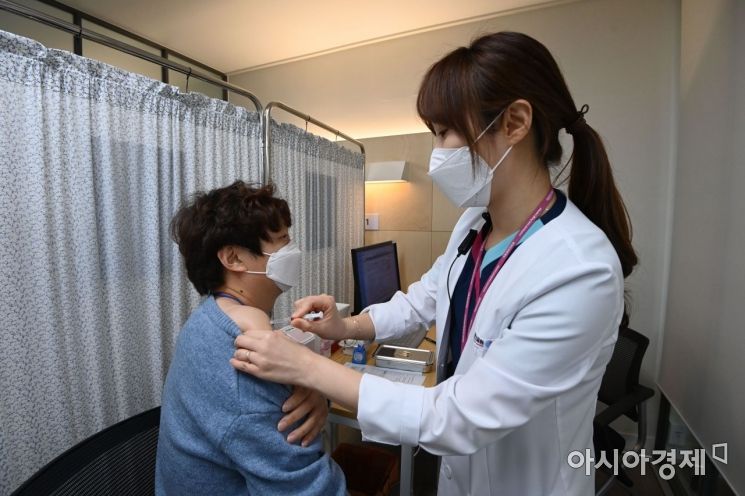
 On the afternoon of the 9th, medical staff administered vaccines to training participants during a mock vaccination drill held at the Comprehensive Cancer Vaccination Center of the National Medical Center in Jung-gu, Seoul. Photo by Joint Press Corps
[Asia Economy Reporter Lee Chun-hee] Following Pfizer, AstraZeneca's COVID-19 vaccine has been approved domestically, and with vaccination set to begin in earnest this month in South Korea, attention is also focused on the introduction schedules of other vaccines.
As of the 11th, the COVID-19 vaccines approved in South Korea are two types: Pfizer and AstraZeneca vaccines. In addition, the government has secured a total of 56 million doses of vaccines, including Janssen (Johnson & Johnson) and Moderna vaccines. Furthermore, discussions are underway to finalize a contract for 20 million doses of the Novavax vaccine. Globally, vaccinations are also being carried out with Russia's Sputnik V vaccine and China's Sinopharm and Sinovac vaccines.
The vaccine scheduled to be administered first domestically is the AstraZeneca vaccine. Detailed introduction and vaccination schedules have been announced. Of the 10 million doses the government plans to procure through a contract with AstraZeneca, 750,000 doses will arrive between the 24th and 28th of this month, be distributed nationwide starting on the 25th, and vaccinations will begin on the 26th.
Notably, these vaccines are not imported from overseas but are produced and distributed from SK Bioscience's factory in Andong, Gyeongbuk, which is entrusted with manufacturing. One of the advantages of the AstraZeneca vaccine is that it can be distributed under normal refrigeration conditions of 2?8 degrees Celsius, rather than requiring ultra-cold 'cold chain' logistics, increasing its usability for vaccination.
Initially, the government planned to introduce the Pfizer vaccine before the Lunar New Year holiday, and with special import approval granted on the 3rd, it was considered the leading candidate for the first vaccination. However, the vaccination schedule for Pfizer is expected to be somewhat delayed. Prime Minister Chung Sye-kyun stated that the domestic introduction of the Pfizer vaccine is "expected around late February or early March." Administrative procedures with Pfizer regarding supply and transportation plans remain, causing the introduction to be later than initially anticipated.
The doses in question are separate from the 10 million doses the government promised to procure from Pfizer last year and are being introduced through the global vaccine joint procurement project called the 'COVAX Facility.' The government plans to procure 10 million doses through COVAX, with 60,000 doses of Pfizer and 1.3 million doses of AstraZeneca to be supplied first.
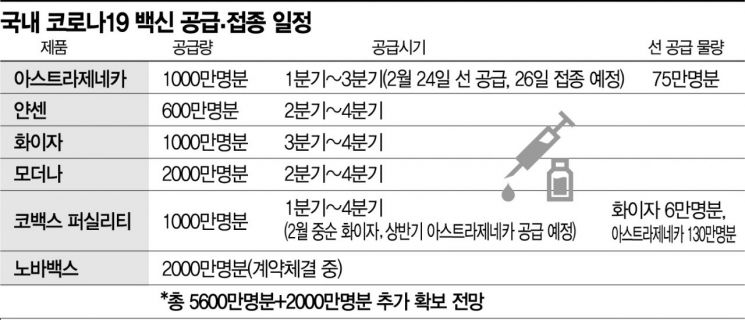
Besides the 10 million doses each from AstraZeneca and the COVAX Facility, the vaccines planned for the earliest introduction are Janssen (6 million doses) and Moderna (20 million doses), scheduled for the second quarter. Subsequently, the general supply of 10 million doses of Pfizer is expected to arrive domestically in the third quarter.
Additionally, the government is currently negotiating the procurement of 20 million doses of the Novavax COVID-19 vaccine, which is expected to be supplied as early as the second quarter.
© The Asia Business Daily(www.asiae.co.kr). All rights reserved.
![Clutching a Stolen Dior Bag, Saying "I Hate Being Poor but Real"... The Grotesque Con of a "Human Knockoff" [Slate]](https://cwcontent.asiae.co.kr/asiaresize/183/2026021902243444107_1771435474.jpg)

















