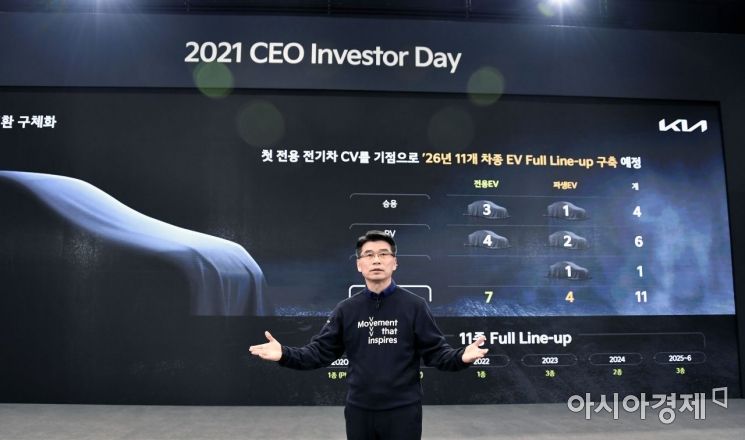
[Asia Economy Reporter Ki-min Lee] As major global automakers are announcing their electric vehicle (EV) business plans one after another, ushering in the so-called "Electric Vehicle Warring States Period," South Korea's leading automakers Hyundai Motor Company and Kia are also accelerating their transition to the EV business.
According to the industry on the 11th, Kia held its CEO Investor Day on the 9th and announced plans to establish a full lineup of 11 electric vehicles by 2026. Specifically, Kia, which has released derivative electric vehicles based on internal combustion engine vehicles until last year, plans to launch 7 dedicated electric vehicles by 2026 starting with the dedicated EV CV this year, and build a total lineup of 11 electric vehicles including 4 derivative EVs. Hyundai Motor Company also declared at its CEO Investor Day in December last year that it will stop selling internal combustion engine vehicles in major markets from 2040 and focus solely on selling electrified vehicles centered on hydrogen and electric vehicles.
Global automakers are also shifting away from internal combustion engine vehicles and focusing their capabilities on electric vehicle research and development (R&D) and lineup establishment. GM announced last month its plan to cease internal combustion engine vehicle business by 2035 and produce only electric vehicles. To this end, GM plans to invest $27 billion (approximately 30 trillion KRW) in R&D over the next five years. German automaker Daimler announced by 2022 it would release electric or hybrid models for each Mercedes-Benz model, and Volkswagen has announced plans to launch 75 electric vehicle models by 2029. Ford also plans to invest a total of $29 billion (approximately 32 trillion KRW) in electric and autonomous vehicles by 2025.
This trend is related to the eco-friendly policy directions of various countries accelerating the transition from internal combustion engine vehicles to electric vehicles. Norway aims to phase out internal combustion engines by 2025, the UK by 2035, and France by 2040. Japan also plans to focus on electric and hybrid vehicles for new cars starting in 2030. U.S. President Joe Biden’s executive order last month to replace government agency vehicles with electric vehicles produced in the U.S. is also interpreted as a measure to lead the transition away from internal combustion engines and the EV market. China is also recently exploring measures to promote electric vehicle adoption. According to local foreign media, the Chinese government is considering increasing EV adoption by exempting households without vehicles from license plate restrictions if they purchase eco-friendly vehicles such as electric cars, moving beyond the current policy of limiting annual license plate issuance to address air pollution problems in major cities.
The increasing demand for electric vehicles is also cited as a major factor accelerating automakers’ EV business. Market research firms expect the proportion of electric vehicles in the total automobile market to exceed 30% by 2030, and more than half by 2040.
© The Asia Business Daily(www.asiae.co.kr). All rights reserved.
![Clutching a Stolen Dior Bag, Saying "I Hate Being Poor but Real"... The Grotesque Con of a "Human Knockoff" [Slate]](https://cwcontent.asiae.co.kr/asiaresize/183/2026021902243444107_1771435474.jpg)
















