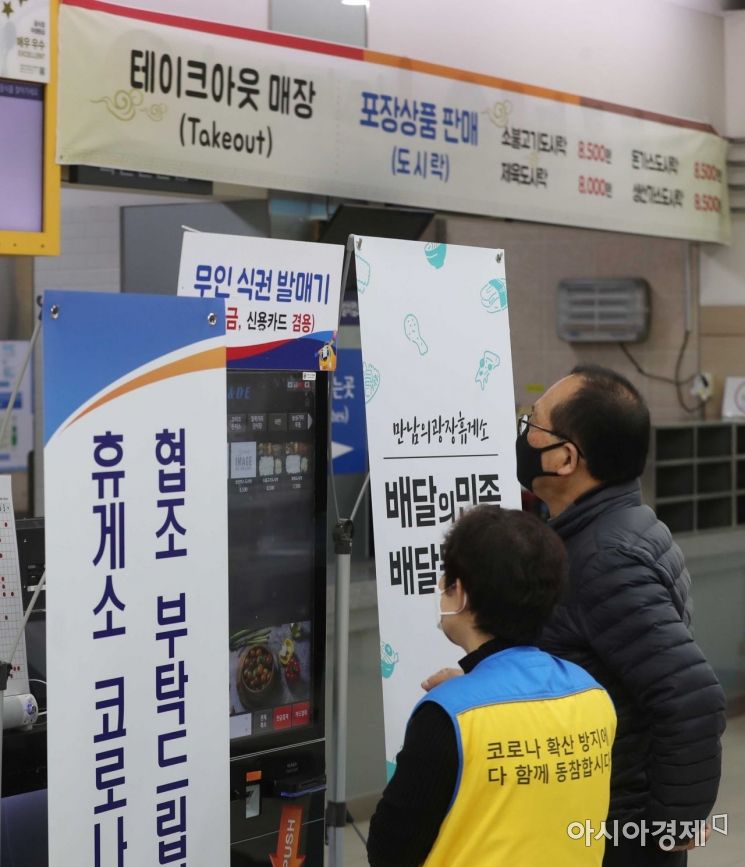
 On the 10th, one day before the Lunar New Year holiday, citizens are ordering lunch boxes using an unmanned meal ticket vending machine at the Mannam Square rest area on the Seoul-Gyeongbu Expressway heading toward Busan. The Ministry of Land, Infrastructure and Transport has designated the five days from today until the end of the Lunar New Year holiday on the 14th as the "Lunar New Year Special Traffic Measures Period" to strengthen COVID-19 prevention. Eating inside stores at highway rest areas is prohibited, and only takeout is allowed. Photo by Moon Honam munonam@
[Asia Economy Reporter Kim Bong-su] "Face reality as it is and focus on what you can do while taking action."
It has been almost a year since the government raised the COVID-19 response level to 'serious' on February 23 last year. Contrary to the expectation that "it will be over in a few months," the pandemic has prolonged for over a year, and with ultra-strong quarantine measures such as the 'ban on private gatherings of five or more people' continuing, the public is experiencing severe mental stress including depression, anxiety, and fatigue. Experts are concerned about the aftershocks following the pandemic, such as 'delayed suicides,' and emphasize the importance of psychological quarantine for individuals and society alongside COVID-19 prevention.
According to the recent issue of 'Science and Technology' published by the Korea Federation of Science and Technology Societies on the 12th, the number of people complaining of mental symptoms has surged due to the prolonged COVID-19 situation. One survey found that about 43% of infected patients showed signs of depression, and the general public is also experiencing increased social and psychological stress. A survey by the Gyeonggi Research Institute showed that 45% of respondents felt depression and anxiety, especially among socially vulnerable groups such as women, those under 40, chronic disease patients, the unemployed, and students, as well as medical staff who exhibited symptoms like anxiety, headaches, neck pain, fatigue, and insomnia. The Korean Society of Trauma Stress reported that the national average depression score increased from 5.10 in March last year to 5.86 in September, more than doubling from the 2018 average of 2.34.
The problem is that the post-COVID-19 period is expected to be even more serious. Currently, South Koreans are under tremendous stress due to the unprecedented public health crisis of COVID-19, yet the suicide rate has paradoxically decreased. According to Statistics Korea, the number of suicides from March to September last year was 7,723, a 5.7% decrease compared to 8,188 in the same period the previous year. Similar results have been reported in the UK (30% decrease) and Japan (13.5% decrease).
Experts analyze this phenomenon not as a success of psychological quarantine or less severe psychological distress than expected from COVID-19, but as 'delayed suicide.' In cases of severe disasters, suicide rates temporarily decrease initially but tend to surge as the situation prolongs. For example, after major disasters such as Hurricane Katrina in the southeastern US in 2005, the Great East Japan Earthquake in 2011, and the SARS outbreak in Hong Kong in 2013, suicide rates initially decreased but then sharply increased after some time. Young people and women are particularly at risk. The number of female suicides from March to September last year was 2,440, an increase from 2,290 in the same period the previous year. Conversely, male suicides decreased from 5,898 to 5,283 during the same period.
Therefore, the government and experts emphasize that psychological quarantine for mental health is as important as quarantine against the COVID-19 virus. Key guidelines for psychological quarantine include ▲ accepting the changed daily life ▲ following quarantine guidelines without excessive worry ▲ maintaining a regular lifestyle ▲ engaging in hobbies or leisure activities ▲ regular physical activities such as walking ▲ continuous communication with family and friends. If one cannot overcome depression or anxiety, it is advisable to consult experts or medical professionals and participate in healing programs conducted by institutions such as the National Trauma Center to seek help.
Professor Lee Dong-woo of the Department of Psychiatry at Inje University, in a contribution to 'Science and Technology,' stated, "It is important for individuals to accurately assess their condition and receive necessary help," adding, "There is a need to upgrade the government's crisis response and communication capabilities, establish referral and linkage systems between various government-provided services and private medical services, and implement psychological and non-psychological measures for victims facing job loss or business closure risks."
© The Asia Business Daily(www.asiae.co.kr). All rights reserved.
![From Hostess to Organ Seller to High Society... The Grotesque Scam of a "Human Counterfeit" Shaking the Korean Psyche [Slate]](https://cwcontent.asiae.co.kr/asiaresize/183/2026021902243444107_1771435474.jpg)
















