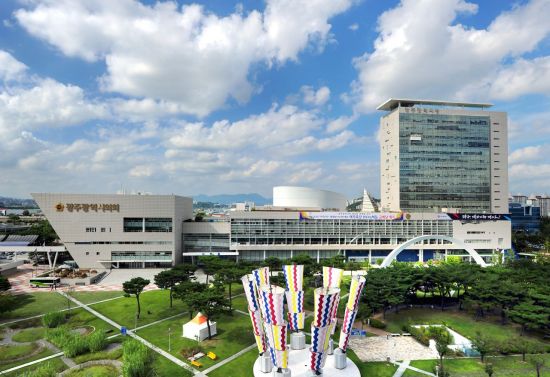
[Asia Economy Honam Reporting Headquarters Reporter Park Seon-gang] Gwangju Metropolitan City announced on the 11th that it is implementing the ‘Ancestor Land Search Service’ using the computerized land and forest register system to support descendants who cannot identify their ancestors' land due to lack of knowledge or unforeseen accidents.
The ‘Ancestor Land Search Service’ allows applicants to visit the city hall or district office regardless of the location of the land or their residence, submit documents proving they are heirs or owners, and receive inquiry results immediately through the ‘National Land Information System’.
For those who died before January 1, 2008, a family register removal certificate (jejeokdeungbon) must be submitted, and for those who died after that date, a family relation certificate in the deceased’s name and a basic certificate indicating the date of death must be submitted.
If the death occurred before January 1, 1960, only the eldest son or household successor can apply; for deaths after that date, the spouse or direct ascendants/descendants with inheritance rights may apply.
Through the ‘Ancestor Land Search Service,’ Gwangju helped 12,258 people find 20,279 land parcels totaling 20,062,128 square meters last year.
In this regard, Gwangju has been temporarily enforcing the ‘Special Act on Real Estate Ownership Transfer Registration, etc.’ for two years since August 5 last year.
This special law allows real estate without ownership preservation registration or with registry entries that do not match the actual rights to be registered through procedures such as submission of supporting documents and guarantor verification.
Accordingly, it is expected to provide an opportunity for citizens who have had difficulties exercising property rights to correct real estate rights relationships.
The scope of application includes real estate that was effectively transferred by legal acts such as sale, gift, or exchange before June 30, 1995, or inherited real estate without ownership preservation registration, specifically farmland and forest land.
Within the jurisdiction, the former Songjeongji and Gwangsan-gun areas incorporated into Gwangju in 1988 are subject to the special law, including the entire current Gwangsan-gu and eight neighborhoods in Seo-gu?Seochang, Seha, Yongdu, Pungam, Byeokjin, Geumho, Mareuk, Maewol?and fifteen neighborhoods in Nam-gu?Guso, Yangchon, Dogeum, Seungchon, Jiseok, Apchon, Hwajang, Chilseok, Seokjeong, Sinjang, Yanggwa, Ijang, Daeji, Wonsan, and Wolseong.
Lee Su-won, head of the Land Information Division of the city, said, “Through the Ancestor Land Search, people can find ancestors’ land they did not know about, and if applicable under the special law, registration can be done through simplified procedures. We will continue to make every effort to protect citizens’ property rights through ongoing publicity.”
© The Asia Business Daily(www.asiae.co.kr). All rights reserved.

















