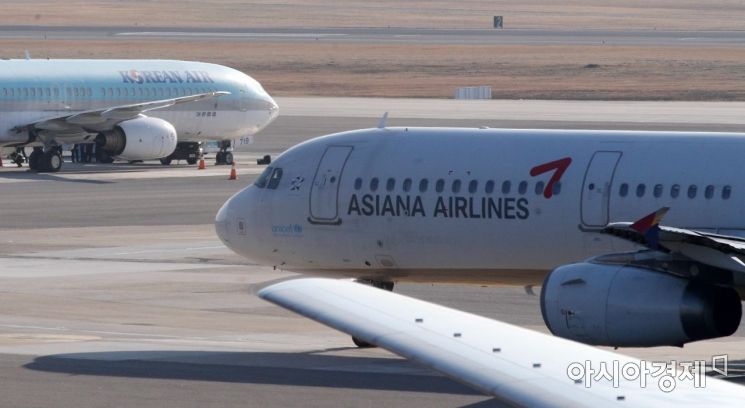
 As the court's decision on Korean Air's acquisition of Asiana Airlines approaches, on the 30th, Korean Air and Asiana Airlines passenger planes were moving toward the runway at Gimpo Airport apron in Gangseo-gu, Seoul. The Seoul Central District Court is expected to deliver a ruling today or tomorrow on the injunction request filed by the activist private equity fund KCGI against Hanjin KAL to prohibit the issuance of new shares. If the court dismisses the injunction request, the acquisition process will accelerate, but if the injunction is granted, the acquisition is likely to be canceled. Photo by Kim Hyun-min kimhyun81@
[Asia Economy Reporter Dongwoo Lee] The aviation industry is facing a double hardship as it struggles with a decline in passenger and cargo demand due to the prolonged COVID-19 pandemic, compounded by rising international oil prices. Fixed costs are becoming increasingly burdensome amid a situation where international flights have decreased by more than 90%.
On the 10th (local time) at the New York Mercantile Exchange, March delivery West Texas Intermediate (WTI) crude oil closed at $58.68 per barrel, up 0.6% from the previous trading day. This marks the longest continuous rise since January 10, 2019. Brent crude also surpassed $61.28 per barrel.
The aviation industry is closely monitoring recent fluctuations as rising oil prices directly affect profitability through increased fuel costs. For some airlines, fuel expenses account for as much as 30% of total operating costs, leading to higher fixed costs.
In fact, Korean Air stated, "The average annual fuel consumption over the past five years is about 30 million barrels, and a $1 change per barrel results in approximately 33 billion KRW in profit and loss fluctuations." Asiana Airlines also reported that a $1 increase in oil prices raised operating costs by about 20 billion KRW in 2019.
Accordingly, major carriers such as Korean Air and Asiana Airlines, followed by low-cost carriers (LCC) like Jeju Air, have decided to impose a domestic fuel surcharge of 1,100 KRW per one-way fare starting next month.
The industry urgently needs to increase the number of flights to offset fixed costs and improve profitability, but the prolonged impact of COVID-19 makes even this difficult.
According to the Korea Airports Corporation, as of last month, the total number of passengers on international and domestic flights operated by 13 domestic airlines was 3,138,757, a 77% decrease compared to the same period last year. In particular, international passengers numbered 212,925, a 97% drop during the same period. Cargo volume also declined by 22% year-on-year to 289,556 tons, delaying recovery.
In this process, the gap between full-service carriers (FSC) and low-cost carriers (LCC) is widening. While FSCs are focusing on cargo transport to improve performance amid declining passenger demand, LCCs, lacking dedicated cargo aircraft, are struggling even with this.
While Korean Air achieved a rare profit with sales of 7.405 trillion KRW and operating profit of 238.3 billion KRW last year due to strong air transport performance, airlines like Jin Air and Air Busan reported operating losses of 184.7 billion KRW and 197 billion KRW respectively, worsening their deficits.
An industry official said, "The prolonged impact of COVID-19 has led to a decline in passenger demand, compounded by rising fuel costs, resulting in continued difficulties. To reduce fixed costs such as fuel and maintenance expenses, recovery of passenger demand on some short-haul international routes in the second half of this year will be essential."
© The Asia Business Daily(www.asiae.co.kr). All rights reserved.
![Clutching a Stolen Dior Bag, Saying "I Hate Being Poor but Real"... The Grotesque Con of a "Human Knockoff" [Slate]](https://cwcontent.asiae.co.kr/asiaresize/183/2026021902243444107_1771435474.jpg)
















