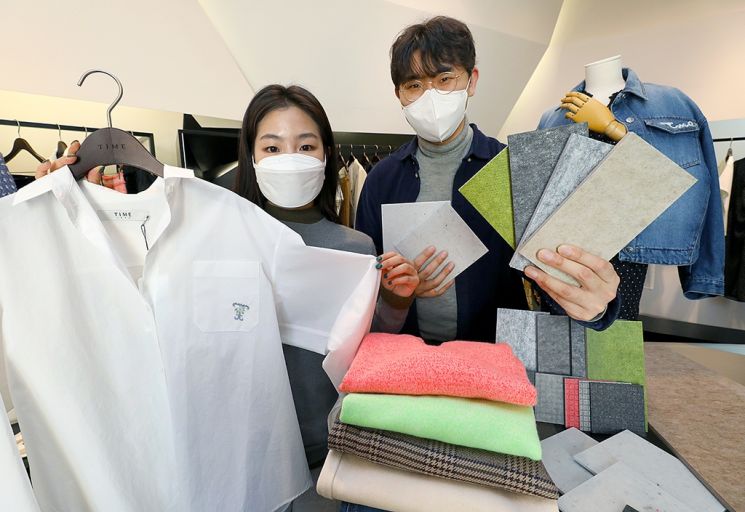
 Employees at Time Cheongdam Avenue store located in Cheongdam-dong, Gangnam-gu, Seoul, are introducing eco-friendly interior finishing materials made from surplus clothing.
[Asia Economy Reporter Seungjin Lee] The fashion industry continues its eco-friendly initiatives. Companies are leading environmental protection efforts by recycling waste plastic to make clothing or transforming inventory garments that were previously incinerated into finishing materials.
According to the fashion industry on the 11th, Handsome is implementing the 'Carbon Zero (0) Project,' the first in the domestic fashion industry to switch the disposal of inventory garments to an eco-friendly method. The 'Carbon Zero (0) Project' features the recycling of discarded inventory garments by a waste clothing recycling company (Sejin Plus), which molds them under high temperature and pressure into eco-friendly interior finishing materials (fiber panels).
Through this project, Handsome piloted the eco-friendly disposal of 12 tons of inventory garments in the second half of last year and plans to process about 30 tons this year, which is about half of the annual inventory garment volume. The goal is to handle all recyclable inventory garments of Handsome in an eco-friendly way by 2024.
The amount of clothing made from recycled plastic is also increasing significantly. These garments are popular especially among young customers who value 'value consumption,' expressing social values through their purchases.
The North Face introduced eco-friendly clothing by recycling about 100 tons of PET bottles?approximately 10 million bottles?in collaboration with Jeju Island and Hyosung TNC. Most of the fleece products produced in the first batch have been sold out, and the second and third productions are underway. This is due to a significant increase in customers wanting to purchase eco-friendly products whenever possible.
BYN Black Yak has started producing eco-friendly products using transparent PET bottles collected in Seoul. Black Yak signed a business agreement last May with TK Chemical, the Ministry of Environment, Gangwon Province, Gangneung City, and Samcheok City, launching the country's first K-rPET recycled fiber functional clothing through a transparent PET bottle resource circulation system that connects disposal, recycling, product manufacturing, and consumption.
Kolon Industries FnC division's outdoor brand Kolon Sports plans to apply eco-friendly materials to 50% of all Kolon Sports products by 2023, the brand's 50th anniversary. K2 plans to expand eco-friendly products to 40% of its total this year. In 2019, two years ago, eco-friendly products accounted for only 5% of K2's offerings.
The Ministry of Environment's 'Go Go Challenge,' a lifestyle 'plastic-free' campaign started through social networking services (SNS), is also spreading. Sung Ki-hak, chairman of Youngone Outdoor, who was nominated by Hyosung TNC CEO Kim Yong-seop, announced his plan to practice plastic reduction in daily life through The North Face's official SNS channel, stating, "We do not encourage customers to use disposable plastic shopping bags, but encourage the use of multi-purpose shopping bags (eco and paper materials) and promise to reduce plastic for the planet."
© The Asia Business Daily(www.asiae.co.kr). All rights reserved.
![User Who Sold Erroneously Deposited Bitcoins to Repay Debt and Fund Entertainment... What Did the Supreme Court Decide in 2021? [Legal Issue Check]](https://cwcontent.asiae.co.kr/asiaresize/183/2026020910431234020_1770601391.png)
















