Asahi Shimbun: "Donghak Gaemi Are the Main Drivers of KOSPI Boom"
"Young Employees Rush to the Restroom at 9 AM"
"If the Bubble Bursts, Young People Will Suffer the Most"
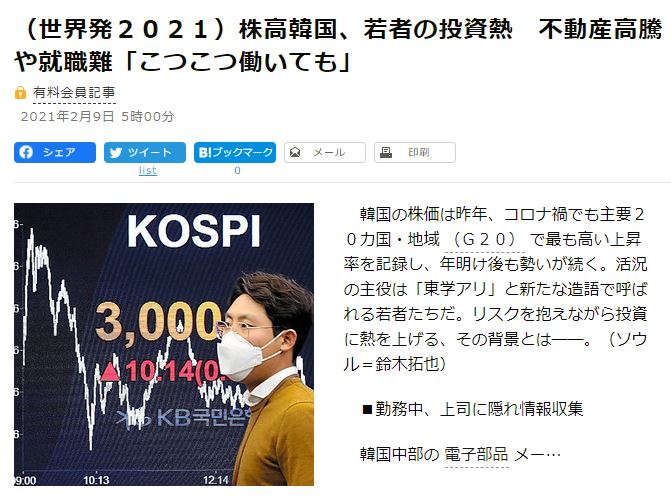 An article from the Japanese media outlet Asahi Shimbun published on the 9th (local time). It detailed the Korean stock market boom and the emergence of new terms such as 'Donghak Ants' related to this trend. / Photo by Internet homepage capture
[Asia Economy Reporter Lim Juhyung] The Japanese media outlet 'Asahi Shimbun' recently provided a detailed report on the booming trend of stock investment in Korea. However, the outlet expressed concerns that Korea's investment boom bears similarities to Japan's past 'bubble economy' that led to an overheated market, warning that young investors could suffer significant losses when a market correction occurs.
On the 9th (local time), Asahi Shimbun reported, "Despite the COVID-19 disaster, Korea's stock market recorded the highest growth rate among the G20 countries," adding, "The driving force behind this boom is young investors known by the newly coined term 'Donghak Ants'."
The newspaper provided a detailed explanation of the reality and background of Korea's stock investment craze. The media also cited the case of a male office worker A (28), employed at an electronic components company.
It was reported that Mr. A pretends to check work-related emails on his computer during work hours while actually searching for information on companies to invest in.
Mr. A told Asahi, "Everyone does it, hiding from the boss's eyes." He explained that with a low salary, it is impossible to afford an apartment or even cover children's education expenses, so stock investment is the only option.
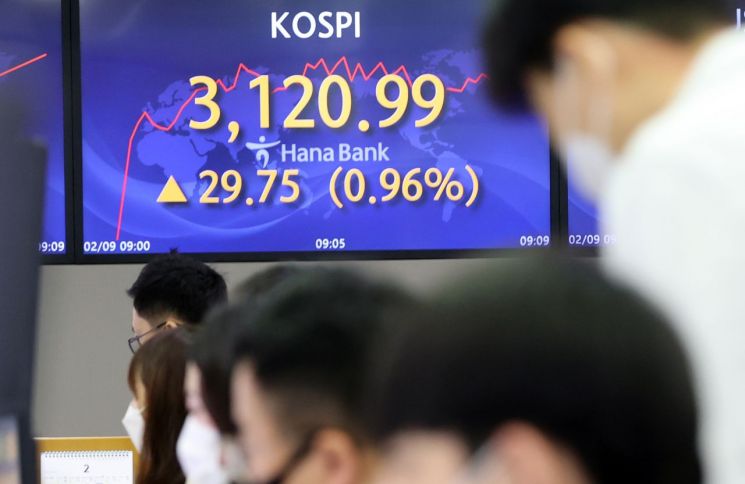
He added, "In the era of low interest rates, saving money is meaningless," and revealed, "I started investing in stocks in January last year and earned 8 million won in profits over the past year."
Asahi explained that not only employees of small and medium-sized enterprises but also young people who graduated from prestigious universities in Seoul and got jobs at conglomerates are actively investing in stocks. The newspaper reported, "When stock trading starts at 9 a.m., young employees rushing to the restroom has been covered by the media."
However, Asahi pointed out that Korea's stock market cannot be seen as reflecting the real economy.
The newspaper reported that Korea's economic growth rate last year recorded a negative 1%, indicating a recession, and that Lee Ju-yeol, Governor of the Bank of Korea, stated at a financial industry New Year's gathering, "Potential threats are expected to fully emerge this year."
It also noted that the current situation in Korea resembles Japan's so-called 'bubble economy' of the 1980s.
Quoting Professor Yang Jun-mo of Yonsei University's Department of Economics, the newspaper said, "The current situation in Korea resembles Japan in the 1980s when the bubble economy peaked," expressing concern that "when the bubble bursts someday, the damage to the younger generation will be especially severe."
© The Asia Business Daily(www.asiae.co.kr). All rights reserved.


















