FKCCI Analyzes Changes in Global Trade and Investment Structures Due to the COVID-19 Pandemic
[Asia Economy Reporter Kim Hyewon] Amid a significant decline in global trade last year due to the impact of COVID-19, China's share of the global export market reached an all-time high. Foreign capital inflows into China also increased, leading to an assessment that China's influence in the global trade economy has actually grown.
The Federation of Korean Industries (FKI) analyzed and announced on the 9th the changes in the global trade and investment structure caused by the COVID-19 pandemic and the future policy response directions for South Korea.
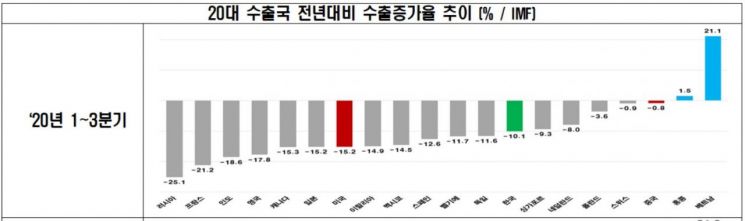
From the first to the third quarter of last year, the scale of global trade recorded $12.5168 trillion, a 10.6% decrease compared to the same period the previous year. This was the third-largest decline after the 2008 global financial crisis (-23.6%) and the 2015 Chinese economic slowdown (-12.9%). The spread of COVID-19, which was initially limited to Asia including China in February last year, expanded worldwide from March to the US, Europe, and other regions, leading countries to impose economic lockdown measures. However, the International Monetary Fund (IMF) estimated that global trade decreased by 9.6% year-on-year for the entire year, as it showed signs of recovery from the third quarter.
By country, major nations such as the US (-15.2%), Japan (-15.2%), and Germany (-11.6%) saw double-digit declines in exports, while China, which showed a rapid economic recovery, experienced only a 0.8% decrease. China's exports turned positive in the third quarter of last year.
Because China's exports declined less compared to traditional export powerhouses, its share of the global export market from the first to the third quarter of last year increased by 1.4 percentage points year-on-year to 14.5%, setting a new record. China's global export market share had been on a downward trend, falling from 13.9% in 2015?affected by trade conflicts with the US and value chain restructuring toward ASEAN countries?to 13.2% in 2019. Meanwhile, the US export market share decreased by 0.5 percentage points from 8.8% to 8.3% during the same period.
Global foreign direct investment (FDI) also fell sharply by 42.3% last year to $85.9 billion. In contrast, India and China saw increases of 13% and 4%, respectively. India attracted investments from global ICT companies, such as Google's announcement in July last year of a $10 billion investment plan to build digital infrastructure in India, while China saw increased foreign investment inflows in the service and advanced technology sectors.
Kim Bongman, head of the FKI's International Cooperation Office, stated, "Global trade is expected to increase by 7-8% this year, and South Korea's exports are projected to grow by 6-7%, driven by strong performance in semiconductors and other digital-related products. However, with the ongoing spread of COVID-19, the continuation of the US-China hegemonic rivalry, and the spread of protectionism without distinction between developed and developing countries, external trade instability factors are likely to persist."
In fact, last November, Chinese President Xi Jinping officially announced at the Asia-Pacific Economic Cooperation (APEC) summit the pursuit of joining the Comprehensive and Progressive Agreement for Trans-Pacific Partnership (CPTPP). Meanwhile, Katherine Tai, the newly appointed US Trade Representative, identified addressing China's unfair trade practices as the top trade priority of the Joe Biden administration, indicating a high likelihood of continued US-China trade conflicts this year.
Kim emphasized, "Our trade authorities need to strengthen domestic and international conditions for joining the CPTPP, which is likely to become a new global trade and commerce platform. Since protectionist measures against South Korea by new southern countries including China and India have increased due to COVID-19, trade authorities should also focus on strengthening trade diplomacy with these countries."
© The Asia Business Daily(www.asiae.co.kr). All rights reserved.

















