Government to Hold Space Development Promotion Committee Meeting on 8th, Plans Set for This Year
615 Billion KRW Investment Planned Including Cheollian 3 Satellite
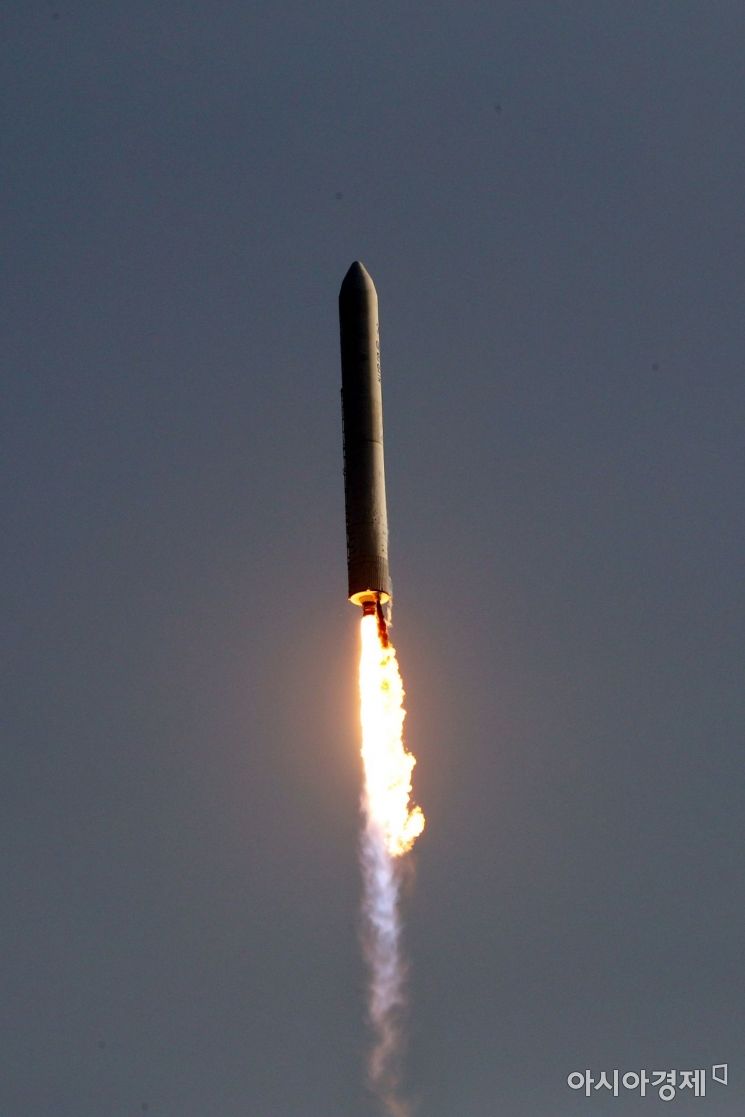 On the afternoon of the 28th, at the Naro Space Center launch pad in Bongrae-myeon, Goheung-gun, Jeollanam-do, a test launch vehicle for the Korean launch vehicle Nuriho's engine emitted white smoke and soared into the sky. This engine test launch vehicle is designed to verify the performance of the 75-ton liquid engine used in the Korean launch vehicle 'Nuriho' and corresponds to the second stage of Nuriho, which consists of a total of three stages. The test launch vehicle is 25.8 meters long, has a maximum diameter of 2.6 meters, and weighs 52.1 tons. / Goheung = Photo by Joint Press Corps
[Asia Economy Reporter Kim Bong-su] In October this year, Korea’s own launch vehicle ‘Nuriho (KSLV-II)’, capable of placing an artificial satellite into orbit with our own hands, will be launched. In addition, the first next-generation medium-sized satellite will be launched in March, and the development of the geostationary public multi-purpose communication satellite ‘Cheollian 3’ will also begin in earnest.
According to the Ministry of Science and ICT on the 8th, the government held the 36th Space Development Promotion Working Committee meeting in writing with 16 related ministries and agencies to review and finalize three agenda items, including the ‘2021 Space Development Promotion Implementation Plan’ containing these details.
The government will spend a total of 615 billion KRW this year on space development projects. In October, the Korean launch vehicle Nuriho, which is being developed to secure independent space transportation capability, will be launched from the Naro Space Center in Goheung, Jeollanam-do. Previously, in November 2018, the government successfully conducted a test launch of the second-stage engine rocket of the three-stage Nuriho. The Nuriho to be launched this time is the complete three-stage model, and performance will be verified by carrying a model satellite for now.
To this end, the government will conduct a combustion test of the first-stage certification model clustered with four 75-ton engines in the first half of the year. While completing the construction of a new launch pad for the launch, it will also conduct simulated training to check the tracking system of the launch site.
The government will also launch the first next-generation medium-sized satellite in March from Kazakhstan using a Russian Soyuz launch vehicle. It is being jointly developed by the Ministry of Science and ICT and the Ministry of Land, Infrastructure and Transport to meet public demand and foster related industries, and will be used in various fields such as ground observation and change detection, urban planning, and map making. Various purpose satellites will be developed through a 500 kg-class standard platform, with the first, second, and fourth satellites currently under development, and the third and fifth satellites scheduled to begin development this year and next year, respectively.
Development of Cheollian 3 will also begin in earnest. It is being developed for disaster and safety response such as monitoring flood damage, supporting maritime patrol activities, and providing emergency communication support in disaster areas, as well as for providing GPS correction signals and serving as a test bed for future satellite communication technologies. Additionally, the multipurpose practical satellites 6 and 7, which are being developed to provide various public services including national security through all-weather ground observation, will enter final assembly and functional testing aiming for launch in 2022.
Korea’s first ‘lunar exploration orbiter’ will also be developed in earnest aiming for launch in 2022. Payloads performing various missions such as lunar surface imaging will be assembled with the orbiter, and a total assembly test of the lunar orbiter system will be conducted. To observe the space environment and utilize it for basic research on space weather understanding and space disaster response, four 10 kg-class nano satellites will be launched in the second half of this year under the leadership of the Korea Astronomy and Space Science Institute. Like the first next-generation medium-sized satellite, they will be launched from Kazakhstan using a Russian Soyuz launch vehicle.
The establishment of the Korean Positioning System (KPS) will also be promoted. It aims to provide essential location, navigation, and timing information for the 4th industrial revolution and national infrastructure operations such as autonomous vehicles and drones. After securing the budget in the first half of this year, full-scale development will begin next year.
Along with this, the government plans to expand support for the Space Challenge project, which has been promoted since last year to develop challenging and innovative future-leading space technologies. While only two projects were supported with a total of 1 billion KRW last year, the budget will be increased to 4 billion KRW this year to support six new projects additionally. A new ‘Space Pioneer Project’ will be launched to support company-led R&D for the localization of core components used in system projects such as launch vehicles and satellites.
At the meeting, the ‘Satellite Information Utilization Implementation Plan’ to activate satellite utilization and the ‘Space Risk Preparedness Implementation Plan’ to prepare for space risks such as the fall and collision of space objects were also reviewed. It was decided to expand support for the use of satellite images in public sectors closely related to citizens’ lives (weather, environment, ocean, land management, etc.), including improvements to the Land Satellite Center utilization system for using images from the first next-generation medium-sized satellite and providing public services in the atmospheric environment field using Cheollian Satellite 2B. Along with support for AI learning data utilization of satellite images, efficiency in satellite image utilization will be improved by shortening image processing time through optimization of standard image processing codes, and development of a support system for ultra-small satellite utilization will be initiated, continuing investment in satellite utilization technology development.
In the field of space risk preparedness, to prevent collisions in space involving our satellites and to monitor the risk of space objects such as satellites and asteroids falling on the Korean Peninsula, the installation of a 1.5-meter-class wide-field optical telescope in the southern hemisphere will be actively promoted. It is planned to be linked with OWL-Net, an optical space monitoring equipment installed and operated at five locations in the northern hemisphere, which is expected to be an opportunity to expand Korea’s independent space monitoring capabilities.
Jeong Byeong-seon, 1st Vice Minister of the Ministry of Science and ICT, said, “2021 will be a year to successfully complete space development projects that have great public interest and expectations, such as the launch of the Korean launch vehicle ‘Nuriho’ and the first next-generation medium-sized satellite developed with our own technology.”
© The Asia Business Daily(www.asiae.co.kr). All rights reserved.

















