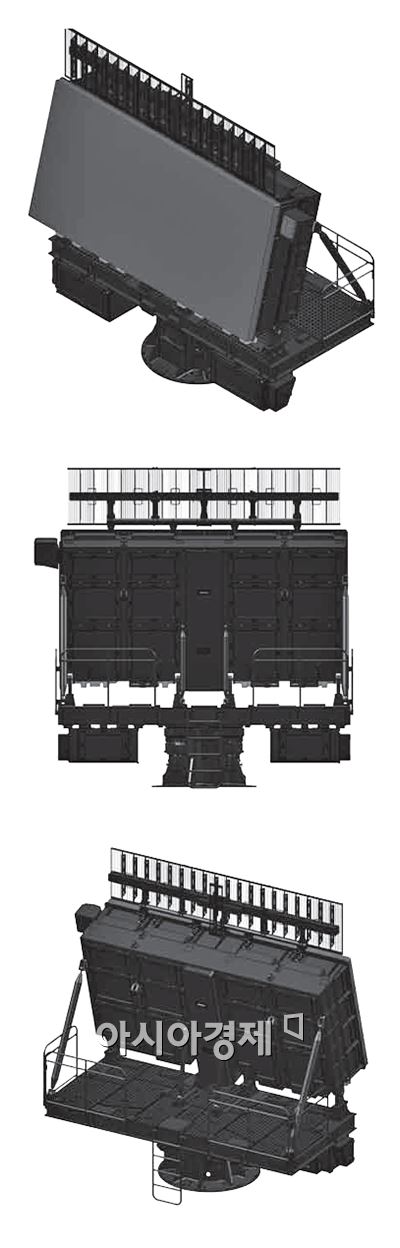
 State-of-the-art low-altitude radar developed by LIG Nex1.
[Asia Economy Yang Nak-gyu, Military Specialist Reporter] LIG Nex1 has signed a contract worth approximately 46 billion KRW for the development of a long-range radar system. It is said that the over 30-year-old Korean Air Defense Identification Zone (KADIZ) long-range surveillance radar can be replaced with domestically developed technology.
On the 8th, LIG Nex1 announced that the goal is to sequentially deploy the system from 2027 after system development and mass production in cooperation with the Defense Acquisition Program Administration (DAPA). The long-range radar monitors and identifies aircraft within the KADIZ. The data detected by the radar is transmitted to the Air Force's Mobile Control and Reporting Center (MCRC) and used for air defense operations.
According to LIG Nex1, only a few countries such as the United States, France, Italy, and Spain produce long-range radars. In South Korea, domestic research and development of long-range radar had been pursued before, but the project was halted in 2017 due to some performance shortcomings.
However, considering the recently improved domestic technological level and economic ripple effects, the decision was made in 2019 to resume research and development, and the system development contract has now been signed.
This project is being carried out as a joint investment between the government and the company, with the government investing 65% of the development cost, considering the project's resumption. DAPA explained that this is intended to increase accountability for the success of the development. Considering the urgency of radar replacement, the system development period will be shortened by six months compared to the past, to be completed within 48 months.
The currently operated Air Force long-range radar was introduced before 1990 and is American-made equipment, reportedly suffering from severe aging. The Air Force possesses about 20 mobile long-range radars (4 types). Among them, eight long-range radars (FPS-117K) manufactured by Lockheed Martin in the United States have already exceeded their service life. The long-range radars deployed at the control battalions in Hwangbyeongsan and Mangil in Pyeongchang, Gangwon Province, located in the frontline area, were introduced in 1987 and have exceeded their service life by 13 years.
Long-range radars deployed at Palgongsan, Yongmunsan, and Hwaaksan were deployed in 1988. Those deployed in Uisang, Jeju, and Ilwon areas were deployed in 1992. When the service life of long-range radars exceeds 20 years, their operational rate inevitably declines. Furthermore, as it becomes difficult to procure repair parts for the long-range radars, the operational rate is known to be less than 60%. In particular, the radar base facilities are also severely aged. According to a safety inspection conducted by the Air Force Headquarters in 2018, eight radar bases received C and D grades, indicating the need for repairs.
© The Asia Business Daily(www.asiae.co.kr). All rights reserved.
!["The Woman Who Threw Herself into the Water Clutching a Stolen Dior Bag"...A Grotesque Success Story That Shakes the Korean Psyche [Slate]](https://cwcontent.asiae.co.kr/asiaresize/183/2026021902243444107_1771435474.jpg)















