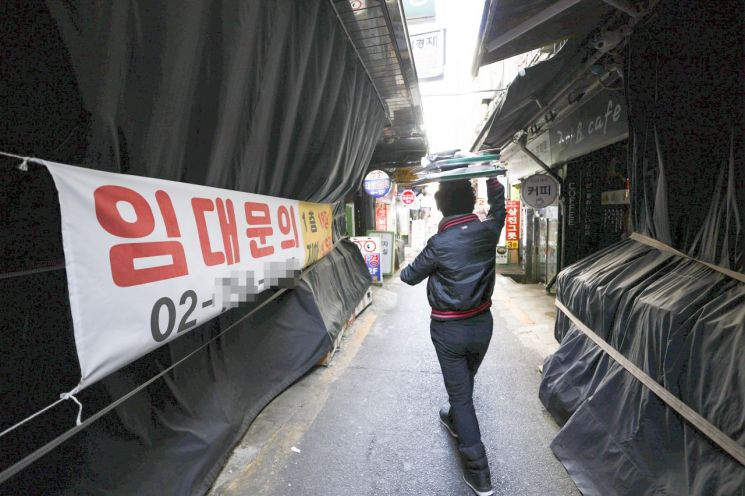
[Asia Economy Reporter Eunbyul Kim] As the Democratic Party and the government clash over the target recipients of the 4th disaster relief fund, the economics community is also engaged in heated debates over sensitive issues such as disaster relief funds and local currency. Regarding disaster relief funds, there are conflicting claims: one side argues that a 'universal payment' to all people is effective in stimulating consumption, while the other contends that selective payments are more effective for those who truly need it, and that if the scale becomes too large, it only increases deficit bond issuance, raising market interest rates and thus diminishing the effectiveness of the payments. There are also economists' analyses showing that local currency payments do not induce employment within regions.
Disaster Relief Fund 'Universal vs Selective' Debate
Researcher Eulsik Kim of the Gyeonggi Research Institute revealed in a report titled 'Consumption Stimulus Effect of the 1st Disaster Relief Fund,' presented at the Korean Economic Association’s ‘2021 Joint Economics Conference’ held on the 4th and 5th, that the consumption stimulus effect was greater when universal payments were made.
Last year, the central government and Gyeonggi Province made universal payments for the 1st disaster relief fund, while Seoul City separately made selective payments targeting low-income households. Researcher Kim argued that as a result, Gyeonggi Province showed a greater consumption stimulus effect. He stated, "The marginal propensity to consume (MPC) in Gyeonggi, which made the largest universal disaster relief payments by city/province, was 30.5%, the highest, while Seoul, which selectively paid 50% of the metropolitan disaster relief fund, had the lowest at 28.0%." The overall MPC was estimated at 29.2%. The MPC refers to the additional consumption effect of the disaster relief fund; for example, an MPC of 30% means that when 100,000 KRW is paid, an additional 30,000 KRW worth of consumption occurs. The remaining 70,000 KRW either replaced consumption that would have occurred anyway or was used for savings or debt repayment.
Researcher Kim pointed out that the main recipients of the 2nd disaster relief fund last year, the self-employed, did not show an effect on consumption stimulation. However, he explained, "Low-income groups, self-employed, irregular workers, and minor households, which are discussed as targets for selective payments, may be appropriate targets for redistribution purposes."
On the other hand, the Korea Development Institute (KDI) stated that the effect of disaster relief funds is not significant and that selective support is necessary because direct income support is needed for industries affected by COVID-19. KDI also released research results showing that after the 1st disaster relief fund payment last year, sales increased by 26.2?36.1% compared to the total budget input in industries where the support funds could be used.
Although there are differences in views on the support method, the economics community generally estimates that when 100,000 KRW of disaster relief funds are paid, about 30,000 KRW (30% sales increase effect) leads to additional consumption. However, there are analyses suggesting this effect is much larger. Professor Woojin Lee of Korea University’s Department of Economics and two others announced that "the nationwide emergency disaster relief fund resulted in a consumption stimulus effect of up to about 11 trillion KRW." This study was submitted to the Presidential Committee on Income-Led Growth. The research analyzed that the MPC of the 1st disaster relief fund reached 65.4?78.2% (combined for Q2 and Q3).
Regarding the 'basic income' issue that arose during the nationwide disaster relief fund payment, there was criticism that it was rather an economic effect of universal welfare. Professor Yongsung Jang of Seoul National University’s Department of Economics stated in the paper ‘Economic Effects Analysis of Basic Income Introduction’ that "not only is there no economic effect of universal welfare, but it may rather increase the national burden and widen inequality among low-income groups." To pay a basic income of 300,000 KRW per month to 39.19 million adults aged 25 and over in Korea, a total of 141.1 trillion KRW annually (equivalent to 7.35% of GDP) is required. If the funding is fully covered by income tax rates, the income tax rate would increase from the current 6.8% by 17.6 percentage points to 24.4%. Total production (-19%), total capital (-22%), and total labor (-16%) would significantly decrease.
Basic income is the idea that the government provides all citizens with a basic living allowance every month regardless of assets or employment status. However, realistically, to secure the funds for basic income, taxes must be raised, which may reduce labor and savings and widen income gaps between working-age and elderly populations. To avoid increasing the tax burden, welfare benefits provided to low-income groups would have to be eliminated, potentially resulting in 'basic income being given but welfare systems disappearing.'
There are also concerns that if funds are raised by issuing government bonds to pay for basic income or universal disaster relief funds, increased deficit bond issuance could raise market interest rates and suppress private consumption and investment, known as the 'crowding-out effect.' Recently, government bond yields have been on the rise. On the 5th, the 3-year maturity government bond yield in the Seoul bond market closed at 0.982% per annum. The 10-year bond yield recorded 1.791% per annum. Although it fell by 0.2 basis points (1bp = 0.01 percentage points), it remains close to the 1.8% level.
Local Currency 'No Employment Induction vs Small Business Sales Expansion'
At the Korean Economic Association conference, debates also arose around local currency. Professor Changhee Kang of Chung-Ang University’s Department of Economics presented results calculating the employment induction effect of local currency based on the National Statistical Office’s nationwide business survey. Comparing employment trends by region before and after local currency issuance, he concluded that there is no evidence to suggest that local currency issuance induced employment. As of last year, about 9 trillion KRW worth of local currency was issued in 228 local governments. Even when isolating retail and food & beverage industries, the main consumers of local currency, no clear employment changes were observed. Professor Kang emphasized in his report, "While it may affect small business sales, it does not affect employment."
The National Tax Service-affiliated Korea Institute of Public Finance (KIPF) also viewed that local currency, being usable only within the region, did not significantly impact sales in sectors like accommodation and travel. Analyzing card-type local currency payments as of the first half of last year, KIPF found that 1.301765 trillion KRW was consumed in 33 industries where small businesses are concentrated. About half of this was used in general food service and distribution (such as supermarkets). However, consumption shares in accommodation (1.226 billion KRW) and travel (150 million KRW) were less than 0.1% each.
Meanwhile, when these findings were presented at the conference, Gyeonggi Province Governor Jaemyung Lee criticized the part stating that local currency had no effect. On his social media, he argued, "It is common sense, even without research, just by looking at statistics, that paying with local currency, which cannot be used at large department stores but only at neighborhood small businesses, helps the sales of small merchants in alleyway markets." He added, "The purpose of local currency is to prevent sales polarization, not to increase employment or sales in travel and accommodation industries," and rebutted again, "Isn't it an effect that the sales of most small businesses like local restaurants, chicken shops, pubs, butcher shops, fish markets, vegetable stores, side dish shops, and rice cake shops increase?"
© The Asia Business Daily(www.asiae.co.kr). All rights reserved.

















