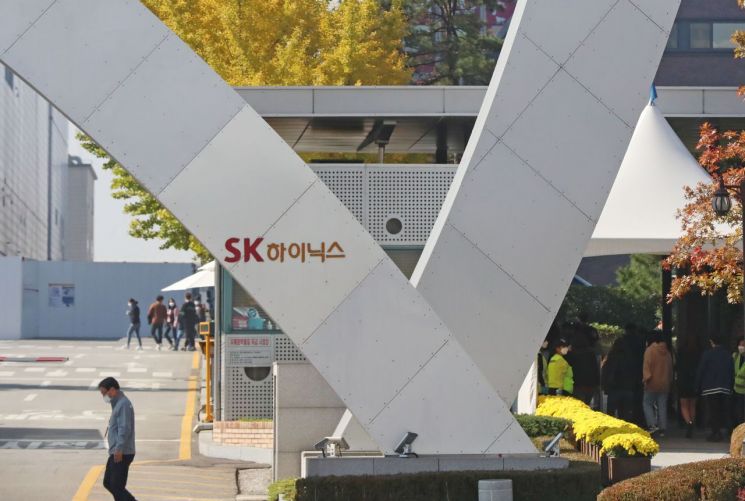
[Asia Economy Reporter Kim Heung-soon] "While constantly emphasizing the company's future, they have crushed the hopes of the members regarding their own futures."
This is part of a message recently posted by SK Hynix employees on an anonymous community amid the controversy over performance bonuses. It reveals the unfiltered temperature difference between the company and its employees during the annual profit distribution process. The issue of performance bonuses has become a hot topic across the industry this year, not only at SK Hynix but also among major conglomerates.
On the 6th, an industry insider said, "There have been employee complaints about performance bonuses every year, but usually the controversies flare up and subside within internal communication channels." He added, "This is the first time that an internal company issue has spread externally and highlighted conflicts." A mid-level employee at SK Hynix also said, "I was surprised to see a young employee send an email expressing dissatisfaction about the performance bonus to the president, and that this was reported through the media."
"Expectations for performance bonuses rise amid limited opportunities for lump sums"
"The fate of a successful organization requires transparent procedures"
Earlier, a fourth-year employee at SK Hynix publicly sent a protest email to all members, including President Lee Seok-hee, after the company announced the internal performance bonus payment at the end of last month. This triggered a flood of complaints. Subsequently, SK Group Chairman Chey Tae-won declared on the 1st of this month that he would forgo his salary, and President Lee sent an apology email to all employees the next day, but the controversy did not subside.
SK Hynix employees criticized through anonymous boards and online communities that although the company achieved an operating profit of 5 trillion won last year, significantly higher than the previous year, the performance bonus was decided to be paid at 400% of the base salary, the same level as in 2019. Voices expressing intentions to move to other companies that have started hiring experienced professionals also increased.
The industry commonly agrees that such dissatisfaction is particularly prominent among lower-tenure and younger generation employees. An employee at a major conglomerate said, "For young members who have loans due to real estate or stock market booms, performance bonuses are one of the few opportunities to secure a lump sum." He pointed out, "If the performance bonus is small compared to the company's achievements, dissatisfaction naturally grows among those who need money." Another employee at a major conglomerate explained, "In a situation where job changes are more active than before, many contracts are made by lowering the base salary and increasing the performance bonus for experienced hires." He added, "From their perspective, receiving a small performance bonus can lead to doubts about their choices."
Lee Jang-joo, a socio-cultural psychologist at the Irak Digital Culture Research Institute, said, "Just as counterrevolutions occur after successful coups, conflicts are inevitable in organizations that must achieve goals and distribute profits." He emphasized, "Now that the concept of a 'lifetime job' has disappeared and comparisons with competitors and overseas cases are possible, clear standards that members can accept must be established."
For now, SK Hynix decided on the 4th, through labor-management consultations, to abolish EVA (Economic Value Added), which was previously used as the performance bonus calculation indicator, and link performance bonuses to operating profit. Additionally, subject to board approval, they agreed to issue employee stock ownership plans that provide benefits equivalent to 200% of the base salary to members, and to grant 3 million in-house welfare points.

Aftermath of Performance Bonus Disclosure
Companies Preparing Announcements Also Struggle
Other companies that have already announced their performance bonus payment plans are also facing ongoing controversies. SK Telecom's labor union raised issues regarding last year's performance bonus, which was about 20% lower than the previous year, and has announced plans for protests. SK Telecom President Park Jung-ho promised communication with employees and the company decided to grant 3 million in-house points for the Lunar New Year, but the union dismissed this as a temporary measure.
At Samsung Electronics, dissatisfaction is emerging mainly among employees in business units that receive relatively smaller shares as performance bonus ratios differ by division. Additionally, within LG Group, LG Chem's petrochemical division is expected to pay up to 400% of the base salary, the life sciences division 300%, and LG Energy Solution, responsible for the battery business, around 200%. Employees of LG Energy Solution, recently spun off from LG Chem, have expressed dissatisfaction that the battery division's rewards are lower compared to other business units despite achieving record-high performance last year.
Furthermore, LG Electronics is expected to announce its performance bonus payment plan within this month. LG Electronics has traditionally distributed performance bonuses proportionally based on the achievement of targets set at the beginning of the year for each business unit. Given the significant controversies over performance bonuses at other companies, there is concern about potential conflicts over this year's payment ratios by business unit.
Professor Kwak Geum-joo of Seoul National University's Department of Psychology said, "As generations sensitive to the value of fairness and with clear self-expression join the workforce, the performance bonus criteria unilaterally set by companies are also being questioned." She added, "After controversies arise, explanations, apologies, or alternative proposals from management are not sufficient for these employees." She emphasized, "If the performance bonus payment method is transparently disclosed and the company's current situation and plans are openly shared to seek understanding, employees are more open to accepting it." She concluded, "Building trust through 'empathic management,' which involves paying attention even to minor issues and frequently sharing with employees, is essential."
© The Asia Business Daily(www.asiae.co.kr). All rights reserved.
![User Who Sold Erroneously Deposited Bitcoins to Repay Debt and Fund Entertainment... What Did the Supreme Court Decide in 2021? [Legal Issue Check]](https://cwcontent.asiae.co.kr/asiaresize/183/2026020910431234020_1770601391.png)















