Early in the session, surpassed 3100 but declined again
Won-Dollar exchange rate rise reduces foreign inflow appeal
Individual inflow stagnates, slowing upward momentum... Shift to individual stock market sentiment
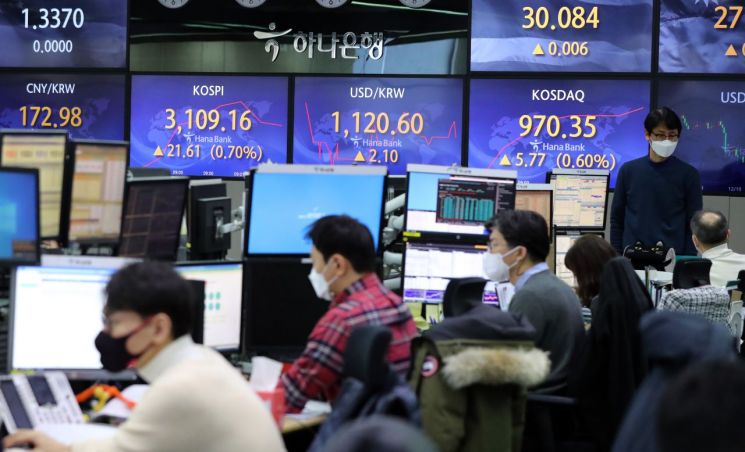
[Asia Economy Reporter Minwoo Lee] The KOSPI, which had risen to the 3100 level early in the session, has fallen back to the 3000 level. Amid net selling by institutions and foreigners, only individual investors have consistently shown net buying. The rise in the won-dollar exchange rate has reduced factors that expand foreign demand, while individual demand is also somewhat limited compared to the previous month. Additionally, although corporate profits are improving, since this has already been priced into the market, the lack of additional upward momentum has led to a shift toward a stock-specific market.
As of 10:30 a.m. on the 5th, the KOSPI recorded 3090.74, up 0.10% from the previous day. It opened at 3098.49, 0.35% higher than the previous day, and extended its gains early in the session to reach the 3100 level, but soon lost upward momentum and stalled. Around 10:10 a.m., it even dropped to 3081.78, down 0.19% from the previous day.
Individual investors alone showed net buying. They purchased a total of 115.5 billion won, while foreigners and institutions net sold 17.3 billion won and 91.6 billion won, respectively. Among institutional investors, only financial investment firms with a strong short-term trading nature showed net buying of 56.4 billion won, while most others, including pension funds (-80.3 billion won), private equity funds (-16.8 billion won), and investment trusts (-42.7 billion won), sold stocks.
The KOSDAQ showed a similar trend. At the same time, it recorded 965.77, up 0.12%, but showed signs of stalling compared to early session levels. Shortly after opening, it rose to 970.60 at 9:02 a.m. but steadily reduced its gains. Around 10:06 a.m., it turned downward, falling to 961.26, down 0.34% from the previous day.
In the KOSDAQ market as well, only individual investors showed net buying (104.1 billion won). Foreigners and institutions net sold 26.7 billion won and 66.2 billion won, respectively.
It is analyzed that the domestic stock market has stagnated as factors for additional capital inflow into emerging markets have diminished, such as the rising won-dollar exchange rate. As of 10:40 a.m. in the Seoul foreign exchange market, the won-dollar exchange rate stood at 1123.45 won, up 0.44% from the previous day. After starting at 1121.0 won, it rose to 1124.00 won around 10:25 a.m. This is the highest level since the intraday high of 1126.9 won on November 6 last year.
Researcher Jaeseon Lee of Hana Financial Investment explained, "As the won-dollar exchange rate has recently been on the rise, the attractiveness of currency arbitrage in emerging markets is diminishing, so there is little room for improvement in foreign demand conditions. Customer deposit levels are also stagnant, and the government is concerned about debt burdens and is strengthening credit loans, making it difficult for individual demand to rise further."
With reduced potential for additional capital inflows, the index is expected to stagnate, and a stock-specific market is likely to continue for the time being. Researcher Lee forecasted, "Although corporate profits have improved significantly, this has already been priced into the market, increasing valuation burdens. Since there is no additional upward momentum this month, a stock-specific market will continue."
© The Asia Business Daily(www.asiae.co.kr). All rights reserved.

















