Exaggeration of Nuclear Accident Risks and Omission of Solar Power Social Costs Reflect 'Double Standards'
Accident Costs Contested in Power Generation Cost Calculations... Accident Probability Applied Higher Than Expert Analysis
[Sejong=Asia Economy Reporter Kwon Haeyoung] Controversy has arisen over allegations that the Korea Energy Economics Institute, a government-funded research institute, inflated the cost of nuclear power generation. The institute is accused of overestimating the costs associated with accidents, which could lead to the interpretation that the efficiency of nuclear power decreases the more it is operated. On the other hand, the social costs of solar power, which has sparked environmental destruction debates, were not reflected at all, leading to criticism that the institute exaggerated the accident risks of nuclear power to align with the current government's nuclear phase-out policy.
According to the Korea Energy Economics Institute on the 5th, the institute recently estimated the levelized cost of electricity (LCOE) for nuclear power at 60.3 to 66.2 KRW per kilowatt-hour (kWh) based on 2019 data in its final report titled "Study on Trends in Levelized Cost of Electricity by Power Source." Coal-fired power was listed at 90.67 KRW per kWh, and gas combined cycle and solar power at 101.43 KRW and 121.9 to 134.4 KRW per kWh, respectively.
Typically, power generation costs are calculated including only construction, fuel, and operating costs. The levelized cost of electricity is a concept that adds quantified social and environmental costs to these figures. When the government and ruling party pushed the nuclear phase-out policy in 2017, they decided to introduce LCOE to block counterarguments that nuclear power is the most economical power source. The institute predicted in the report that by 2035, the cost of solar power generation would reverse to 64.7 to 70.3 KRW per kWh, surpassing nuclear power at 66.05 to 78.75 KRW per kWh.
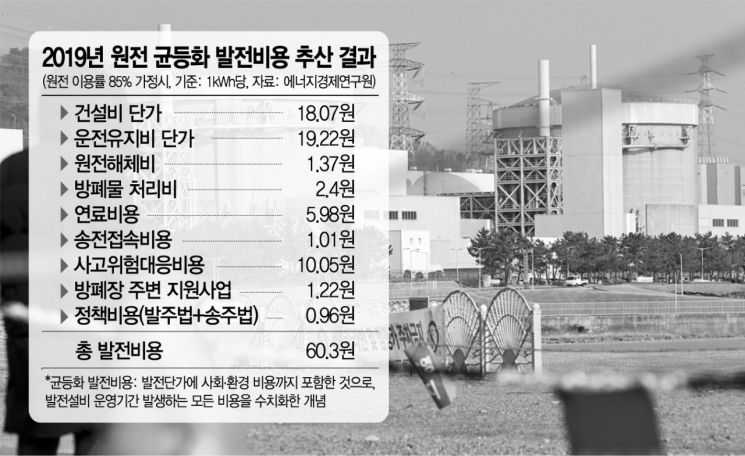
The problem lies in the institute applying arbitrary standards when calculating nuclear power costs. The institute estimated nuclear power costs at 60.3 KRW (assuming an 85% utilization rate), of which 10.05 KRW was allocated to unrealized accident risk response costs. This accounts for 16.7% of the total generation cost, ranking third after construction costs (18.07 KRW) and operation and maintenance costs (19.22 KRW). Fuel costs (5.98 KRW), high- and intermediate-level radioactive waste disposal costs (2.4 KRW), nuclear power plant decommissioning costs (1.37 KRW), support projects around waste disposal sites (1.22 KRW), transmission connection costs (1.01 KRW), and policy costs (0.96 KRW) were all estimated lower than accident costs.
The focus on accident costs stems from the institute applying an accident probability several dozen times higher than expert analyses. The institute assumed a nuclear accident probability of 0.00035% and calculated accident risk costs based on the decommissioning and compensation costs (2.15 trillion yen) related to the Fukushima nuclear accident.
However, experts commonly agree that the accident probability for domestic nuclear power plants is lower than this. Based on reactor damage frequency, the accident probability for Shin-Kori Units 3 and 4 is 0.00000754%, which is lower than the licensing standard of 0.00001%. The institute thus overestimated the risk level when applying accident costs to domestic nuclear power generation costs.
Professor Sung Poonghyun, Emeritus Professor of Nuclear and Quantum Engineering at KAIST, pointed out, "To obtain a nuclear power plant license, it must be proven that the probability of internal damage is less than once in 100,000 years and the probability of radioactive material leakage outside is less than once in 1,000,000 years." He added, "Based on this, the nuclear accident probability is 0.00001%, but it seems the institute viewed this probability excessively high."
Experts also emphasize that except for Japan, which experienced the Fukushima nuclear accident, no country worldwide includes unrealized accident costs in the levelized cost of electricity. Even the Korea Energy Economics Institute explicitly stated this in a report released three years ago.
A representative from the Korea Energy Economics Institute explained, "In the U.S., safety factors are sufficiently reflected in the initial construction costs of nuclear power plants, resulting in very high capital costs." He added, "The reason accident costs are not included in the LCOE overseas is because nuclear power plants are constructed safely." He further explained, "The social costs incurred in the event of a nuclear accident are very large. Although most countries currently do not include accident costs in power generation costs, discussions on the social costs of nuclear power should be considered in the future."
Unlike nuclear power, the report did not reflect social costs in the generation costs of solar power, which the current government is actively promoting. The 2019 LCOE for solar power (121.9 KRW) included construction costs (73%), operation and maintenance costs (14%), post-processing costs (2%), waste module disposal costs (2%), land costs (11%), and policy costs (less than 1%). However, social conflicts and environmental destruction costs such as noise, forest damage, and soil erosion, which have recently become issues, were not included.
An energy expert criticized, "If accident risk costs for nuclear power are exaggerated while social costs from renewable energy like solar power are not reflected at all, isn't there an intention behind this?" He called it an "original equipment manufacturer (OEM) report supporting the government's nuclear phase-out policy."
© The Asia Business Daily(www.asiae.co.kr). All rights reserved.

















