Professor Oh Byungha of KAIST, jointly developed with a US research team... "Rapid testing of various target proteins possible"
[Asia Economy Reporter Kim Bong-su] An artificial protein sensor capable of detecting the presence of various pathogens invading the human body, including the coronavirus, has been jointly developed by researchers from Korea and the United States.
According to the Korea Advanced Institute of Science and Technology (KAIST) on the 5th, Professor Oh Byung-ha of the Department of Biological Sciences at KAIST, through an international joint research with a research team from the University of Washington, developed a highly sensitive artificial protein sensor platform, which was published in the international journal Nature on the 27th of last month.
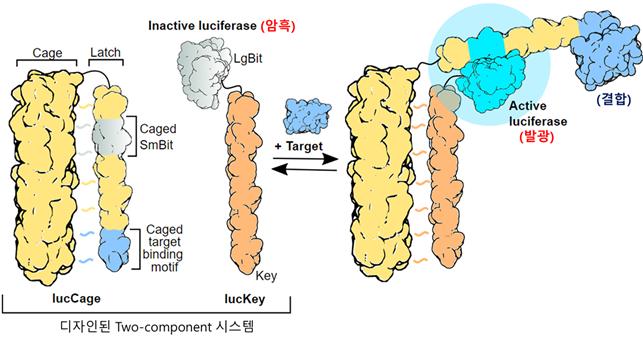
This protein sensor platform itself does not emit light, but when the target protein to be detected is present, it binds to it and emits light. Although naturally occurring proteins, either in their original or slightly modified forms, have been widely used for disease diagnosis, monitoring treatment progress, and detecting pathogenic microorganisms, the joint research team created an entirely new artificial scaffold protein using computational protein design methods. In particular, they recombined it with a bioluminescent protein produced by deep-sea shrimp to confer the function of detecting proteins.
Since the intensity of the emitted light varies proportionally with the concentration of the target protein, measuring the luminescence intensity allows detection not only of the presence but also the concentration of the target protein. The emitted light can be detected without any sample pretreatment, and the luminescent reaction is immediate. This means that the test results can be obtained quickly without additional reagents.
The platform can also be applied to detect various target proteins. The protein system created by the researchers can be used like Lego blocks to easily produce a variety of protein sensors. In fact, the research team included eight highly sensitive protein sensors in their paper, such as sensors for hepatitis B virus proteins and coronavirus proteins.
A KAIST official stated, "The operating mechanism of the protein sensor cannot be found in nature, demonstrating that it is possible to create proteins and functions that do not exist in nature, going beyond mere imitation of nature."
This research was conducted as a joint project during Professor Oh’s one-year visit to the United States, supported by the LG Yonam Cultural Foundation, working with Professor David Baker’s team at the University of Washington. Professors Lee Han-sol of KAIST’s Department of Biological Sciences and Hong Hyo-jung of Kangwon National University also participated.
© The Asia Business Daily(www.asiae.co.kr). All rights reserved.
![Clutching a Stolen Dior Bag, Saying "I Hate Being Poor but Real"... The Grotesque Con of a "Human Knockoff" [Slate]](https://cwcontent.asiae.co.kr/asiaresize/183/2026021902243444107_1771435474.jpg)
















